Introduction
In high precision spring steel flat wire manufacturing, achieving stable dimensions and reliable mechanical performance requires much more than selecting a powerful rolling mill. The design of the reduction ratio and rolling pass schedule plays a critical role in controlling material deformation, work hardening behavior, residual stress distribution and final fatigue performance.
For high carbon spring steels and alloy spring steels, excessive reduction in a single pass may create edge cracking, uneven deformation and excessive hardening, while insufficient reduction may reduce production efficiency and increase the number of rolling stages.
A well-designed pass schedule allows manufacturers to achieve the ideal balance between productivity, dimensional accuracy and spring performance.
Sky Bluer Environmental Technology Co., Ltd. (CRM) develops precision rolling solutions based on advanced deformation control technology, helping spring manufacturers produce high-quality flat wire and profile wire with stable tolerances.
Why Reduction Ratio Design Is Critical in Spring Steel Rolling
Reduction ratio refers to the percentage reduction of cross-sectional area during each rolling pass.
The basic calculation is:
| Parameter | Formula |
| Reduction Ratio | (A₀ – A₁) / A₀ × 100% |
| A₀ | Initial cross-sectional area |
| A₁ | Final cross-sectional area |
During cold rolling, the steel undergoes plastic deformation. Unlike low carbon materials, high carbon spring steel has higher strength and lower ductility, making deformation control more challenging.
Typical spring steel materials include:
| Material Grade | Carbon Content | Typical Application |
| SAE1070 | ~0.70% C | Flat springs, clips |
| SAE1075 | ~0.75% C | High strength springs |
| SAE1095 | ~0.95% C | Precision spring components |
| 60Si2Mn | Silicon manganese spring steel | Automotive springs |
| SUP10 | Chromium silicon spring steel | Valve springs |
These materials require carefully controlled reduction per pass to avoid excessive cold work accumulation.
Relationship Between Reduction Ratio and Cold Work Hardening
Cold rolling increases material strength through work hardening.
The higher the deformation amount, the higher the dislocation density inside the steel structure.
The relationship between reduction ratio and mechanical properties can be summarized:
| Reduction Condition | Material Behavior | Production Risk |
| Low reduction per pass | Stable deformation | More passes required |
| Medium reduction | Balanced efficiency and quality | Preferred condition |
| Excessive reduction | Rapid hardening | Crack risk and dimensional instability |
For spring steel production, the objective is not maximum reduction.
The objective is controlled deformation.
A suitable pass schedule maintains enough ductility for subsequent passes while gradually achieving the required final dimensions.
Typical Pass Schedule Design for Spring Steel Flat Wire
A professional rolling process usually applies multi-pass deformation.
Input material: Round wire diameter: 8 mm
Final flat wire: 4 mm × 1.5 mm
Approximate rolling strategy:
| Pass | Thickness / Width Change | Reduction Purpose |
| Initial pass | Round → oval profile | Establish stable deformation |
| Intermediate pass | Increase width, reduce thickness | Control material flow |
| Finishing pass | Achieve final dimension | Improve tolerance and surface quality |
A typical reduction distribution:
| Rolling Stage | Recommended Reduction |
| Breakdown pass | 15–25% |
| Intermediate passes | 10–20% |
| Finishing passes | 5–10% |
The final passes usually require smaller reductions because dimensional accuracy and surface finish become the priority.
Effect of Pass Schedule on Edge Quality
Edge quality is one of the most important indicators for precision spring steel flat wire.
Poor reduction design can cause:
- Edge cracking
- Uneven edge radius
- Material folding
- Surface defects
During flat wire rolling, metal flow is not uniform.
The center section and edge section experience different deformation resistance.
Therefore, advanced rolling systems use:
- optimized roll groove design
- controlled reduction distribution
- precision roll gap adjustment
- online dimensional monitoring
CRM precision rolling mills are designed to maintain stable deformation conditions throughout the complete rolling process.
Reduction Ratio Optimization for Different Spring Steel Applications
Different applications require different deformation strategies.
Automotive Valve Springs
Valve spring materials require:
- high tensile strength
- excellent fatigue resistance
- stable dimensional accuracy
Typical requirements:
| Parameter | Requirement |
| Material | Chrome silicon spring steel |
| Rolling Type | Multi-pass cold rolling |
| Dimension Accuracy | ±0.01 mm or better |
| Surface Quality | Ra ≤0.8 μm |
A controlled pass schedule helps minimize residual stress and improve fatigue life.
.webp)
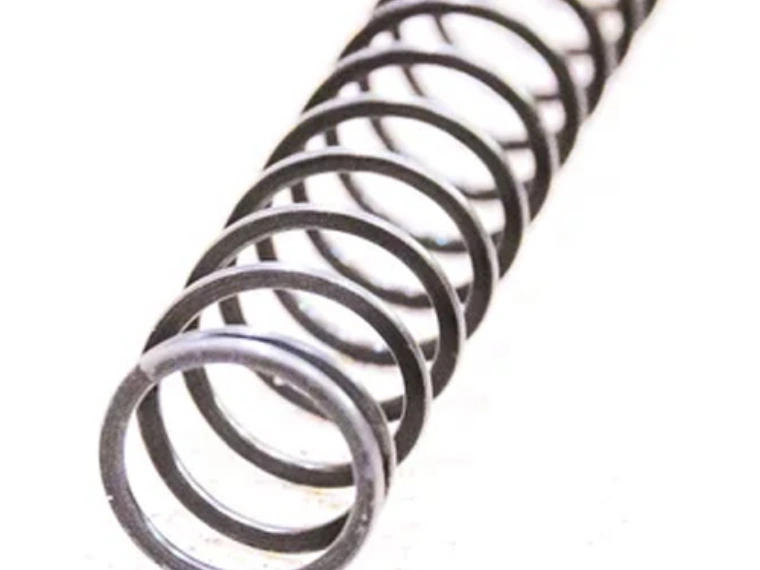
Precision Industrial Springs
For industrial springs and mechanical components:
Important factors include:
- consistent thickness
- controlled hardness
- stable elasticity
The rolling process must balance:
- productivity
- dimensional tolerance
- mechanical properties
How Excessive Reduction Affects Spring Performance
Incorrect reduction ratio design can negatively influence spring performance.
Main problems include:
Increased Residual Stress
Large deformation in one pass creates uneven stress distribution.
This may lead to:
- dimensional change after cutting
- instability during heat treatment
- reduced fatigue performance
Excessive Hardening
High cold work increases hardness but reduces ductility.
The material may become:
- difficult to form
- sensitive to cracks
- unstable during later processing
Poor Surface Integrity
High reduction can damage surface quality, especially for high carbon steels.
Surface defects can become fatigue crack initiation points.
Pass Schedule Optimization in Modern Precision Rolling Mills
Modern spring steel rolling production relies on precise process control.
A complete precision rolling system normally includes:
| System Component | Function |
| Precision rolling mill | Controlled deformation |
| Rolling cassette | Accurate roll positioning |
| Servo roll adjustment | Automatic gap control |
| Laser measuring system | Online dimension inspection |
| PLC control system | Process optimization |
| Automatic tension control | Stable material feeding |
Through closed-loop control, manufacturers can maintain consistent reduction conditions during continuous production.
Connection Between Reduction Ratio and Rolling Mill Selection
The required pass schedule directly influences equipment configuration.
For high strength spring steel, manufacturers must consider:
- number of rolling stands
- roll diameter
- rolling force
- material hardness
- final tolerance requirement
Different applications may require:
- 2-high rolling mills
- 4-roll Turks Head rolling systems
- multi-stand precision rolling lines
For oil tempered spring steel and other high strength materials, reduction per pass must be carefully controlled to avoid excessive work hardening and cracking risks. Therefore, selecting the correct precision rolling mill configuration is essential for stable production.
Reduction Ratio Optimization and Complete Spring Steel Flat Wire Manufacturing
Reduction ratio design is only one part of the complete spring steel flat wire production process.
Material selection, rolling equipment, surface control and final inspection must work together.
The manufacturing of high carbon spring steel flat wire requires not only suitable rolling equipment but also an optimized pass schedule. Different reduction ratios in each rolling pass directly influence material deformation behavior, edge quality and final dimensional accuracy.
FAQ
1. What is the recommended reduction ratio for spring steel flat wire rolling?
The reduction ratio depends on material grade, incoming size and final dimensions. In general, high carbon spring steels require controlled multi-pass deformation, with approximately 10–25% reduction per pass depending on rolling conditions.
2. Why cannot spring steel be rolled with a large reduction in one pass?
High carbon spring steel has limited ductility during cold deformation. Excessive reduction increases work hardening, residual stress and cracking risk, which can reduce final fatigue performance.
3. How does pass schedule affect spring fatigue life?
A properly designed pass schedule controls deformation uniformity and residual stress. Stable deformation improves surface quality and reduces potential fatigue crack initiation points.
4. How many rolling passes are required for spring steel flat wire production?
The number of passes depends on input diameter, final size and tolerance requirements. Precision spring wire production commonly uses multiple controlled passes instead of a single heavy reduction.
5. Can the same rolling schedule be used for different spring steel grades?
No. SAE1095, 60Si2Mn, SUP10 and other spring steels have different deformation characteristics. Each grade requires optimized rolling parameters.
6. What equipment is suitable for precision spring steel flat wire rolling?
Precision rolling mills equipped with accurate roll adjustment, online measurement systems and stable tension control are commonly used. CRM provides customized precision rolling solutions according to material and product requirements.
Conclusion
Reduction ratio design and pass schedule optimization are fundamental technologies in precision spring steel flat wire production.
A successful rolling process must control:
- deformation amount per pass
- work hardening accumulation
- edge quality
- dimensional accuracy
- residual stress distribution
For high carbon and alloy spring steels, the goal is not simply reducing material thickness. The goal is achieving controlled deformation that delivers reliable spring performance.
With advanced precision rolling technology, Sky Bluer Environmental Technology Co., Ltd. (CRM) provides customized rolling solutions for global spring manufacturers, supporting the production of high accuracy flat wire and profile wire products.