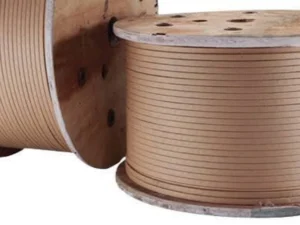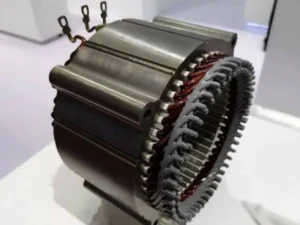
Introduction: The Growing Demand for Precision Spring Steel Flat Wire
High carbon spring steel flat wire is a critical material used in applications where high strength, fatigue resistance, dimensional stability, and long service life are required. Unlike conventional round spring wire, flat wire provides greater design flexibility because engineers can precisely control the width, thickness, edge condition, and stress distribution of the final spring component.
From automotive suspension systems and valve springs to constant force springs, electrical contacts, and industrial mechanical components, manufacturers increasingly require spring steel flat wire with extremely tight dimensional tolerances and consistent mechanical properties.
In modern production environments, producing high-quality spring steel flat wire is not simply a matter of reducing round wire into a rectangular shape. It requires a carefully controlled cold forming process involving material selection, rolling technology, tension control, surface management, and online measurement.
Based on more than 25 years of experience in precision metal forming, engineers understand that the final performance of a spring component depends heavily on the stability of the flat wire manufacturing process.
For this reason, advanced manufacturers are adopting precision rolling mills and complete flat wire production lines to achieve repeatable quality and higher production efficiency.
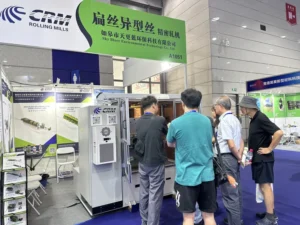
Sky Bluer Environmental Technology Co., Ltd. (CRM) provides customized precision rolling solutions for high carbon spring steel flat wire production, supporting manufacturers with reliable equipment technology and optimized forming processes.
What Is High Carbon Spring Steel Flat Wire?
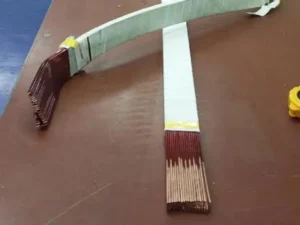
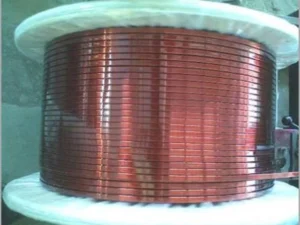
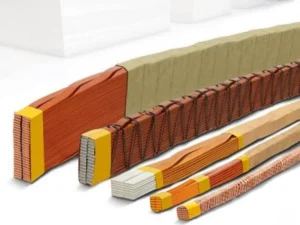
High carbon spring steel flat wire is produced by transforming round steel wire or wire rod into a flat rectangular cross-section through precision forming processes.
Typical spring steel materials include high carbon steels and alloy spring steels that provide excellent elastic performance after heat treatment.
Common materials include:
| Material Grade | Standard | Characteristics | Typical Application |
| SAE 1070 | ASTM | High carbon content, good strength | Industrial springs |
| SAE 1075 | ASTM | High fatigue resistance | Precision springs |
| SAE 1095 | ASTM | High hardness capability | High load springs |
| 60Si2Mn | GB/DIN equivalent | Silicon alloy spring steel | Automotive springs |
| SUP10 | JIS | High performance spring steel | Vehicle components |
| EN10270-2 | EN | Oil hardened spring wire | European spring industry |
The chemical composition directly affects rolling behavior, deformation resistance, and final mechanical properties.
High carbon spring steel generally has:
| Property | Typical Requirement |
| High tensile strength | 1200–2200 MPa after treatment |
| Good fatigue resistance | Suitable for cyclic loading |
| High elastic limit | Maintains spring force |
| Controlled surface quality | Prevents fatigue cracks |
Manufacturing Process of High Carbon Spring Steel Flat Wire
The production of precision spring steel flat wire normally includes several controlled stages.
Step 1: Raw Material Preparation
The process begins with high-quality spring steel wire.
Before rolling, manufacturers must control:
- Chemical composition
- Surface defects
- Wire diameter tolerance
- Initial straightness
- Material hardness condition
Poor raw material quality can create problems during rolling, including:
- Edge cracking
- Uneven deformation
- Surface defects
- Dimensional instability
Step 2: Precision Rolling Process
Precision rolling is the core forming process for spring steel flat wire.
Compared with traditional drawing methods, rolling provides several advantages:
- Higher production efficiency
- Better material utilization
- Improved surface finish
- Lower internal stress concentration
A typical precision rolling system includes:
| Equipment Module | Function |
| Pay-off system | Stable wire feeding |
| Straightening unit | Removes initial deformation |
| Precision rolling mill | Controls width and thickness |
| Online measuring system | Real-time dimensional inspection |
| Cooling and lubrication system | Maintains stable rolling conditions |
| Take-up system | Stable finished wire collection |
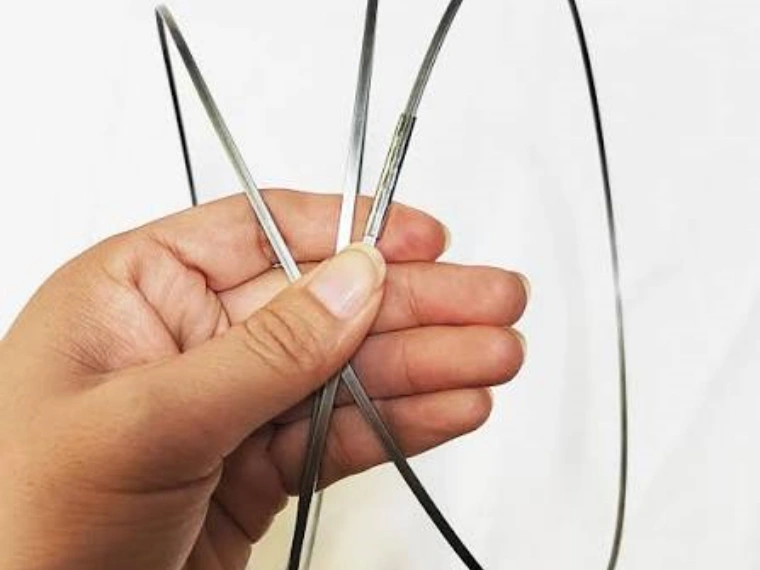
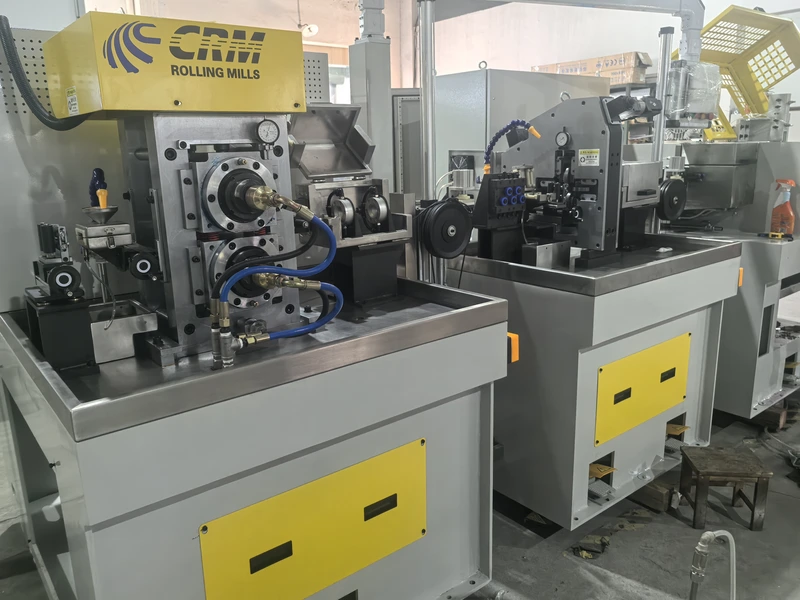
Technical Requirements for Precision Spring Steel Flat Wire
Spring manufacturers usually require strict control of dimensional accuracy.
Typical production requirements:
| Parameter | Typical Range |
| Material | SAE1070, SAE1075, SAE1095, 60Si2Mn |
| Input diameter | 1.0–10 mm |
| Finished thickness | 0.3–6 mm |
| Finished width | 1–20 mm |
| Thickness tolerance | ±0.005–0.02 mm |
| Width tolerance | ±0.01–0.05 mm |
| Surface roughness | Ra 0.4–0.8 μm |
| Straightness | ≤3/1000 mm |
For high-performance automotive applications, even small dimensional variations can influence:
- Spring force
- Fatigue life
- Assembly accuracy
- Product reliability
Therefore, modern production lines increasingly use laser measuring systems and closed-loop control technology.
Precision Rolling Mill Technology for Spring Steel Flat Wire
A precision rolling mill is the key equipment for producing high-quality spring steel flat wire.
Unlike conventional rolling equipment, modern precision rolling mills use advanced control systems to maintain stable deformation.
Important technologies include:
Multi-pass Rolling
High carbon spring steel usually requires controlled deformation.
Instead of reducing the wire size aggressively in one pass, multi-pass rolling gradually achieves the required dimensions.
Advantages:
- Reduced cracking risk
- Improved dimensional stability
- Lower residual stress
Closed-loop Thickness Control
Online measurement systems continuously monitor:
- Thickness
- Width
- Profile accuracy
The system automatically adjusts roll gap conditions to maintain stable output.
Precision Roll Design
The rolling cassette and rolls directly influence:
- Surface quality
- Edge shape
- Dimensional accuracy
High-quality rolls require:
- High hardness
- Excellent wear resistance
- Precise machining accuracy
CRM precision rolling systems are designed according to customer requirements, including different spring steel grades, production speeds, and final wire specifications.
Equipment Selection for Spring Steel Flat Wire Production
Different production requirements require different equipment configurations.
| Production Requirement | Recommended Solution |
| Standard flat spring wire | Two-roll precision rolling mill |
| High accuracy rectangular wire | Four-roll Turks Head rolling system |
| Multiple profile shapes | Universal rolling system |
| Large production capacity | Complete flat wire production line |
| Automotive spring applications | Rolling + online inspection system |
When selecting equipment, manufacturers should consider:
Material Characteristics
High carbon spring steel has higher deformation resistance than copper or aluminum.
Therefore, equipment requires:
- High rigidity structure
- Accurate roll adjustment
- Stable drive system
Product Accuracy
Different applications require different tolerances.
For precision springs, dimensional consistency is more important than simply achieving high production speed.
Production Volume
High-volume manufacturers benefit from:
- Automatic feeding
- Continuous rolling
- Online inspection
- Automated winding systems
Applications of High Carbon Spring Steel Flat Wire
Precision spring steel flat wire is widely used in industries requiring reliable elastic performance.
| Industry | Application |
| Automotive | Valve springs, seat springs, transmission springs |
| Electronics | Contact springs, conductive components |
| Industrial Equipment | Mechanical springs |
| Aerospace | Lightweight precision springs |
| Consumer Products | Constant force springs |
Automotive manufacturers especially require stable flat wire production because spring failure can directly affect safety and reliability.
Why Precision Rolling Is Becoming the Preferred Manufacturing Method
Traditional wire drawing can produce rectangular wire, but precision rolling provides unique advantages for many spring steel applications.
Main advantages include:
Better Material Flow
Rolling creates controlled plastic deformation, reducing unnecessary material loss.
Improved Surface Quality
The contact between precision rolls and material produces a smooth surface suitable for fatigue applications.
Flexible Production
Modern rolling systems can produce different widths and thicknesses by adjusting tooling and process parameters.
Higher Automation Level
Integrated systems can combine:
- Rolling
- Measurement
- Control
- Winding
This helps manufacturers achieve stable long-term production.
CRM Precision Rolling Solutions for Spring Steel Flat Wire Manufacturing
Sky Bluer Environmental Technology Co., Ltd. (CRM) focuses on precision wire forming technology, providing customized solutions for spring steel flat wire manufacturers worldwide.
CRM systems are developed for applications requiring:
- High dimensional accuracy
- Stable continuous production
- Flexible product specifications
- Reliable industrial performance
Through advanced precision rolling technology, CRM helps customers improve production efficiency while maintaining consistent flat wire quality.
Frequently Asked Questions (FAQ)
1. What materials are commonly used for high carbon spring steel flat wire production?
High carbon spring steel flat wire is commonly manufactured from SAE1070, SAE1075, SAE1095, 60Si2Mn, SUP10, and EN10270 series materials.
The material selection depends on the final application requirements, including tensile strength, fatigue resistance, hardness after heat treatment, and operating environment.
For automotive springs and high-cycle applications, alloy spring steels such as 60Si2Mn and SUP10 are often selected because silicon and alloying elements improve elastic performance and fatigue resistance.
2. What is the difference between rolling and drawing for spring steel flat wire manufacturing?
Both rolling and drawing can produce rectangular wire, but the deformation mechanisms are different.
Precision rolling uses compressive deformation between rolls, which provides:
- Higher production efficiency
- Better material utilization
- Improved surface finish
- Flexible width and thickness control
Wire drawing mainly reduces cross-sectional area through a die and is often suitable for applications requiring specific profiles or smaller dimensions.
For high carbon spring steel flat wire, precision rolling is frequently preferred when manufacturers require stable dimensions, high productivity, and excellent surface quality.
3. What tolerance can a precision rolling mill achieve for spring steel flat wire?
The achievable tolerance depends on material condition, product dimensions, equipment configuration, and process control.
Typical precision spring steel flat wire production can achieve:
| Parameter | Typical Accuracy |
| Thickness tolerance | ±0.005–0.02 mm |
| Width tolerance | ±0.01–0.05 mm |
| Straightness | ≤3/1000 mm |
| Surface roughness | Ra 0.4–0.8 μm |
For demanding applications such as automotive springs and precision mechanical components, online measurement systems are recommended to maintain continuous quality control.
4. Does high carbon spring steel flat wire require annealing before rolling?
The need for annealing depends on the initial material condition and the required deformation amount.
Some high carbon spring steels require intermediate annealing during large deformation processes to reduce work hardening and prevent cracking.
However, optimized rolling schedules can reduce unnecessary heat treatment steps by controlling:
- Reduction rate per pass
- Rolling speed
- Lubrication condition
- Material hardness
A process evaluation is required before selecting the final production route.
5. What equipment is required for a complete spring steel flat wire production line?
A complete production line normally includes:
| Equipment | Function |
| Pay-off system | Stable material feeding |
| Straightening unit | Removes initial bending |
| Precision rolling mill | Controls wire dimensions |
| Online laser measuring system | Real-time inspection |
| Cooling system | Controls rolling temperature |
| Take-up system | Stable finished coil collection |
For high-volume production, automatic control systems can integrate the entire process to improve efficiency and consistency.
6. How does CRM ensure quality in spring steel flat wire production?
CRM precision rolling solutions focus on process stability through:
- High-precision rolling cassettes
- Rigid machine structures
- Servo-controlled roll adjustment
- Online dimensional monitoring
- Customized tooling design
Each production system is designed according to the customer’s material grade, wire dimensions, tolerance requirements, and production capacity.
This approach helps manufacturers achieve reliable long-term production for demanding spring steel applications.
Conclusion: Building Reliable Spring Steel Flat Wire Production with Precision Rolling Technology
High carbon spring steel flat wire manufacturing requires much more than simple wire reduction. The process involves careful material selection, controlled deformation, precision tooling, and continuous quality monitoring.
For spring manufacturers producing automotive, industrial, and high-performance components, dimensional accuracy and surface consistency directly determine the final product performance.
A modern spring steel flat wire production system should combine:
- High rigidity precision rolling equipment
- Accurate roll gap adjustment
- Stable tension control
- Online dimensional measurement
- Reliable winding technology
With increasing requirements for lightweight design, higher fatigue resistance, and longer service life, precision rolling technology has become an essential solution for advanced spring steel wire manufacturing.
Sky Bluer Environmental Technology Co., Ltd. (CRM) provides customized Precision Rolling Mill and Flat Wire Production Line solutions for manufacturers requiring stable and high-accuracy spring steel flat wire production.
Through advanced rolling technology and engineering experience, CRM supports customers worldwide in achieving consistent quality and efficient production for demanding spring applications.