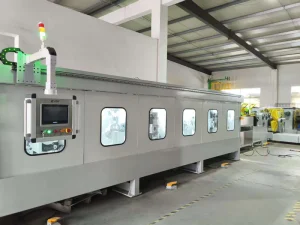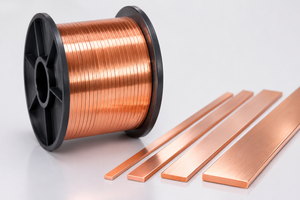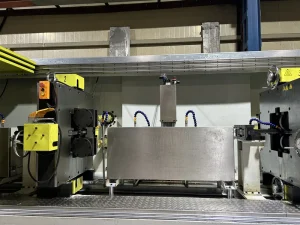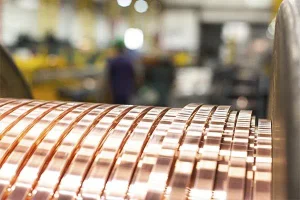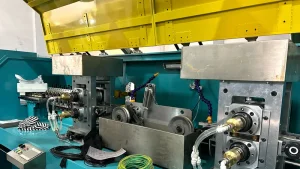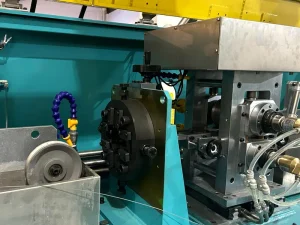
Single-pass vs multi-pass rolling is an important consideration in rectangular copper wire manufacturing. The choice affects how deformation is distributed, how the rolling process is controlled, and which equipment configuration may be suitable.
Single-pass rolling completes the required forming operation in one pass, while multi-pass rolling distributes deformation across several passes. Neither approach automatically guarantees better dimensional accuracy, higher productivity, or improved surface quality.
This guide explains the main differences, rolling reduction calculations, and practical factors to consider when selecting a process for rectangular copper conductors.
1. Single-Pass vs Multi-Pass Rolling: Key Differences
Single-Pass Rolling
Single-pass rolling forms or reduces copper wire through one rolling pass. The resulting dimensions depend on the incoming material, roll geometry, roll-gap setting, and operating conditions.
It may be suitable when the input wire is already close to the target dimensions and the required deformation can be achieved within the equipment’s capabilities.
Multi-Pass Rolling
Multi-pass rolling distributes the required deformation across two or more passes, using multiple rolling stands or repeated processing where appropriate.
This approach allows the reduction schedule to be divided into stages. However, it also requires consideration of alignment, speed coordination, tension, and accumulated material deformation.
Key Differences
| Factor | Single-Pass Rolling | Multi-Pass Rolling |
|---|---|---|
| Rolling passes | One | Two or more |
| Deformation | Applied in one stage | Distributed across stages |
| Equipment | May require fewer rolling stages | May require additional stands or repeated passes |
| Process adjustment | Fewer pass-related settings | More variables to coordinate |
| Dimensional accuracy | Depends on tooling and operating conditions | Depends on individual passes and process coordination |
| Main consideration | Feasibility of one-pass forming | Stability of the complete pass schedule |
These are general process differences, not guaranteed performance advantages.
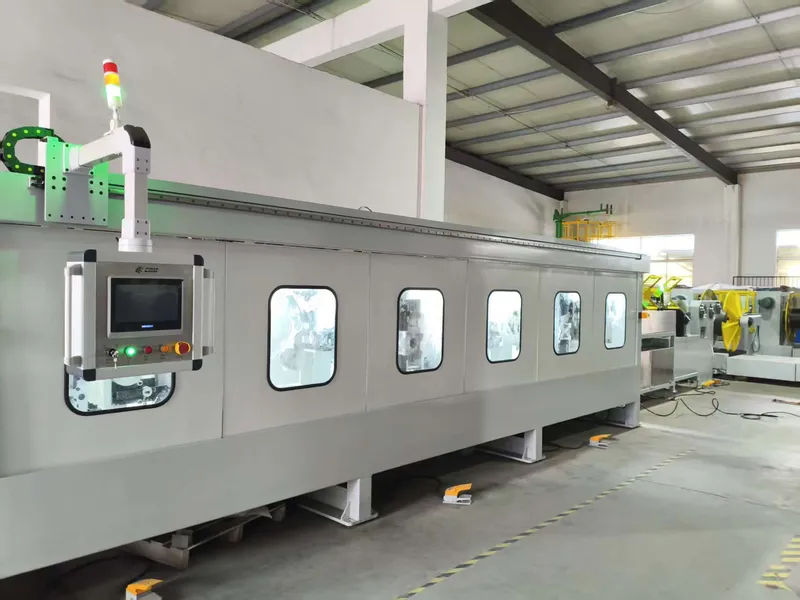
2. How to Calculate Rolling Reduction
Rolling reduction helps manufacturers evaluate the dimensional change required during processing.
For thickness reduction:
Thickness Reduction (%) = [(Input Thickness − Output Thickness) ÷ Input Thickness] × 100
Example: Reducing Copper Wire from 2.00 mm to 1.50 mm
Consider a rectangular copper conductor with an initial thickness of 2.00 mm and a target thickness of 1.50 mm.
For single-pass rolling:
Reduction = [(2.00 − 1.50) ÷ 2.00] × 100 = 25%
An illustrative two-pass arrangement could distribute the reduction as follows:
| Rolling stage | Input thickness | Output thickness | Reduction |
|---|---|---|---|
| Single pass | 2.00 mm | 1.50 mm | 25.0% |
| Multi-pass: Pass 1 | 2.00 mm | 1.75 mm | 12.5% |
| Multi-pass: Pass 2 | 1.75 mm | 1.50 mm | 14.3% |
Both approaches produce the same overall thickness reduction of 25%.
These figures are mathematical examples, not recommended rolling schedules or guaranteed CRM equipment capabilities.
Thickness Reduction vs Area Reduction
Thickness reduction is not necessarily equal to cross-sectional area reduction because copper may spread laterally during rolling.
For a rectangular conductor with sharp corners:
Area (mm²) = Width (mm) × Thickness (mm)
Area Reduction (%) = [(Input Area − Output Area) ÷ Input Area] × 100
For rounded corners or special profiles, use the actual cross-sectional geometry.
Both thickness and area reduction should be considered when evaluating a rolling process.
3. How Rolling Passes Affect Wire Quality
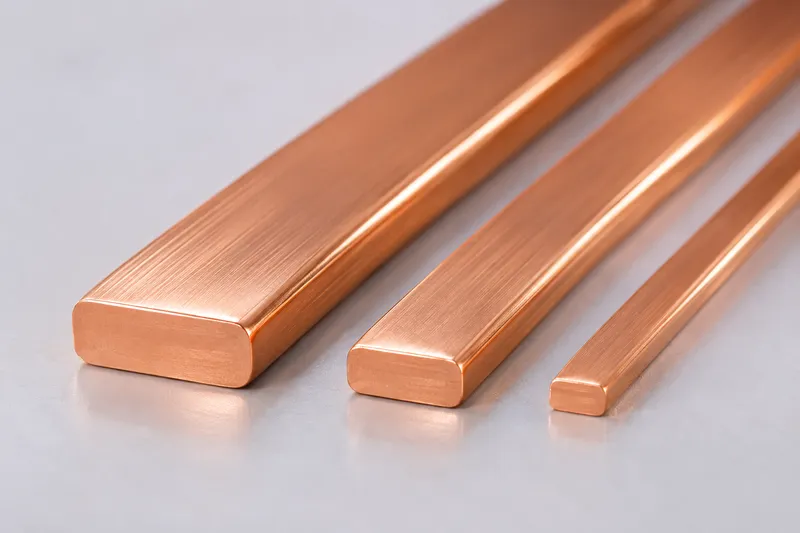
Rectangular copper wire is commonly specified by width, thickness, corner radius, surface condition, and mechanical properties.
Dimensional Accuracy
In single-pass rolling, the required dimensional change occurs in one stage. In multi-pass rolling, deformation is distributed across successive stages.
Both methods depend on roll-gap control, tooling geometry, incoming material consistency, and stable operating conditions.
More rolling passes do not automatically result in tighter tolerances.
Corner Radius and Surface Quality
The final corner radius depends on tooling design, material flow, and forming conditions. Additional edge-forming operations may be necessary for certain conductor specifications.
Surface quality is influenced by incoming material condition, roll wear, alignment, lubrication, and process stability.
Neither rolling method inherently guarantees better surface quality.
For additional background, see our Copper Rolling Process Guide.
4. Material Properties and Production Capacity
Copper Grade and Work Hardening
Common copper grades used in electrical conductors include C11000 (Cu-ETP), C10200 (Cu-OF), and C10100 (Cu-OFE).
The appropriate rolling process depends not only on the copper grade but also on its initial temper, previous deformation, and required finished properties.
Cold rolling can cause work hardening, affecting strength and ductility. Multi-pass rolling distributes deformation but does not eliminate accumulated work hardening.
Annealing may be required depending on the material condition and finished conductor specifications. Its necessity and position in the process should be evaluated separately.
Does Multi-Pass Rolling Increase Output?
Not necessarily.
For a single bare copper conductor, theoretical production can be calculated as:
Theoretical Output (kg/h) = Area (mm²) × Speed (m/min) × Copper Density (g/cm³) × 0.06
Copper density is approximately 8.96 g/cm³ at room temperature.
Actual production also depends on downtime, operating efficiency, and acceptable product yield.
In multi-pass rolling, connected stages must operate at compatible speeds while maintaining stable tension and product quality.
Adding rolling stands does not automatically increase production capacity. Likewise, fewer passes do not necessarily mean faster production.
The capacity of the complete line should be evaluated rather than relying on the maximum speed of an individual rolling stand.
5. How to Choose the Right Rolling Process
The selection between single-pass and multi-pass rolling should begin with the finished conductor requirements.
| Required information | Purpose |
|---|---|
| Copper grade and temper | Evaluate material deformation behavior |
| Input dimensions and shape | Establish the starting geometry |
| Finished width and thickness | Determine the required dimensional change |
| Dimensional tolerances | Define precision requirements |
| Corner radius and surface requirements | Evaluate tooling and forming needs |
| Target production capacity | Assess line configuration |
| Annealing and take-up requirements | Evaluate complete process integration |
Single-pass rolling may be considered when the required deformation is achievable in one stage under verified operating conditions.
Multi-pass rolling may be considered when deformation needs to be distributed across several stages or additional forming adjustments are required.
The appropriate number of passes must be determined through engineering evaluation and, where necessary, process trials.
For related guidance, see Flat Wire Rolling Mill vs Drawing Machine for Rectangular Copper Conductors and How to Specify a Flat Magnet Wire Production Line for Custom Dimensions.
Verify Equipment Performance Before Purchasing
Ask suppliers to explain the proposed pass schedule, tooling configuration, operating conditions, and expected output for representative conductor sizes.
During agreed factory acceptance testing (FAT), evaluate stable operating speed, finished dimensions, corner radius, surface quality, accepted output, and relevant mechanical properties.
Guaranteed values should be documented in the agreed technical specifications.
The CRM Precision Flat Wire Rolling Mill provides a reference for discussing application-specific equipment configurations.
Frequently Asked Questions
Is multi-pass rolling more accurate than single-pass rolling?
Not necessarily. Accuracy depends on tooling, roll-gap control, material consistency, alignment, and operating conditions rather than pass count alone.
Can rectangular copper wire be produced in a single pass?
Some dimensional changes may be achievable in one pass. Feasibility depends on the input material, required dimensions, tolerances, and equipment capabilities.
Does multi-pass rolling require intermediate annealing?
Not always. Annealing requirements depend on the starting material condition, accumulated deformation, and required finished properties.
How many rolling passes are needed for rectangular copper wire?
There is no universal number. The pass count depends on the material, starting dimensions, target profile, allowable deformation, and equipment configuration.
Conclusion
Single-pass and multi-pass rolling offer different approaches to rectangular copper wire manufacturing.
Single-pass rolling applies deformation in one stage, while multi-pass rolling distributes it across multiple stages. The appropriate choice depends on conductor dimensions, material properties, quality requirements, and production conditions.
Neither method inherently guarantees superior accuracy or productivity. Equipment selection should be supported by engineering calculations and appropriate process verification.
Sky Bluer Environmental Technology Co., Ltd. (CRM) manufactures precision rolling mills and customized wire-processing equipment.
Share your conductor drawing, material specifications, and target output with our engineering team to evaluate a suitable rolling configuration.