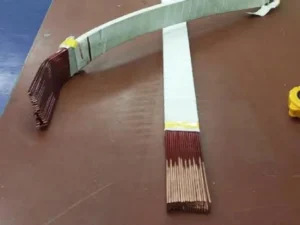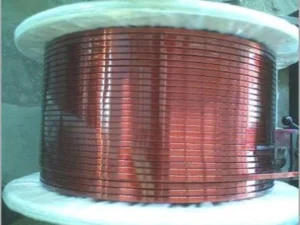
A flat magnet wire production line must be specified around the finished conductor—not simply the maximum speed of a rolling mill. Copper grade, bare dimensions, corner radius, insulation build, mechanical properties, and take-up requirements all affect equipment selection.
Rectangular enameled copper wire is used in motors, transformers, and other electrical equipment. Its compact geometry supports space-efficient windings, but inconsistent corners, surface damage, or uneven enamel can compromise downstream processing.
For custom conductor dimensions, manufacturers must coordinate rolling, annealing, insulation, and inspection requirements. This guide helps engineers and buyers define equipment specifications and measurable acceptance criteria.
1. Start With a Complete Wire Drawing
A nominal size such as 5.00 × 2.00 mm does not establish whether the dimensions refer to bare copper or insulated wire. Specify both, along with the applicable product standard.
| Specification | Information to Provide |
|---|---|
| Copper | Grade, incoming temper, and input diameter or profile |
| Bare conductor | Width, thickness, and separate tolerances |
| Corners | Required radius and allowable variation |
| Insulation | Enamel type, grade, thermal requirements, and finished dimensions |
| Mechanical properties | Hardness or elongation requirements |
| Production | Target output, spool dimensions, and winding pattern |
Insulation build is not necessarily uniform around the rectangular profile. Do not assume identical coating thickness on broad faces and corners. Agree on measurement locations and acceptance methods before equipment design.
2. Choose the Forming Route
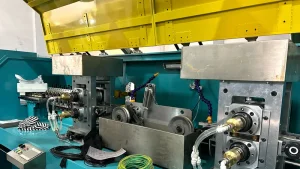
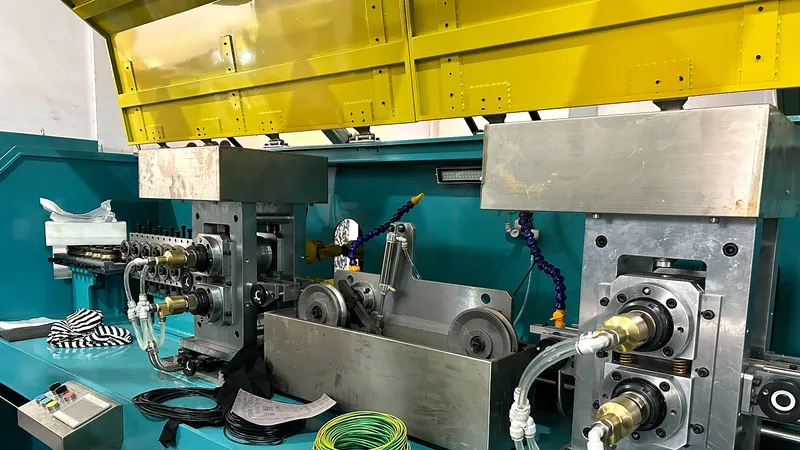
A flat magnet wire production line may combine drawing, precision rolling, edge forming, annealing, enameling, inspection, and take-up equipment.
A representative manufacturing sequence is:
Copper Rod → Drawing → Flat Rolling → Edge Forming → Sizing → Annealing and Surface Preparation → Enameling and Curing → Testing → Take-Up
The actual position of annealing depends on material condition and line design. Not every project requires every module.
| Process | Best Use | Engineering Check |
|---|---|---|
| Drawing → Rolling | Reduce round-wire diameter before flattening | Drawing reduction and rolling pass schedule |
| Rolling with Edge Forming | Control thickness, width, and corners | Lateral spread and tool alignment |
| Profile Drawing | Produce suitable shaped sections through dies | Pulling force, die wear, and corner accuracy |
For details, see Flat Wire Rolling Mill vs Drawing Machine for Rectangular Copper Conductors.
3. Rolling Precision in a Flat Magnet Wire Production Line
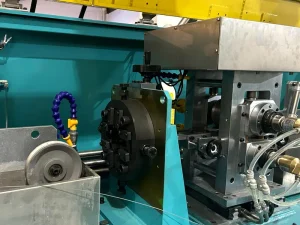
In a two-high (2-Hi) rolling stand, the roll gap primarily controls thickness. Width also depends on lateral metal flow, so closing the gap does not independently correct width.
Multiple moderate reductions, stable entry and exit tension, accurate guides, and aligned rolls help maintain repeatable dimensions.
Corner Radius and Surface Quality
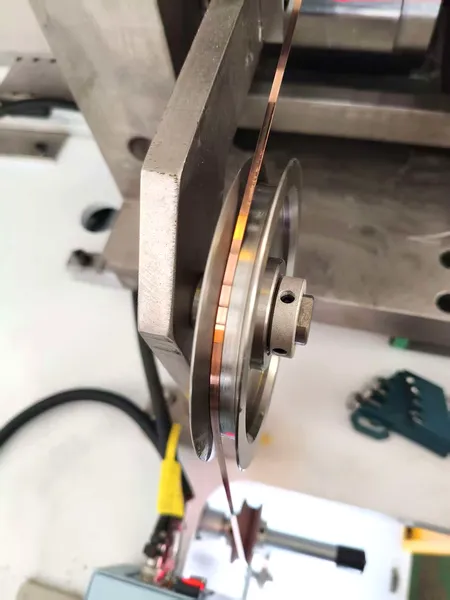
Corner radius deserves a separate requirement. Sharp edges or burrs can threaten enamel coverage, while excessive rounding reduces copper area within specified outside dimensions.
A dedicated edge-forming stage may be needed when the conductor requires a controlled radius.
Specify how all four corners will be inspected. A conventional laser gauge measuring only width and thickness cannot fully verify the corner contour.
Surface quality is equally important. Contaminated rolls, worn guides, or unstable wire movement may cause scratches that affect subsequent insulation processing.
Read How to Control Edge Radius in Rectangular Copper Wire Production for additional guidance.
4. Match Copper Condition and Annealing
Common conductor materials include Cu-ETP (C11000) and oxygen-free copper such as C10200.
Drawing and rolling cause work hardening, changing ductility and forming loads. The incoming material condition therefore affects both processing stability and final conductor properties.
Specify finished hardness or elongation rather than assuming every conductor needs the same annealing cycle.
Heat treatment depends on starting temper, accumulated deformation, conductor dimensions, and downstream bending requirements.
For hairpin motor windings, representative forming trials help confirm whether the finished conductor has suitable mechanical properties.
5. Define Enameling as a Separate Equipment Scope
A precision rolling mill produces the bare rectangular conductor; it does not automatically include an enameling line.
Enameling requires compatible cleaning, coating, curing, inspection, and handling equipment.
The insulation specification should define enamel chemistry, insulation grade, thermal requirements, overall dimensions, dielectric tests, coating continuity, adhesion, and flexibility.
The international standard IEC 60317-0-2:2020 establishes general requirements for enameled rectangular copper winding wires. Applicable NEMA MW 1000 requirements may also guide product specifications.
The relevant standard, edition, and product designation should be confirmed with the customer.
| Insulation Control | What to Verify |
|---|---|
| Coating build | Finished width, thickness, and corner coverage |
| Curing | Approved process conditions and coating quality |
| Electrical integrity | Agreed test methods and acceptance limits |
| Flexibility | Insulation performance after required deformation |
A published thermal class alone does not establish the performance of an entire motor or transformer insulation system.
6. Select Equipment as an Integrated Line
Selecting a flat magnet wire production line requires coordination between rolling, annealing, enameling, inspection, and take-up equipment.
Each module must accommodate the specified conductor dimensions, mechanical condition, and operating requirements.
| Module | Main Selection Question |
|---|---|
| Pay-Off and Drawing | Can they handle the incoming diameter and package? |
| Rolling and Edge Forming | Can they meet each specified profile and tolerance? |
| Annealing and Cleaning | Will they deliver the required copper condition and surface? |
| Enameling and Curing | Can they coat the target dimensions consistently? |
| Inspection and Take-Up | Can they detect defects and wind without damage? |
Speed and tension must be synchronized between modules.
The slowest qualified process—not the rolling mill’s maximum design speed—determines practical production output.
7. Interpret Published Machine Specifications Carefully
Published equipment specifications provide useful reference information, but they must be evaluated against the actual conductor requirements.
The CRM Precision Flat Wire Rolling Mill for Transformers publishes the following technical parameters:
| Parameter | Published Value |
|---|---|
| Round-Wire Input | 1.0–6.0 mm |
| Finished Width / Thickness | 0.6–10 mm / 0.4–6 mm |
| Width / Thickness Tolerance | ±0.01 mm / ±0.005 mm |
| Adjustable Corner Radius | R0.05–1.0 mm |
| Design Speed | 180 m/min |
These values describe rolling equipment, not a complete insulated-wire production line.
They are not simultaneous guarantees for every conductor size, material, corner radius, and operating speed.
For custom applications, request size-specific technical confirmation and representative production trials.
8. Troubleshoot the Whole Process
Manufacturing problems may originate from material properties, tooling condition, tension control, or insulation processing.
| Symptom | Likely Cause to Check | Corrective Action |
|---|---|---|
| Thickness Drift | Roll-gap movement or tool wear | Inspect rolls and measurement trends |
| Width Variation | Unstable lateral spread or tension | Review pass schedule and drive synchronization |
| Unequal Corners | Off-center feed or misalignment | Recenter wire and inspect tooling |
| Surface Scratches | Contaminated guides, rolls, or dies | Clean and inspect contact surfaces |
| Enamel Defects | Surface contamination or coating/curing issues | Verify preparation and insulation settings |
| Wire Breakage | Excessive reduction or insufficient ductility | Review drawing loads and material condition |
Changing rolling force or operating speed without identifying the underlying cause may introduce additional defects.
Consistent incoming material, repeatable process settings, and reliable inspection are essential for stable production.
9. Set Production and Acceptance Criteria
A flat magnet wire production line should be evaluated by its acceptable finished output, not simply its maximum mechanical speed.
Actual capacity depends on conductor size, insulation process, changeover time, operating efficiency, and reject rate.
A factory acceptance test (FAT) should use agreed copper grades and representative conductor dimensions.
The acceptance plan should verify:
- Bare and insulated conductor dimensions
- Corner radius and surface condition
- Electrical insulation performance
- Stable operating speed and finished output
- Take-up tension and winding quality
- Dimensional consistency during sustained operation
Measurements should be recorded over an agreed production length.
The FAT must also distinguish the performance of the bare-wire rolling section from that of the complete insulated-wire production line.
Frequently Asked Questions
Can one rolling mill produce multiple custom sizes?
Often, within its designed operating range. Different sizes may require new rolls, edge-forming tools, pass schedules, and tension settings. Each target profile should be verified individually.
Is a four-high rolling mill always required?
No. Two-high and other configurations should be evaluated against rolling load, stand stiffness, conductor geometry, and demonstrated tolerance capability.
Can a width-and-thickness laser gauge measure corner radius?
Not completely. Suitable optical or contour inspection equipment is needed to verify the full corner profile.
Does a flat wire rolling mill include enameling equipment?
Only when the supplier explicitly includes coating, curing, and associated inspection equipment in the scope of supply. Rolling and enameling are separate manufacturing operations.
How should buyers compare equipment quotations?
Compare guaranteed size-specific results, included equipment modules, inspection methods, utilities, FAT criteria, and acceptable production output—not headline speed alone.
Conclusion
A reliable flat magnet wire production line starts with a complete conductor drawing and clearly defined insulation requirements.
Forming, annealing, coating, inspection, and take-up must work together to deliver consistent product quality under realistic operating conditions.
Sky Bluer Environmental Technology Co., Ltd. supplies CRM precision rolling mills and wire-processing equipment for copper and aluminum conductors.
Planning a custom rectangular copper wire project? Send us your copper grade, input size, finished cross-section, dimensional tolerances, corner radius, insulation requirements, and target production capacity.
Our engineering team can evaluate the appropriate rolling configuration and equipment interfaces for your manufacturing requirements.