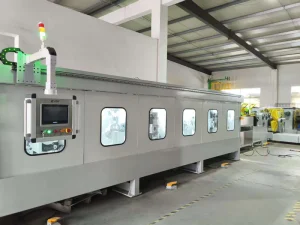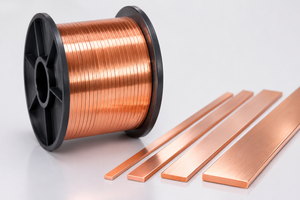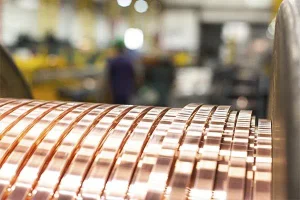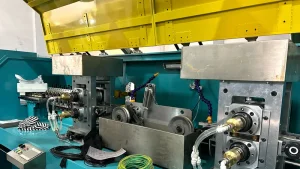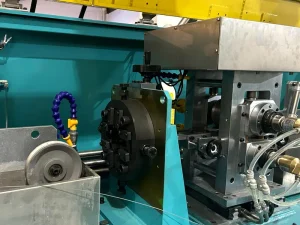
Flat magnet wire production capacity is a key consideration when selecting a precision rolling line. Yet a machine’s rated speed does not tell manufacturers how many kilograms of acceptable rectangular copper wire they can produce per shift. Output also depends on conductor dimensions, copper density, downtime, operating speed, and scrap.
This guide explains the formulas and practical checks needed to estimate production capacity for transformer winding conductors, enameled rectangular wire, and other flat copper magnet wire applications.
1. Understanding Flat Magnet Wire Production Capacity
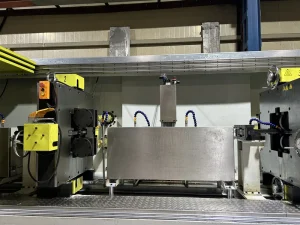
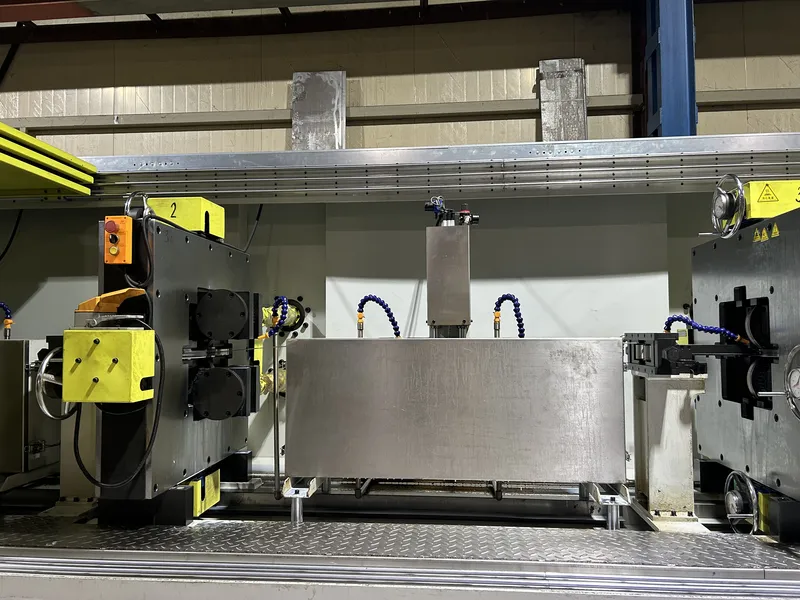
A typical bare-wire process may include:
Pay-Off → Drawing (if required) → Multi-Pass Rolling → Edge Forming → Annealing (if required) → Inspection → Take-Up
Enameling or paper covering may follow as a separate process.
| Measure | Meaning | Unit |
|---|---|---|
| Line speed | Conductor travel speed | m/min |
| Theoretical output | Mass processed at constant speed | kg/h |
| Actual good output | Accepted wire after production losses | kg/shift |
Always distinguish the capacity of the rolling section from that of a complete insulated-wire production line. For more background, see our Copper Rolling Process Guide.
2. Calculate Theoretical Output in kg/h
For a single bare copper conductor, calculate mass output using its cross-sectional area and travel speed:
Capacity (kg/h) = Area (mm²) × Speed (m/min) × Density (g/cm³) × 0.06
Copper density is approximately 8.96 g/cm³ at room temperature. The factor 0.06 converts the units to kilograms per hour.
For a rectangular conductor with sharp corners:
Area (mm²) = Width (mm) × Thickness (mm)
Worked Example: 5.00 × 2.00 mm Copper Wire
Assume a C11000 (Cu-ETP) conductor with a nominal width of 5.00 mm, thickness of 2.00 mm, and continuous operating speed of 60 m/min.
Area = 5.00 × 2.00 = 10.00 mm²
Theoretical output = 10.00 × 60 × 8.96 × 0.06 = 322.56 kg/h
This means approximately 322.6 kg/h of bare copper at the assumed speed, before accounting for production losses. The 60 m/min figure is illustrative, not a guaranteed CRM machine speed.
Allow for Rounded Corners
Flat magnet wire often has rounded edges. For four identical circular corner radii, the copper area can be estimated as:
Area = Width × Thickness − (4 − π) × Radius²
For a 5.00 × 2.00 mm conductor with a 0.30 mm corner radius, the calculated area is approximately 9.923 mm², giving 320.1 kg/h at 60 m/min. Use a measured profile or approved drawing for nonstandard corners.
3. Estimate Actual Production per Shift
Real production includes spool changes, maintenance, setup, speed reductions, and rejected wire. A useful planning model is:
Good Output = Theoretical Output × Availability × Performance × Quality Rate
| Factor | Example assumption |
|---|---|
| Availability: operating time / planned time | 85% |
| Performance: actual / reference speed while running | 90% |
| Quality: accepted / processed output | 98% |
The combined factor is 0.85 × 0.90 × 0.98 = 0.7497, or about 75% overall equipment effectiveness when the factors are measured consistently.
For the earlier example:
Good output = 322.56 × 0.7497 ≈ 241.8 kg/h
At eight planned production hours per shift, this equals 1,934.6 kg, or approximately 1.93 tons per shift. Two shifts per day and 22 operating days per month would yield approximately 85.1 tons/month, assuming the same product and efficiency throughout.
These percentages are hypothetical. Use actual operating records or agreed factory acceptance test data for investment decisions. Avoid counting the same downtime twice.
4. Understand the Effect of Conductor Size
At a fixed speed, output increases in proportion to copper cross-sectional area. The table below uses 60 m/min, sharp-corner nominal areas, and 8.96 g/cm³ copper density.
| Bare wire dimensions | Area | Theoretical output |
|---|---|---|
| 2.00 × 1.00 mm | 2.00 mm² | 64.5 kg/h |
| 3.00 × 1.50 mm | 4.50 mm² | 145.2 kg/h |
| 5.00 × 2.00 mm | 10.00 mm² | 322.6 kg/h |
| 6.00 × 2.50 mm | 15.00 mm² | 483.8 kg/h |
| 8.00 × 3.00 mm | 24.00 mm² | 774.1 kg/h |
These are mathematical comparisons, not confirmed production rates. Larger profiles may require greater rolling force or different motors, while tighter tolerances can require lower speeds. Each size needs its own qualified operating conditions.
5. Identify the Line’s Production Bottleneck
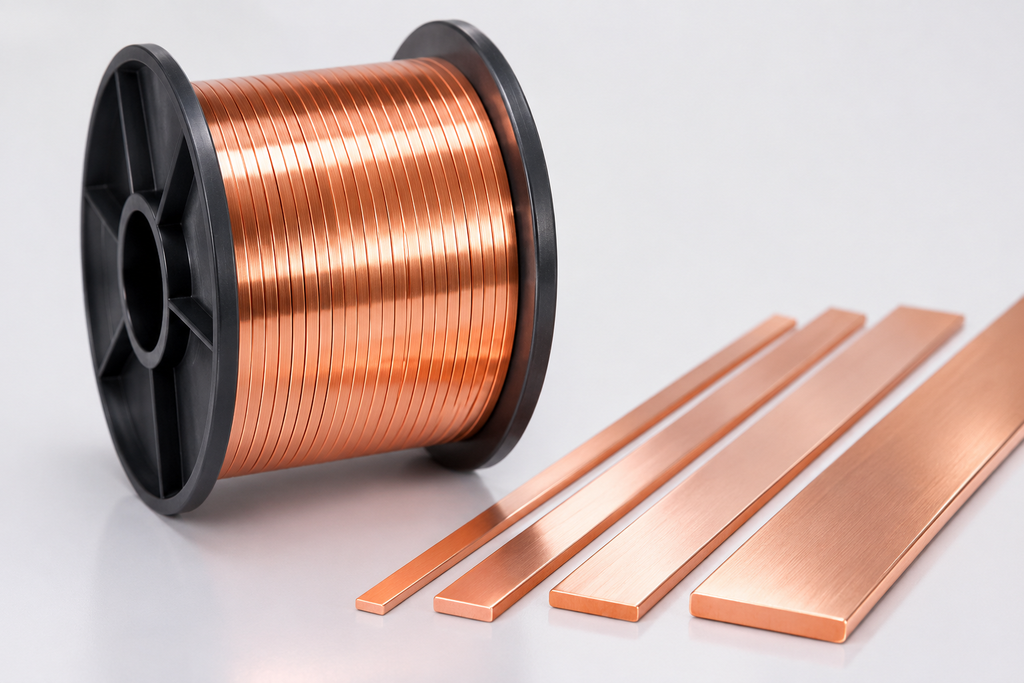
The fastest rolling stand does not necessarily determine total line capacity. The limiting stage may be the drawing machine, edge-forming unit, annealing system, inspection equipment, or take-up.
| Line section | Possible constraint |
|---|---|
| Rolling stands | Force, drive power, dimensional stability |
| Annealing | Heating capacity and required material properties |
| Take-up | Winding tension and spool changeover |
| Inspection | Measurement and quality acceptance requirements |
A line must operate at a speed that every connected process can sustain while meeting the finished conductor specification. The bottleneck may change with wire size.
See Flat Wire Rolling Mill vs Drawing Machine for Rectangular Copper Conductors for forming-process differences, and How to Specify a Flat Magnet Wire Production Line for Custom Dimensions for specification planning.
6. Calculate the Speed Required for Your Target Output
To calculate the line speed needed to meet your target flat magnet wire production capacity, rearrange the formula:
Required Speed = Target Good Output (kg) ÷ [Area × Density × 0.06 × Planned Hours × Effective Factor]
Suppose a factory needs 2,000 kg of acceptable 5.00 × 2.00 mm bare copper wire per eight-hour shift, with a planning efficiency of 75%.
Required speed = 2,000 ÷ (10 × 8.96 × 0.06 × 8 × 0.75) ≈ 62.0 m/min
The equipment supplier must then confirm whether the proposed configuration can sustain that speed while meeting width, thickness, corner-radius, surface, and mechanical-property requirements. The calculated target is not evidence of achievable machine performance.
7. Verify Capacity Before Purchasing
Ask suppliers to specify guaranteed output for each representative conductor size, not only maximum machine speed. During factory acceptance testing (FAT), record stable speed, test duration, accepted kilograms, stoppages, and rejected material. Inspect dimensions, corner radius, surface condition, mechanical properties where required, and winding quality.
Capacity can often be improved by optimizing the pass schedule, maintaining consistent tension, inspecting roll wear, and reducing spool-change downtime rather than simply increasing speed. The CRM Precision Flat Wire Rolling Mill provides a reference for discussing application-specific equipment configurations.
Frequently Asked Questions
How is flat magnet wire capacity calculated?
Multiply bare copper cross-sectional area by line speed, copper density, and 0.06. Apply availability, performance, and quality factors to estimate acceptable output.
Does higher speed always mean higher production?
Not necessarily. Output also depends on conductor area, line bottlenecks, stable processing conditions, and reject rates.
Should I use bare or insulated wire dimensions?
Use the bare copper cross-section to calculate rolling-section copper output. A complete insulated-wire line also requires separate consideration of insulation mass and downstream process capacity.
Can one rolling line run every conductor size at the same speed?
No. Rolling force, reduction schedule, tooling, and tolerances vary with product dimensions.
What should I include in a capacity inquiry?
Provide copper grade, input size, finished width and thickness, tolerances, corner radius, required kg/h or tons/day, shift hours, and spool specifications. State whether annealing or insulation is required.
Conclusion
Reliable flat magnet wire production capacity planning combines conductor area, density, qualified line speed, operating efficiency, and acceptable product yield. Compare theoretical calculations with the capabilities of the complete line and verify performance under agreed test conditions.
Sky Bluer Environmental Technology Co., Ltd. (CRM) manufactures precision rolling mills and customized wire-processing equipment. Share your conductor drawing and target output with our engineering team to evaluate a suitable rolling configuration.