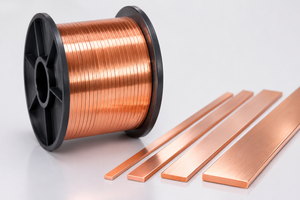
Copper vs Aluminum Flat Wire is an important comparison for manufacturers selecting precision rolling processes and equipment. Both materials are widely used in transformers, electric motors, busbars, and power cables. Although they can be formed through similar cold rolling technologies, their different metallurgical properties affect process settings, surface quality, and dimensional control.
1. Material Characteristics That Affect Rolling
Electrical conductivity and density influence material selection, while work hardening, friction, and surface oxidation affect rolling stability.
| Rolling Factor | Copper (C11000 / C10200) | Aluminum (1050 / 1060 / 1070) |
|---|---|---|
| Work hardening | Increases with cold deformation | Depends on grade and temper |
| Deformation behavior | Requires control of cumulative strain | Depends strongly on alloy and temper |
| Surface concerns | Scratches, roll marks, and oxidation | Oxide film, surface pickup, and embedded debris |
| Lubrication | Must control friction and surface marking | Must also prevent material adhesion and pickup |
| Dimensional control | Thickness, width, and residual stress | Thickness, lateral spread, and surface condition |
Copper is commonly selected for applications requiring high electrical conductivity and compact conductor dimensions. Aluminum offers lower weight, making it attractive for applications where weight reduction is important.
However, the specific grade and temper must always be considered. Pure aluminum grades such as 1050, 1060, and 1070 have different forming characteristics from stronger aluminum alloys such as 5052.
Material condition also determines whether intermediate annealing is needed. The decision should be based on deformation history, mechanical properties, and the required final condition rather than a universal reduction percentage.
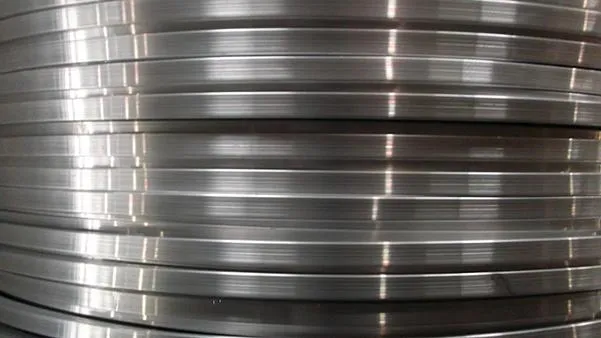
2. 2. Copper vs Aluminum Flat Wire: Rolling Process Differences
Both materials can be converted from round wire or an existing profile into rectangular wire through multiple rolling passes. The process generally includes:
Pay-off and wire guiding → Incoming material inspection → Preliminary drawing, if required → Multi-pass flat rolling → Edge rounding → Intermediate annealing, if required → Dimensional inspection → Straightening and take-up.
Copper Flat Wire Rolling
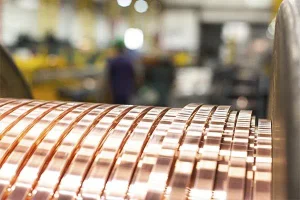
Copper rolling focuses on dimensional repeatability, consistent cross-section, and controlled mechanical properties. These requirements are important for downstream paper wrapping, enameling, and coil winding.
Copper work-hardens during cold deformation. If the reduction schedule is unsuitable, excessive strain may lead to reduced ductility, residual stress, edge defects, or dimensional changes during subsequent processing.
The reduction should therefore be distributed appropriately across passes. Intermediate annealing may be required when the accumulated deformation affects the material’s ability to undergo further forming.
Aluminum Flat Wire Rolling
Aluminum follows a similar production route, but surface protection requires particular attention.
Aluminum naturally forms an oxide film. During rolling, surface contamination, trapped particles, unsuitable roll conditions, or poor lubrication can contribute to scratches and surface defects. Adhesion of aluminum to the rolls can also affect product quality.
Important control points include clean roll surfaces, suitable lubricant selection, stable feeding, and appropriate tension settings. The rolling schedule must reflect the aluminum grade and temper rather than being transferred directly from another material.
Main Process Difference
Copper rolling requires careful management of work hardening and residual stress. Aluminum rolling places additional emphasis on friction control, roll cleanliness, and surface protection. Both require stable tension and accurate dimensional control.
3. Flat Wire Rolling Mill: Shared Equipment, Different Settings
A complete flat wire production line relies on coordinated subsystems rather than the rolling stand alone.
| Subsystem | Main Function | Key Considerations |
|---|---|---|
| Pay-off | Supplies incoming material | Stable feeding and suitable brake settings |
| 2-Hi rolling stands | Reduces thickness and forms the profile | Pass arrangement and reduction distribution |
| Edge rounding unit | Controls corner geometry | Material condition and required radius |
| Tension control | Maintains stable material movement | Avoid excessive pulling force |
| Lubrication and cooling | Controls friction, heat, and roll wear | Material compatibility and filtration |
| Online measurement | Monitors width and thickness | Measurement accuracy and process feedback |
| Take-up | Collects finished wire | Winding tension and spool support |
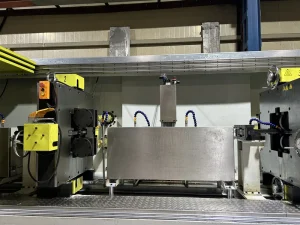
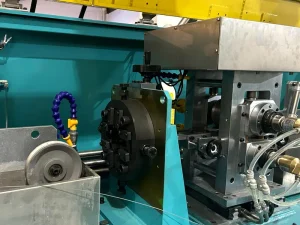
Two-high rolling stands are commonly used for flat wire forming. Multiple stands or passes can distribute deformation and help maintain dimensional consistency.
The required configuration depends on incoming and finished dimensions, total reduction, material grade, corner radius, production speed, and tolerance requirements.
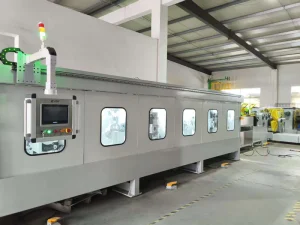
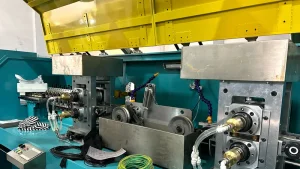
Sky Bluer’s Precision Flat Wire Rolling Mill can be configured for copper, aluminum, and other metal wire applications according to product specifications.
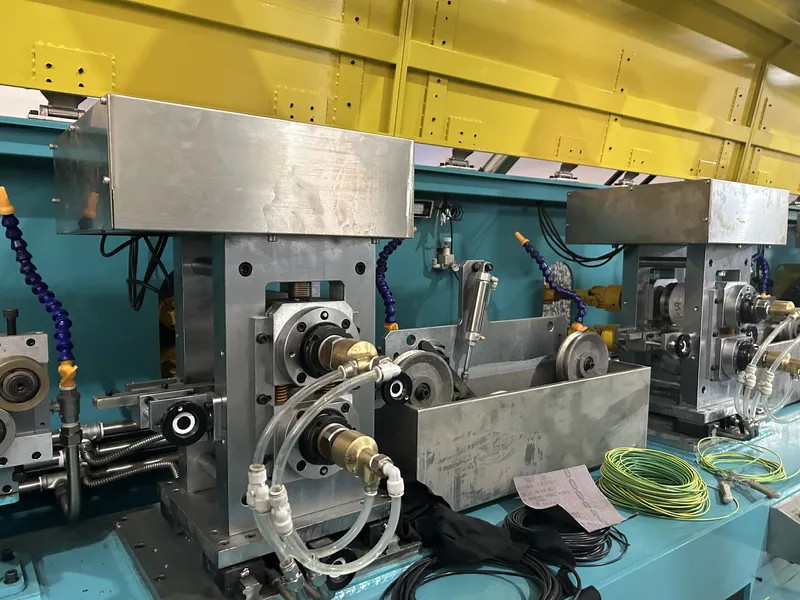
4. Critical Process Control Points
Roll Gap and Alignment
Roll gap directly influences finished thickness, while width is also affected by lateral metal flow, roll geometry, and reduction distribution.
Before changing the pass schedule, check roll parallelism, roll condition, and gap settings. Thickness variation may also result from roll wear, machine deformation, unstable feeding, or material inconsistency.
Edge Radius and Surface Quality
Corner geometry is important for rectangular conductors used in insulation and winding applications. Sharp or inconsistent edges can damage insulation during downstream processing.
The achievable corner radius depends on finished dimensions, material condition, roll profile, and forming sequence.
For more details, read How to Control Edge Radius in Rectangular Copper Wire Production.
Lubrication and Tension
Lubrication helps reduce friction, control heat, limit roll wear, and prevent material adhesion. The lubricant must be compatible with the material and subsequent processes such as annealing or enameling.
Tension must also be coordinated across pay-off, rolling, and take-up. Excessive tension can deform softer wire, while unstable tension may cause tracking problems and irregular winding.
5. Troubleshooting Common Production Problems
Defects should be investigated systematically, starting with incoming material and then checking tooling, rolling conditions, and auxiliary equipment.
| Symptom | First Check | Additional Checks |
|---|---|---|
| Uneven thickness | Roll gap and parallelism | Roll wear, material variation |
| Width inconsistency | Reduction distribution | Roll profile, wire guiding |
| Edge cracking | Material condition and deformation history | Annealing and edge-forming sequence |
| Surface scratches | Roll and guide cleanliness | Lubricant filtration and contact points |
| Aluminum pickup | Roll surface condition | Lubrication and operating conditions |
| Poor straightness | Machine alignment and tension | Uneven deformation, take-up support |
| Irregular winding | Take-up synchronization | Pay-off brake and spool support |
Changing the roll gap alone may not resolve a defect. Correct diagnosis requires checking the entire production process.
6. Equipment Selection Checklist
Before requesting a rolling mill layout or quotation, manufacturers should prepare the following information:
- Material grade and temper
- Incoming wire diameter or starting profile
- Finished width, thickness, and tolerances
- Required corner radius
- Target production speed and output
- Pay-off and take-up spool dimensions
- Downstream processes, including annealing, enameling, or insulation wrapping
One rolling line may be designed to process both copper and aluminum, but separate roll sets, lubrication procedures, or pass schedules may be necessary.
For a comparison of forming methods, see Flat Wire Rolling Mill vs Drawing Machine for Rectangular Copper Conductors.
7. Frequently Asked Questions
Can one rolling mill process both copper and aluminum?
Yes, if the mill’s capacity, roll configuration, and control range meet the requirements of both materials. However, process settings and tooling may need to be adjusted.
Which material is easier to roll into flat wire?
There is no universal answer. Forming difficulty depends on material grade, temper, incoming dimensions, and finished profile. Soft aluminum may be easier to deform but more sensitive to surface damage and handling.
Is aluminum surface pickup caused only by poor lubrication?
No. Roll surface condition, lubricant compatibility, contamination, and operating conditions can all contribute to material pickup.
Can round wire be rolled directly into rectangular flat wire?
Yes. Depending on incoming diameter and required finished dimensions, production may involve multiple rolling passes, edge profiling, and preliminary drawing.
What information is needed for a rolling mill quotation?
Provide the material grade, incoming size, finished dimensions, tolerances, corner radius, production speed, and spool requirements. Product drawings or samples are also helpful.
Conclusion
Copper and aluminum flat wire can be produced using similar precision rolling technologies, but their material characteristics require different process controls.
Copper production focuses on managing work hardening, residual stress, and dimensional stability. Aluminum production requires particular attention to friction, surface protection, and material handling.
For both materials, reliable production depends on coordinated rolling stands, tooling, lubrication, tension control, online measurement, and take-up systems.
Sky Bluer Environmental Technology Co., Ltd. (CRM) designs and manufactures precision rolling mills and customized wire-processing lines for copper, aluminum, and other metal materials.
Share your material grade, incoming dimensions, finished size, and tolerance requirements with our engineering team. We can evaluate a suitable rolling process and equipment configuration for your application.
Contact Sky Bluer to discuss your copper or aluminum flat wire production project.