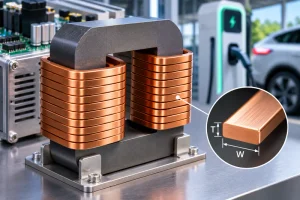
Electric vehicles (EVs) rely on high-current connections between battery modules, inverters, charging circuits, and power distribution units. These connections must minimize electrical losses while maintaining acceptable temperatures and mechanical reliability.
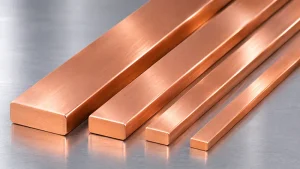
Rectangular copper busbars are used in many such assemblies because their flat geometry supports compact layouts and defined connection surfaces. Yet conductor shape alone does not determine performance. Material grade, cross-section, contact resistance, insulation, and manufacturing quality all matter.
This guide covers EV conductor specifications and the role of precision flat wire rolling.
1. Where Are Rectangular Copper Busbars Used?
Typical applications include:
- Battery packs: Connections between modules, protective devices, and distribution components.
- Power distribution units (PDUs): Current paths connecting high-voltage circuits and switching devices.
- Traction inverters: DC connections between the battery and power electronics.
- On-board chargers: Conductive links within charging and conversion equipment.
- DC/DC converters: Connections between conversion stages and associated components.
Large rigid busbars may be cut and bent from copper strip or plate; other designs use thinner formed conductors, stacked foils, or flexible assemblies.
Consequently, the term “busbar” does not automatically mean a product suitable for a wire rolling mill. Equipment selection must start with actual dimensions and downstream operations.
2. How Dimensions Affect Electrical and Thermal Performance
Cross-Section and Resistance
For a rectangular conductor with width W and thickness T, nominal cross-sectional area is:
A = W × T
For example, a 15.00 × 2.00 mm copper conductor has a nominal area of 30.00 mm². Rounded corners reduce the actual metallic area slightly.
For a uniform conductor, resistance can be estimated using:
R = ρ × L / A
Here, ρ is resistivity, L is conductor length, and A is cross-sectional area, expressed in consistent SI units.
Using copper resistivity of approximately 1.724 × 10⁻⁸ Ω·m at 20°C, a 0.5 m conductor with a 30 mm² cross-section has an estimated resistance of 0.287 mΩ. At 200 A, its calculated resistive loss is approximately 11.5 W.
This is not a current rating: contact resistance and thermal conditions are excluded.
Temperature Rise and Joint Design
Current-carrying capability also depends on cooling, ambient temperature, conductor spacing, enclosure geometry, and allowable operating temperature.
Bolted and welded connections require particular attention. Poor contact quality can produce localized heating even when the conductor cross-section is sufficient.
Electrical and thermal validation should therefore accompany dimensional design.
3. Copper Grades and Material Condition
Copper grade influences conductivity, formability, and compatibility with later processing.
| Copper Grade | Designation | Relevant Characteristics |
|---|---|---|
| C11000 | Cu-ETP | High-conductivity electrolytic tough-pitch copper |
| C10200 | Cu-OF | Oxygen-free copper for specified material requirements |
| C10100 | Cu-OFE | High-purity oxygen-free electronic copper |
Selection should consider material standards, required conductivity, forming operations, joining methods, and availability.
Temper is equally important. Softer copper generally accommodates tighter bends, whereas cold working increases strength but can reduce ductility. Rolling introduces deformation and work hardening; annealing may be needed before demanding forming operations.
4. Manufacturing Rectangular Copper Conductor Stock
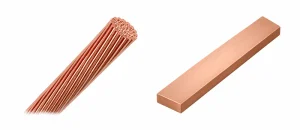
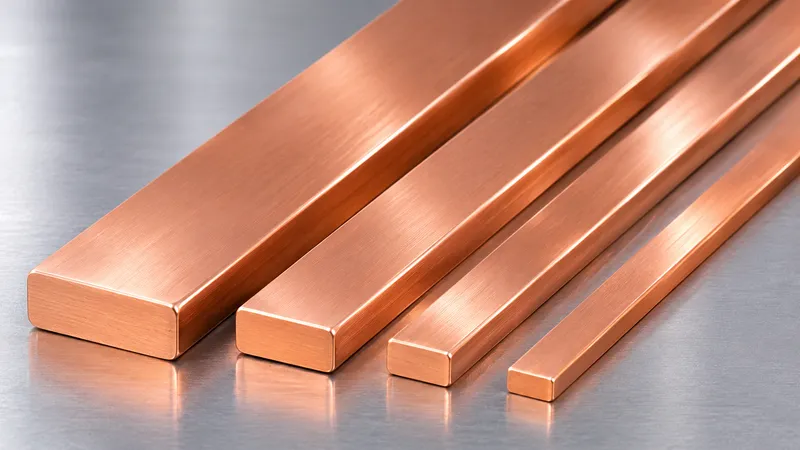
Wide or thick rigid busbars may begin as copper strip, plate, or extruded profiles. Smaller rectangular conductors may be produced from copper rod or wire through drawing and rolling.
A representative wire-based process is:
Copper Rod or Round Wire → Drawing (if Required) → Multi-Pass Rolling → Edge Finishing → Cleaning/Annealing (as Required) → Cutting/Forming → Plating/Insulation (if Required) → Inspection
Precision Flat Wire Rolling
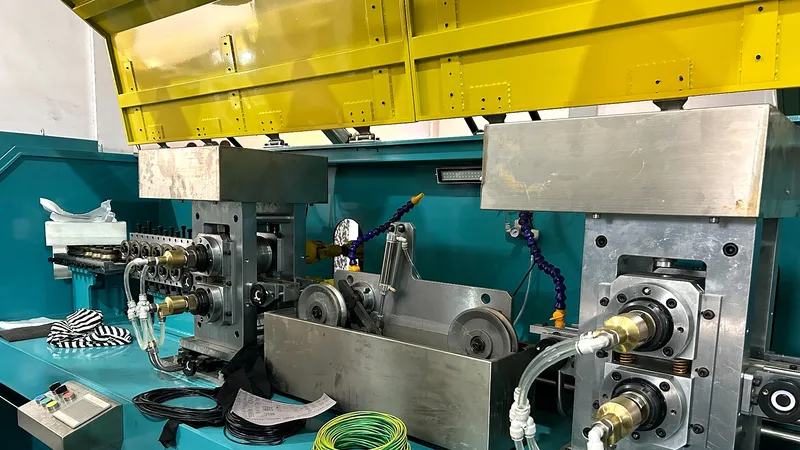
A precision flat wire rolling mill can produce bare rectangular copper stock when input material, finished dimensions, and reduction requirements match its engineered capability.
Critical controls include:
- Roll gap: Governs thickness reduction and consistency.
- Pass schedule: Distributes deformation across successive passes.
- Wire guidance: Limits lateral movement and misalignment.
- Tension control: Stabilizes material movement between stages.
- Roll surface finish: Influences scratches and surface quality.
Thickness reduction can cause lateral spreading, so width and thickness must be controlled together.
A rolling mill does not manufacture a complete EV battery busbar assembly. Punching, bending, coating, joining, and electrical testing require additional processes.
For process selection, see Flat Wire Rolling Mill vs Drawing Machine for Rectangular Copper Conductors.
5. Edge Quality, Surface Treatment, and Insulation
Dimensional accuracy alone is insufficient. Burrs, deep scratches, and damaged edges can interfere with bending, electrical contact, and insulation application.
Corner radius should match forming and insulation requirements without compromising the flatness of mating contact surfaces.
Depending on the design, finished busbars may require tin or nickel plating, insulating coatings, sleeves, or other protective systems. Their suitability must be verified for the intended operating environment.
For related surface-preparation principles, see How to Prepare Copper Flat Wire for Enameling and Paper Insulation.
6. Technical Specifications to Confirm
Before requesting a production-line proposal, provide the following information.
| Parameter | Required Information |
|---|---|
| Copper material | Grade, conductivity, and temper |
| Incoming stock | Shape, dimensions, and condition |
| Finished geometry | Width × thickness, length, and profile |
| Dimensional tolerances | Width, thickness, straightness, and flatness |
| Edge requirements | Corner radius and burr limits |
| Surface quality | Scratch, oxidation, and cleanliness criteria |
| Downstream processing | Bending, punching, joining, plating, insulation |
| Production capacity | Required kg/h or tons/month |
Provide drawings distinguishing rolled dimensions from downstream features such as holes, bends, and terminals.
Tolerances should reflect assembly requirements and achievable process capability, rather than applying the tightest possible limit to every dimension.
7. Quality Control and Troubleshooting
Inspection should begin with incoming copper and continue through rolling and downstream fabrication. Relevant checks include dimensional measurements, cross-sectional profile, edge condition, surface cleanliness, and mechanical properties.
Completed assemblies may also require joint-resistance measurement, dielectric tests, and temperature-rise verification.
Common Manufacturing Problems
| Problem | Possible Cause | Recommended Action |
|---|---|---|
| Thickness variation | Unstable roll gap | Check roll adjustment and process stability |
| Width inconsistency | Uncontrolled lateral spreading | Review pass reductions and wire guidance |
| Cracks during bending | Excessive work hardening | Review temper and annealing |
| Surface scratches | Damaged tooling or handling | Inspect contact surfaces |
| Joint overheating | Excessive contact resistance | Check joint design and assembly |
| Insulation damage | Burrs or sharp edges | Improve edge finishing |
Distinguish conductor-manufacturing defects from problems introduced by assembly or electrical design.
8. Frequently Asked Questions
Can a Flat Wire Rolling Mill Make Complete EV Battery Busbars?
No. Suitable equipment can produce bare rectangular conductor stock within its designed range. Cutting, punching, bending, plating, insulation, and assembly are separate operations.
Is a Larger Copper Cross-Section Always Better?
Not necessarily. It can reduce resistance but increases material consumption, mass, and packaging demands. Thermal behavior and connection quality also matter.
Are Rectangular Busbars Always Better Than Round Conductors?
No. Flat geometry can support compact layouts and defined contact areas, but selection depends on electrical, thermal, mechanical, and installation requirements.
Conclusion
Reliable rectangular copper busbars require coordinated electrical design, material selection, dimensional control, and downstream processing. For suitable conductor sizes, precision rolling can support consistent width, thickness, edge geometry, and surface quality.
Sky Bluer Environmental Technology Co., Ltd. manufactures precision rolling equipment for bare flat and rectangular metal conductors, not finished EV busbar assemblies.
For a rectangular copper conductor production project, share your copper grade, incoming stock, target width × thickness, tolerances, downstream operations, and required capacity. Our engineering team can assess whether a precision rolling solution is suitable.