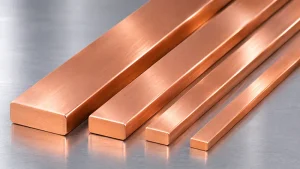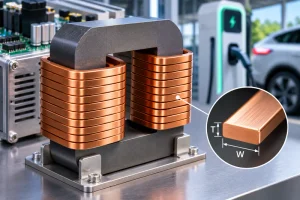
Electric vehicle (EV) charging systems rely on magnetic components to manage current, filter electrical noise, and support efficient power conversion. Inductors used in these systems must meet demanding electrical, thermal, and mechanical requirements.
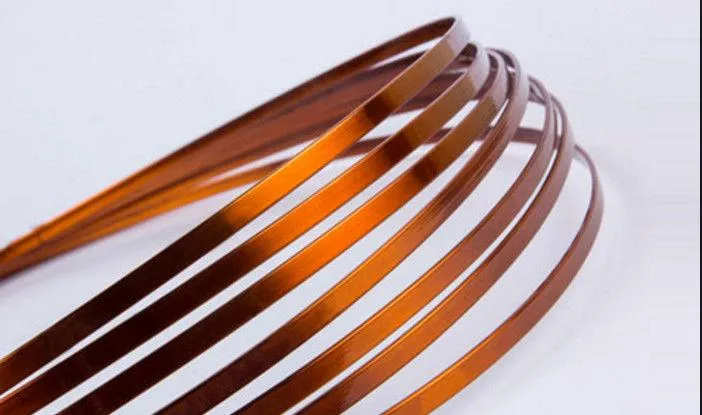
Rectangular copper wire is one conductor option for selected EV charging inductors. Its defined width and thickness can support controlled winding arrangements and compact component designs. However, conductor geometry alone does not guarantee lower losses or higher efficiency.
This guide explains where rectangular copper conductors are used, how to specify them, and why precision flat wire rolling matters for reliable inductor manufacturing.
1. Where Is Rectangular Copper Wire Used in EV Charging Systems?
EV charging equipment contains different magnetic components, depending on its power-conversion architecture.
Typical applications include:
- On-board chargers (OBCs): Power-factor-correction inductors and other magnetic components used during AC-to-DC conversion.
- DC fast chargers: Filter inductors and magnetic components within high-power conversion stages.
- DC-DC converters: Inductors used to regulate current and support voltage conversion.
- Resonant power converters: Selected inductive components designed for specific switching and operating conditions.
Rectangular copper wire may be considered where conductor positioning, winding geometry, and available space justify its use.
Wireless EV charging coils are a separate application. Their high-frequency operating conditions often favor stranded or Litz-wire conductors, so solid rectangular copper wire should not be assumed suitable without electromagnetic analysis.
2. How Conductor Geometry Affects Inductor Performance
Width, Thickness, and Cross-Sectional Area
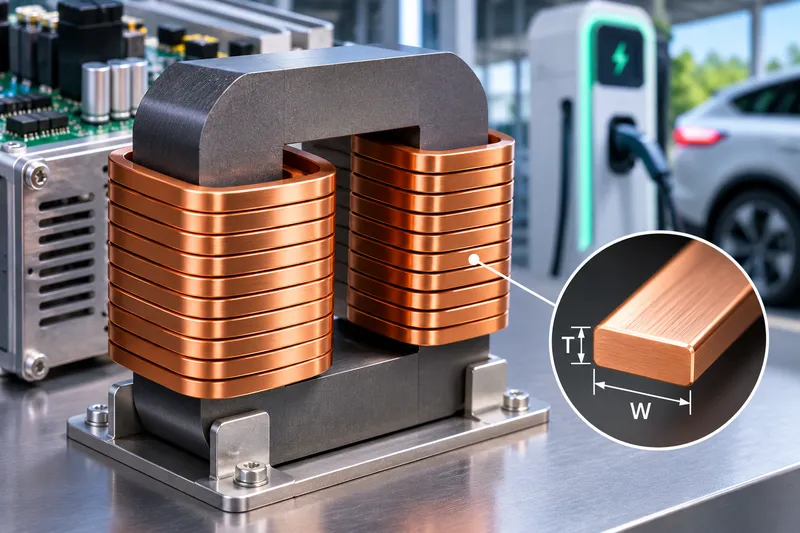
A rectangular conductor is primarily defined by its width (W), thickness (T), and corner radius (r).
For example, a conductor measuring 4.00 × 1.50 mm has a nominal rectangular cross-sectional area of:
A = W × T = 4.00 × 1.50 = 6.00 mm²
This calculation assumes sharp corners. Rounded corners reduce the actual copper area slightly.
The cross-sectional area influences DC resistance, while the conductor’s dimensions and orientation affect winding arrangement and AC current distribution.
Larger copper area can reduce DC resistance for a given conductor length, but it also increases material consumption and may complicate bending.
AC Losses at High Switching Frequencies
EV charging converters frequently operate at switching frequencies where skin and proximity effects become important.
Skin effect concentrates alternating current toward the conductor surface. Proximity effect redistributes current because of magnetic fields generated by nearby conductors.
For copper at approximately 20°C, skin depth at 100 kHz is around 0.21 mm. This illustrates why a thick solid conductor may experience significantly higher AC resistance than its DC resistance suggests.
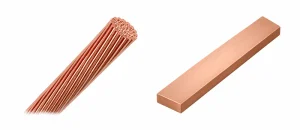
Rectangular geometry can be useful, but it is not automatically superior to round wire, copper foil, or Litz wire.
Engineers should evaluate operating frequency, harmonic content, winding orientation, magnetic-field distribution, and thermal performance before selecting a conductor.
3. Copper Material and Insulation Requirements
Selecting the Copper Grade
Common copper grades considered for electrical conductors include:
| Copper Grade | Designation | Relevant Characteristics |
|---|---|---|
| C11000 | Cu-ETP | High-conductivity electrolytic tough-pitch copper |
| C10200 | Cu-OF | Oxygen-free copper for applications with specific material requirements |
| C10100 | Cu-OFE | High-purity oxygen-free electronic copper |
Material selection should consider conductivity, mechanical properties, processing conditions, availability, and applicable standards.
The temper is particularly important when the conductor must undergo tight bending. Excessive work hardening during rolling can reduce formability and increase the risk of edge cracking.
Insulation and Corner Radius
Inductor windings require suitable electrical insulation.
Depending on the design, rectangular copper conductors may receive enamel, tape, paper, or another qualified insulation system.
Sharp corners and surface defects can damage insulation during winding. Controlled corner radii help reduce localized mechanical stress.
Insulation requirements should specify dielectric strength, coating thickness, thermal class, and acceptable damage limits.
For related processing considerations, see How to Prepare Copper Flat Wire for Enameling and Paper Insulation.
4. Manufacturing Rectangular Copper Wire for EV Charging Inductors
A representative manufacturing sequence is:
Copper Rod or Round Wire → Drawing (if Required) → Multi-Pass Rolling → Edge Finishing → Annealing/Cleaning (as Required) → Insulation → Inductor Winding → Final Inspection
The exact process depends on conductor dimensions, material condition, and insulation requirements.
Precision Flat Wire Rolling
A precision flat wire rolling mill converts suitable copper feedstock into bare rectangular conductors with controlled dimensions and surface quality.
Important rolling parameters include:
- Roll gap: Controls thickness reduction and influences dimensional consistency.
- Pass schedule: Distributes deformation across successive rolling passes.
- Wire guidance: Maintains alignment and reduces lateral movement.
- Tension control: Supports stable feeding between processing stages.
- Roll surface finish: Influences conductor surface condition and potential defects.
Thickness reduction can also cause lateral material spreading. Therefore, width and thickness must be controlled together rather than independently.
Rolling equipment produces the bare conductor, not a finished insulated inductor. Insulation, winding, magnetic-core assembly, and electrical testing require additional equipment and processes.
5. Key Specifications When Ordering Rectangular Copper Wire
Inductor manufacturers should define conductor requirements before selecting a production process.
| Parameter | Information to Specify |
|---|---|
| Copper material | Grade and required material condition |
| Conductor dimensions | Target width × thickness |
| Dimensional tolerance | Permitted width and thickness deviations |
| Corner radius | Target radius and acceptable variation |
| Surface quality | Limits for scratches, burrs, and contamination |
| Insulation | Type, thickness, and dielectric requirements |
| Formability | Minimum winding radius and bending direction |
| Production capacity | Required output in kg/h or tons/month |
Dimensional tolerances must reflect the application and manufacturing capability. A tolerance suitable for one conductor size should not automatically be applied to another.
When comparing manufacturing methods, consult Flat Wire Rolling Mill vs Drawing Machine for Rectangular Copper Conductors.
6. Quality Control for Inductor-Grade Rectangular Copper Wire
Consistent conductor quality is essential for repeatable winding and reliable insulation.
Recommended incoming-wire inspections include dimensional measurement, corner-radius verification, surface examination, and assessment of mechanical properties.
Laser measurement systems can support continuous dimensional monitoring, while suitable profile-measurement equipment can verify the actual cross-section.
After winding, additional validation may include:
- DC resistance measurement
- AC loss evaluation under representative operating conditions
- Insulation integrity and dielectric testing
- Temperature-rise testing
- Mechanical and thermal-cycle testing where required
These tests evaluate different aspects of performance. Dimensional accuracy alone cannot establish the electrical suitability of a finished inductor.
7. Common Manufacturing Problems and Troubleshooting
| Problem | Possible Cause | Recommended Action |
|---|---|---|
| Inconsistent conductor thickness | Unstable roll gap or rolling conditions | Check roll adjustment and process stability |
| Width variation | Uncontrolled lateral spreading or guidance | Review pass reductions and wire alignment |
| Edge cracks during winding | Excessive work hardening or tight bend radius | Review material temper and bending requirements |
| Insulation damage | Burrs, sharp corners, or surface defects | Improve edge finishing and surface inspection |
| Excessive AC losses | Unsuitable conductor geometry or winding layout | Reassess frequency-dependent losses and conductor selection |
| Local overheating | Uneven current distribution or insufficient cooling | Verify electromagnetic and thermal design |
Troubleshooting should distinguish conductor manufacturing defects from problems caused by inductor design or winding conditions.
8. Frequently Asked Questions
Is Rectangular Copper Wire Always Better Than Round Wire for EV Charging Inductors?
No. Rectangular wire may offer packaging and winding advantages, but electrical performance depends on frequency, conductor dimensions, magnetic fields, and cooling.
Can Rectangular Copper Wire Be Used at High Frequencies?
Yes, in appropriately engineered designs. However, skin and proximity effects must be evaluated. Litz wire, foil, or alternative winding arrangements may provide lower AC losses in certain applications.
Does a Rolling Mill Manufacture Complete EV Charging Inductors?
No. A rolling mill produces the bare rectangular copper conductor. Insulation, winding, core assembly, and final testing are separate manufacturing stages.
Conclusion
Rectangular copper wire can be a suitable conductor for selected electric vehicle charging inductors when its geometry, material properties, insulation, and electrical performance match the application.
Reliable production begins with controlled conductor dimensions, consistent corner radii, and appropriate surface quality.
Sky Bluer Environmental Technology Co., Ltd. manufactures precision rolling equipment for producing bare rectangular copper conductors, rather than complete EV charging inductors.
For a rectangular copper wire production project, share your copper grade, incoming material dimensions, target width × thickness, corner radius, dimensional tolerances, and required production capacity. Our engineering team can evaluate a suitable precision rolling solution.