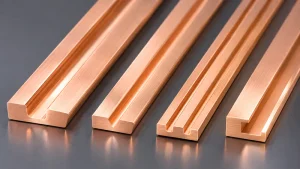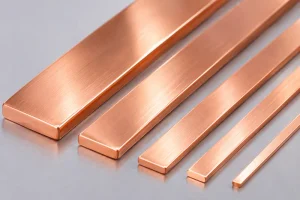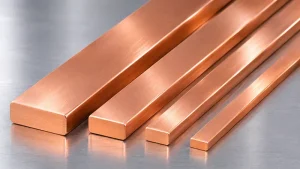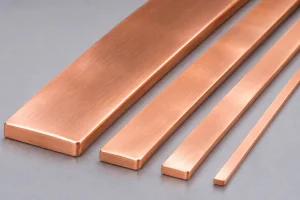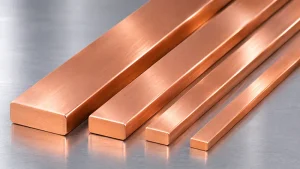
Grooved copper strips provide channels, recesses, or locating features in flat metal components. Producing these features consistently is more demanding than simply flattening wire. Grooved copper strip rolling must control groove depth, position, strip width, remaining thickness, and surface quality together.
This guide covers material selection, precision profile rolling, pass design, inspection, and equipment selection for copper and copper alloys.
1. What Is a Grooved Copper Strip?
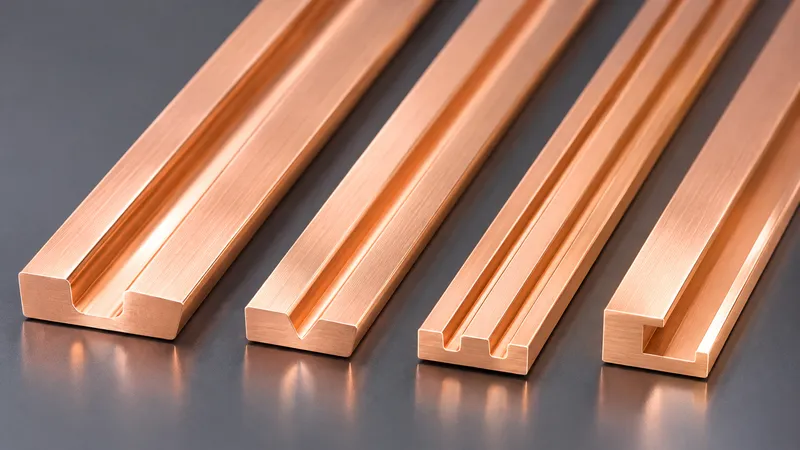
A grooved copper strip is a flat or rectangular product with intentional recesses, often running lengthwise. Cross-sections may be U-shaped, V-shaped, rectangular, or customized, sometimes with shoulders or asymmetric features.
Applications include electrical contact components, locating features, and custom conductive assemblies. The component designer must verify suitability. Where the groove engages a mating part, dimensional consistency and edge condition can be as important as conductivity.
Grooved strip rolling differs from using grooved rolls to make ordinary flat wire: the finished strip itself contains a specified recess. A cross-sectional drawing is therefore essential.
2. Copper Grades and Alloy Behavior
Material selection affects rolling force, formability, and groove accuracy.
| Material | Typical Consideration for Profile Rolling |
|---|---|
| C11000 (Cu-ETP) | High conductivity; confirm temper and forming requirements |
| C10200 (Cu-OF) | Oxygen-free copper; confirm material specification and processing route |
| C10100 (Cu-OFE) | High-purity oxygen-free copper for specified material requirements |
| CuCrZr or CuNiSi alloys | Higher-strength copper alloys; assess rolling forces, temper, and heat-treatment condition |
| Phosphor bronze | Copper alloy with different work-hardening and forming behavior; validate groove-forming trials |
Cold working causes work hardening, particularly in some alloys. Passes suitable for soft copper may overload tooling or damage harder alloys. Intermediate annealing may help, but changes to final properties must be evaluated.
For precipitation-hardened alloys, confirm the supplied heat-treatment condition before selecting rolling reductions.
Check grade properties in the Copper Development Association alloy database and confirm supplier certificates.
3. Groove Geometry: What Must Be Specified?
Drawings must specify more than nominal groove depth.
| Profile Parameter | Why It Matters |
|---|---|
| Strip width and total thickness | Establishes the starting envelope and finished section |
| Groove width and depth | Defines the principal functional feature |
| Groove position and pitch | Controls alignment with mating parts or multiple channels |
| Root and corner radii | Influences metal flow, stress concentration, and tool manufacture |
| Minimum remaining thickness | Helps prevent excessive thinning beneath the groove |
| Edge distance and flatness | Supports handling, guiding, and downstream assembly |
Sharp groove corners may be difficult to roll. Agree on practical radii and, for multiple grooves, minimum feature spacing before tooling manufacture.
Specify whether groove position is measured from a strip edge or centerline; the choice changes inspection and guide requirements.
Engineering tip: Supply a dimensioned cross-section with datums and tolerances; photographs alone are insufficient.
4. How Precision Profile Rolling Works
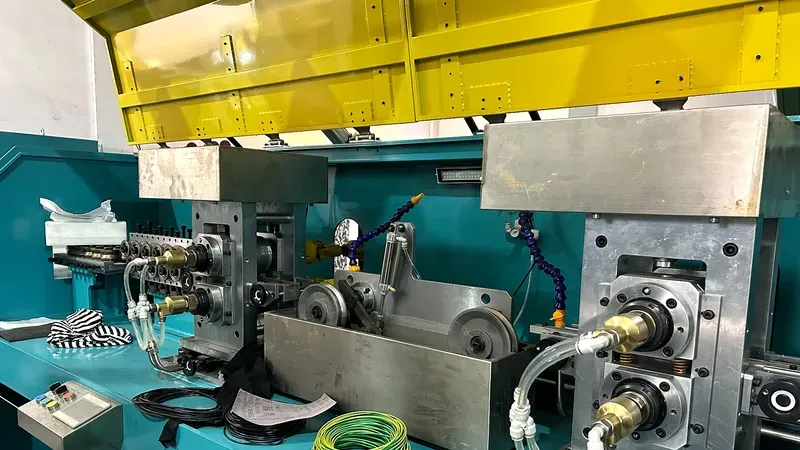
A profile rolling mill uses shaped rolls to form the required section. A raised roll feature creates the groove by displacing metal within the strip.
A representative process route is:
Copper Rod or Strip Stock → Drawing/Pre-Rolling (if required) → Profile Rolling Passes → Edge Finishing → Cleaning/Annealing (if required) → Profile Inspection → Take-Up or Cutting
Deep grooves or stronger alloys may require multiple passes to limit strain, roll loading, and defects.
Unlike machining, rolling primarily redistributes metal rather than removing it, so material flow can alter the outer width and adjacent surfaces.
Lateral spread, springback, tension, and roll deflection mean the finished profile may differ from the tooling. Trials and corrections may be needed.
A precision flat wire rolling mill may be a starting point, but grooved sections need dedicated tooling and feasibility assessment. Not every mill suits every profile.
5. Critical Controls in Grooved Copper Strip Rolling
Roll-Pass Design and Metal Flow
Distribute deformation across passes. Account for metal displacement, width spread, remaining thickness, and the shape of adjacent lands.
Asymmetric grooves may also require special guidance to resist sideways forces.
Alignment, Tension, and Roll Gap
Entry guides center the strip; misalignment shifts groove position. Roll gap affects thickness and groove formation, while unstable tension causes variation along the length.
Surface Protection and Tool Condition
Worn rolls, dirty guides, and handling can mark copper. Use suitable lubrication where appropriate, and monitor roll wear that changes groove width or radii.
For a comparison of forming routes, see Flat Wire Rolling Mill vs Drawing Machine for Rectangular Copper Conductors.
6. Tolerances and Quality Inspection
Inspect the entire cross-section, not just outer dimensions: groove depth, width, datum position, root radius, flatness, and remaining thickness.
Use optical profiling, calibrated gauges, or cross-section checks. Validate optical methods against reference samples because copper is reflective.
Agree on measurement frequency and acceptance criteria before production; a nominal dimension without a defined tolerance cannot establish process capability.
Inspect startup and steady-state samples. Record batch, roll settings, speed, and measurements to identify process drift.
7. Common Defects and Troubleshooting
| Problem | Possible Cause | Practical Check |
|---|---|---|
| Groove too shallow | Insufficient reduction or tool deflection | Check roll gap, load, and pass sequence |
| Groove off-center | Entry misalignment or lateral strip movement | Inspect guides and strip tracking |
| Width variation | Uncontrolled lateral material flow | Review pass design and incoming dimensions |
| Edge cracking | Excessive local strain or unsuitable temper | Check alloy condition and reduction per pass |
| Scratches or burrs | Worn tooling, dirty guides, or handling contact | Inspect and clean contact surfaces |
| Groove changes along length | Tension variation, roll wear, or unstable settings | Trend measurements against operating data |
Bare-strip dimensional inspection is separate from validation of conductivity, joints, fatigue, and service temperature in the final assembly.
8. Information Needed for Equipment Selection
For a quotation, provide copper grade and temper, incoming dimensions, finished cross-section, groove tolerances, surface requirements, and capacity (kg/h or tons/month).
Specify coil or cut-length delivery, downstream forming, and annealing restrictions.
For later coating or insulation, define cleanliness early. See preparing copper flat wire for enameling and paper insulation for related surface considerations; grooved profiles may need different specifications.
Grooved Copper Strip Rolling: Frequently Asked Questions
Can every groove be rolled?
No. Narrow, deep, sharp-cornered, or complex grooves may require redesign, staged forming, or machining.
Is one pass sufficient?
Groove depth, temper, and strain determine whether more passes are needed.
Can one tool handle pure copper and alloys?
Different strength, hardening, and springback may require other settings or tooling.
Conclusion
Successful grooved copper strip rolling combines material selection, cross-section design, pass planning, and inspection. The entire strip—not only the groove—must meet specifications.
Sky Bluer Environmental Technology Co., Ltd. (CRM Rolling Mills) manufactures customized rolling equipment for flat, rectangular, and special-profile wire. We assess profile feasibility from drawings and production requirements.
Planning a grooved strip project? Send your material grade, incoming size, profile drawing, tolerances, and target capacity for engineering review.