Introduction
Precision flat wire rolling is not controlled by the rolling mill alone.
The material must enter the rolling mill at a stable speed and tension, pass through each deformation stage without uncontrolled pulling or slack, and finally be wound into a stable coil.
This makes tension control one of the most important elements of a complete flat wire rolling system.
For spring steel, stainless steel, carbon steel and other high-strength materials, unstable tension can influence:
- Thickness accuracy
- Width stability
- Straightness
- Edge quality
- Surface condition
- Rolling force
- Coil winding quality
A precision production line therefore needs coordinated control between the payoff, rolling mill, dancer system and take-up.
The objective is not simply to apply tension.
The objective is to maintain the correct and stable tension throughout the entire production process.
Sky Bluer Environmental Technology Co., Ltd. (CRM) develops customized precision rolling systems with coordinated feeding, rolling, measurement, tension and take-up technologies for high-accuracy flat wire production.
Why Tension Matters in Flat Wire Rolling
Tension is the longitudinal force applied to the wire during production.
In a continuous rolling line, the material is simultaneously affected by:
- Rolling force
- Friction
- Forward material flow
- Back tension
- Front tension
- Take-up force
The interaction between these forces determines how consistently the wire passes through the rolling system.
A stable tension condition helps maintain predictable material behavior.
An unstable condition can cause:
| Tension Problem | Possible Result |
| Excessive tension | Wire elongation or dimensional variation |
| Insufficient tension | Slack, unstable feeding |
| Tension fluctuation | Thickness and width variation |
| Sudden tension increase | Wire breakage |
| Uneven take-up | Poor coil formation |
For precision flat wire, these problems can directly affect finished-product quality.
The Four Main Tension-Control Zones
A complete precision flat wire production line can be divided into several tension-control sections:
Payoff → Straightening / Feeding → Precision Rolling → Dancer / Buffer → Take-Up
Each section has a different function.
| System | Primary Function |
| Payoff | Releases incoming wire at controlled tension |
| Feeding system | Provides stable material entry |
| Rolling mill | Performs controlled deformation |
| Dancer | Absorbs speed and tension fluctuations |
| Take-up | Maintains controlled winding tension |
The control system must coordinate these components rather than treating each one independently.
Payoff Tension Control
The payoff is the starting point of the production line.
Its job is to release the incoming wire smoothly without creating excessive pulling force or uncontrolled slack.
This becomes particularly important when the input wire is supplied from a large coil.
As the coil diameter decreases, the payoff conditions change.
Therefore, a constant motor speed does not necessarily produce constant material tension.
A controlled payoff system can compensate for changing coil conditions.
Important parameters include:
- Payoff speed
- Motor torque
- Coil diameter
- Wire diameter
- Material strength
- Required line speed
A typical control strategy uses feedback from the downstream process to adjust payoff behavior.
Why Payoff Stability Affects Rolling Accuracy
If the payoff releases material inconsistently, the rolling mill receives unstable input conditions.
For example:
Excessive payoff tension → Material is pulled before entering the rolling zone → Effective deformation conditions change → Dimensional variation may occur
Conversely:
Insufficient payoff tension → Wire becomes loose → Feeding becomes unstable → Material alignment may deteriorate
Therefore, the payoff should provide a controlled and repeatable material supply.
The Role of the Dancer System
A dancer system acts as a mechanical buffer between different sections of a continuous production line.
Its primary purpose is to absorb temporary differences between:
- Incoming speed
- Rolling speed
- Take-up speed
Instead of allowing every speed fluctuation to immediately affect the wire, the dancer provides a temporary material reserve.
Simplified principle:
Speed Difference → Dancer Position Changes → Control Signal → Motor Speed / Torque → Adjustment Tension Stabilization
This makes the dancer particularly useful in continuous wire-processing systems.
Why a Dancer Is Important in Continuous Rolling
A precision rolling mill does not operate in isolation.
The upstream and downstream equipment may have different dynamic responses.
For example:
- The payoff has large rotational inertia.
- The rolling mill has rapid deformation changes.
- The take-up coil diameter continuously increases.
Without a suitable buffer, these differences can create tension fluctuations.
A dancer helps separate the dynamic behavior of different machine sections.
| Without Dancer | With Dancer |
| Speed changes directly affect wire | Speed changes are buffered |
| Higher tension fluctuation | More stable tension |
| Greater risk of wire breakage | Better process stability |
| Difficult synchronization | Easier line coordination |
Tension Control Through the Rolling Section
The rolling section is where tension control becomes especially important.
During rolling, the material experiences substantial deformation.
The rolling process must coordinate:
- Rolling speed
- Roll gap
- Reduction ratio
- Front tension
- Back tension
Tension should not be used to compensate for an improperly designed pass schedule.
Instead, the rolling process should first establish suitable deformation conditions, while tension control maintains stable material transport.
This is particularly important for high-strength spring steel.
Excessive tension combined with high rolling reduction can increase the risk of:
- Wire breakage
- Edge cracking
- Dimensional instability
This connects directly with the reduction ratio and pass schedule optimization.
Front Tension and Back Tension
In rolling technology, tension can exist before and after the deformation zone.
These are commonly described as:
Back Tension
Tension applied before the rolling stand.
Front Tension
Tension applied after the rolling stand.
Their interaction influences:
- Rolling force
- Material flow
- Reduction behavior
- Dimensional stability
However, tension values should be determined according to:
- Material grade
- Input size
- Final size
- Reduction ratio
- Rolling speed
- Equipment configuration
There is no single tension value suitable for every flat wire application.
Take-Up Tension Control
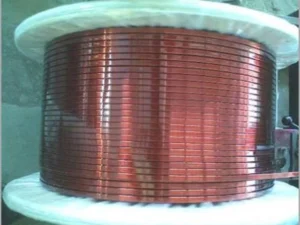
After rolling, the finished flat wire must be collected into a stable coil.
The take-up system must maintain appropriate winding tension throughout the entire coil-building process.
This creates a special challenge:
The coil diameter continuously increases.
As the coil diameter increases, the required rotational speed changes.
If take-up control does not compensate for this change, winding tension may fluctuate.
Possible results include:
- Loose winding
- Excessively tight winding
- Coil deformation
- Edge damage
- Poor unwinding performance
Therefore, take-up control should coordinate:
- Line speed
- Coil diameter
- Motor torque
- Winding tension
Constant Linear Speed vs. Constant RPM
One common misunderstanding in wire winding is that the take-up motor should operate at constant RPM.
In reality, the required rotational speed changes as the coil diameter changes.
The relationship can be expressed as:
Linear Speed = π × Coil Diameter × Rotational Speed
Therefore:
Rotational Speed = Linear Speed / (π × Coil Diameter)
As coil diameter increases, rotational speed must decrease if the production line maintains a constant linear speed.
This is one reason modern take-up systems require coordinated speed and torque control.
Tension Control and Flat Wire Defects
Many flat wire defects can be influenced by unstable tension.
| Defect | Possible Tension-Related Cause |
| Thickness variation | Tension fluctuation |
| Width instability | Uneven material flow |
| Edge deformation | Excessive longitudinal force |
| Wire breakage | Excessive tension |
| Poor coil formation | Incorrect take-up tension |
| Straightness problems | Uneven tension distribution |
However, tension should not automatically be assumed to be the root cause.
Engineers should distinguish between:
- Material-related defects
- Roll-related defects
- Reduction-related defects
- Tension-related defects
- Measurement-related defects
This systematic troubleshooting approach is important for stable production.
For more information about common defects and troubleshooting, see: Common Flat Wire Rolling Defects: Causes, Troubleshooting and Solutions
Tension Control and Closed-Loop Production
Modern precision rolling lines increasingly combine tension control with online measurement and closed-loop dimensional control.
For example:
Laser Gauge → Measures Actual Thickness → PLC / Control System → Calculates Deviation → Servo / Drive System → Adjusts Rolling or Line Parameters → Stable Product
This creates a coordinated production environment in which tension, dimensional accuracy and machine speed can be controlled together.
This is closely related to the closed-loop thickness control technology discussed in: Closed-Loop Thickness Control Technology for Precision Rolling Mills
Tension Control Parameters
The exact parameters depend heavily on the material and equipment configuration.
Important engineering variables include:
| Parameter | Main Influence |
| Line speed | Dynamic response |
| Wire diameter | Required force |
| Material strength | Tension capacity |
| Coil diameter | Payoff / take-up speed |
| Reduction ratio | Rolling deformation |
| Roll diameter | Rolling behavior |
| Motor torque | Tension generation |
| Dancer position | Buffer capacity |
For this reason, tension control should be engineered as part of the complete production line rather than added as an independent component.
Tension Control for Spring Steel Flat Wire
Spring steel requires particularly careful control because the material can have high strength and limited ductility during cold deformation.
Typical applications include:
- Automotive springs
- Valve springs
- Industrial springs
- Precision mechanical components
For these products, unstable tension can influence:
- Dimensional accuracy
- Surface condition
- Residual stress
- Fatigue performance
Different spring steel grades also behave differently during cold rolling.
This is why tension parameters should be developed together with material and rolling-process parameters.
For more information about material selection: Spring Steel Grades for Precision Flat Wire Rolling
Designing a Complete Tension-Controlled Rolling Line
A properly engineered flat wire production line should consider the entire material path.
A typical configuration may include:
Payoff → Active Straightener → Precision Rolling Mill → Online Measuring System → Dancer / Buffer → Take-Up
Each component contributes to production stability.
| Component | Main Objective |
| Payoff | Stable unwinding |
| Straightener | Correct wire alignment |
| Rolling mill | Controlled deformation |
| Online gauge | Real-time dimensional monitoring |
| Dancer | Tension buffering |
| Take-up | Stable finished-wire winding |
The control architecture should allow these systems to communicate and respond to changing production conditions.
CRM Precision Flat Wire Rolling Solutions
Sky Bluer Environmental Technology Co., Ltd. (CRM) provides customized precision rolling solutions for manufacturers producing:
- Spring steel flat wire
- Stainless steel flat wire
- Carbon steel flat wire
- Copper flat wire
- Alloy flat wire
- Precision shaped wire
Depending on the application, a CRM production line can integrate:
- Payoff system
- Straightening and feeding
- Precision rolling mill
- Precision rolls
- Online laser measurement
- Dancer system
- Servo drives
- Take-up system
- PLC and automation control
The objective is to create a coordinated production system rather than simply combining individual machines.
FAQ
1. Why is tension control important in flat wire rolling?
Tension affects how the wire enters, passes through and exits the rolling process. Unstable tension can contribute to thickness variation, width instability, wire breakage and poor coil formation.
2. What is the function of a dancer system?
A dancer acts as a buffer between machine sections with different dynamic responses. It helps absorb temporary speed differences and provides a feedback signal for tension or drive control.
3. How does payoff tension affect rolling quality?
Excessive payoff tension can pull the wire before deformation and alter rolling conditions, while insufficient tension can cause slack and unstable feeding. Stable payoff control provides consistent material entry.
4. Why does take-up tension change during coil winding?
The take-up coil diameter increases continuously. To maintain constant linear production speed, rotational speed must decrease as the coil diameter increases. Motor torque and speed must therefore be coordinated.
5. Is there a standard tension value for spring steel flat wire?
No. The appropriate tension depends on material grade, wire size, strength, reduction ratio, rolling speed and equipment configuration. It must be determined during process engineering.
6. Can tension control improve flat wire dimensional accuracy?
Yes, stable tension helps maintain consistent material flow and reduces production fluctuations. However, dimensional accuracy also depends on roll design, reduction schedule, machine rigidity and online measurement.
Conclusion
Tension control is a fundamental part of precision flat wire rolling.
Stable production requires coordinated control from the moment the raw wire leaves the payoff until the finished flat wire is wound onto the take-up spool.
The key systems include:
- Payoff control
- Dancer / buffer control
- Rolling tension control
- Take-up tension control
- Closed-loop measurement and feedback
The correct tension is not a universal number. It depends on the material, dimensions, reduction ratio, rolling speed and machine configuration.
For high-strength spring steel and other precision flat wire applications, properly engineered tension control improves dimensional stability, production reliability and finished-coil quality.
Sky Bluer Environmental Technology Co., Ltd. (CRM) develops customized precision rolling systems that integrate mechanical engineering, tension control, online measurement and automation to support stable flat wire manufacturing worldwide.