Introduction
In high precision spring steel flat wire production, maintaining stable thickness accuracy throughout the entire manufacturing process is one of the biggest challenges.
Traditional rolling processes rely mainly on operator experience and manual adjustment. However, for modern applications such as automotive springs, valve springs and precision mechanical components, manual control is no longer sufficient.
Small variations in:
- Material hardness
- Incoming wire diameter
- Rolling force
- Roll wear
- Temperature conditions
can influence final product dimensions.
To achieve consistent quality, advanced precision rolling mills use closed-loop thickness control technology, combining online measurement, automatic feedback and real-time adjustment.
This technology allows manufacturers to continuously monitor production conditions and automatically correct deviations before they affect product quality.
Sky Bluer Environmental Technology Co., Ltd. (CRM) integrates precision mechanical design with intelligent control systems to provide advanced rolling solutions for spring steel flat wire and other high accuracy wire products.
Why Thickness Control Is Critical in Precision Flat Wire Production
For spring steel flat wire, dimensional accuracy directly affects:
- Spring performance
- Assembly accuracy
- Fatigue life
- Heat treatment consistency
- Final forming quality
Typical precision flat wire requirements:
| Parameter | Typical Requirement |
| Thickness tolerance | ±0.005–0.01 mm |
| Width tolerance | ±0.01 mm |
| Straightness | ≤3/1000 |
| Surface roughness | Ra ≤0.8 μm |
| Edge radius | Controlled according to application |
Even a small thickness deviation can influence:
- Spring force
- Elastic performance
- Component reliability
Therefore, thickness stability is a core quality indicator in precision rolling.
Limitations of Traditional Open-Loop Rolling Control
Traditional rolling systems often operate with preset parameters.
The process is: Material input → Rolling deformation → Final inspection
The problem is that the system cannot react immediately when conditions change.
Common causes of dimensional variation include:
| Variation Source | Effect |
| Material hardness change | Different deformation resistance |
| Roll wear | Thickness deviation |
| Temperature variation | Material expansion |
| Feeding fluctuation | Uneven reduction |
| Mechanical clearance | Rolling instability |
Without real-time feedback, corrections can only happen after defects appear.
Principle of Closed-Loop Thickness Control
A closed-loop rolling system continuously measures the product and compares actual values with target values.
The control process:Measuremen t→ Data analysis → Deviation calculation → Automatic adjustment → Stable production
The system includes:
| Component | Function |
| Laser measuring system | Real-time thickness detection |
| Control software | Data processing |
| Servo adjustment system | Roll gap correction |
| PLC system | Process control |
| Feedback loop | Continuous optimization |
This creates an intelligent production cycle where the rolling mill can automatically maintain accuracy.
Laser Measurement Technology in Precision Rolling
Online laser measurement is one of the most important technologies in modern rolling lines.
Unlike manual sampling inspection, laser systems provide:
- Continuous measurement
- High-speed detection
- Real-time feedback
Typical measurement parameters:
| Measurement Item | Purpose |
| Thickness | Maintain dimensional accuracy |
| Width | Control profile geometry |
| Flatness | Ensure product stability |
| Position | Correct material alignment |
For high-speed flat wire production, online measurement significantly improves production consistency.
Automatic Gauge Control (AGC) Technology
AGC, or Automatic Gauge Control, is a control method used to maintain stable thickness during rolling.
The basic principle: Target thickness → Actual thickness measurement → Difference calculation → Automatic roll adjustment
When the system detects deviation, it automatically adjusts the roll position.
Advantages:
✓ Reduced thickness variation
✓ Improved production stability
✓ Reduced operator intervention
✓ Higher production efficiency
For spring steel flat wire manufacturing, AGC technology helps maintain consistent mechanical performance.
6. Servo Roll Gap Adjustment System
The roll gap directly determines final thickness.
Traditional manual adjustment has limitations:
- Slow response
- Adjustment errors
- Difficult repeatability
Modern precision rolling mills use servo systems.
Servo adjustment provides:
| Feature | Benefit |
| High positioning accuracy | Precise thickness control |
| Fast response | Immediate correction |
| Digital control | Repeatable adjustment |
| Automatic compensation | Stable production |
Servo-controlled roll positioning is especially important for high-strength spring steel materials where deformation resistance changes during production.
Closed-Loop Control and Material Variation Compensation
Spring steel materials are not completely uniform.
Differences in:
- Chemical composition
- Hardness
- Surface condition
- Incoming diameter
may influence rolling behavior.
A closed-loop system compensates for these variations.
The system continuously adjusts:
- Roll gap
- Rolling force
- Line speed
- Tension parameters
This allows manufacturers to maintain stable output even under changing production conditions.
Closed-Loop Thickness Control for Spring Steel Applications
In automotive and industrial spring applications, dimensional consistency is critical.
Applications include:
Valve Springs
Requirements:
- High fatigue resistance
- Stable wire dimensions
- Reliable mechanical performance
Industrial Springs
Requirements:
- Consistent elasticity
- Accurate geometry
- Long service life
Precision Components
Requirements:
- Tight tolerances
- Excellent surface quality
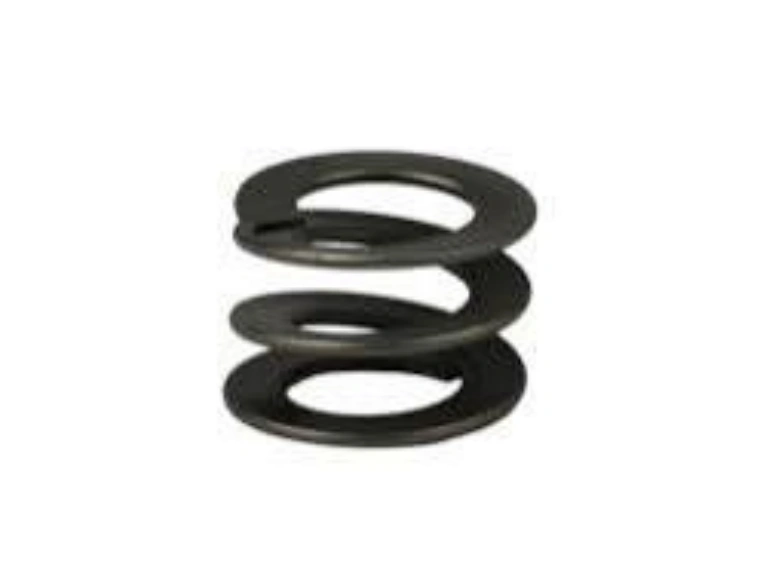
Maintaining tight thickness tolerance in spring steel flat wire production requires more than manual inspection. Modern precision rolling mills use online measurement systems and closed-loop feedback control to ensure stable product quality.
.webp)
Integration with Complete Precision Rolling Systems
Online measurement and automatic adjustment systems are important components of advanced precision rolling lines, improving production consistency and reducing dimensional variation.
A complete CRM precision rolling solution includes:
| System | Function |
| Precision rolling mill | Controlled deformation |
| Precision rolls | Accurate material forming |
| Laser gauge | Online inspection |
| Servo adjustment | Automatic correction |
| PLC control | Intelligent operation |
| Data monitoring | Production analysis |
Future Development of Intelligent Rolling Technology
The future of precision wire production is moving toward intelligent manufacturing.
Advanced rolling systems will increasingly integrate:
- Digital monitoring
- Automatic parameter optimization
- Production data analysis
- Predictive maintenance
- AI-assisted process control
These technologies help manufacturers achieve:
- Higher efficiency
- Lower material waste
- More stable quality
- Reduced production cost
For global spring manufacturers, intelligent precision rolling has become an important competitive advantage.
CRM Closed-Loop Precision Rolling Solutions
Sky Bluer Environmental Technology Co., Ltd. (CRM) provides customized precision rolling systems for:
- Spring steel flat wire
- Alloy steel wire
- Copper flat wire
- Precision shaped wire
Our solutions combine:
✓ Mechanical precision
✓ Advanced measurement technology
✓ Automated control systems
✓ Customized production engineering
From initial material analysis to complete production line design, CRM supports customers in achieving stable and efficient wire manufacturing.
FAQ
1. What is closed-loop thickness control in a rolling mill?
Closed-loop thickness control is an automatic system that measures product dimensions in real time and adjusts rolling parameters to maintain the target thickness.
2. Why is online measurement important for precision flat wire production?
Online measurement detects dimensional changes immediately, allowing automatic correction before defective products are produced.
3. What is the role of AGC in precision rolling?
AGC automatically adjusts the roll gap according to thickness deviation, improving dimensional stability and reducing manual adjustment.
4. How does servo roll adjustment improve rolling accuracy?
Servo systems provide precise and repeatable roll positioning, allowing faster response to material and process variations.
5. Can closed-loop control improve spring fatigue performance?
Yes. Stable thickness and consistent deformation conditions help produce more uniform spring steel wire, improving reliability and fatigue performance.
6. What industries benefit from closed-loop precision rolling technology?
Automotive springs, industrial springs, electronic components and other precision metal industries benefit from improved accuracy and production stability.
Conclusion
Closed-loop thickness control is the foundation of modern precision rolling technology.
For high-performance spring steel flat wire production, stable quality requires more than a precision machine.
It requires:
- Accurate measurement
- Intelligent feedback
- Automatic adjustment
- Continuous process optimization
By combining laser measurement, AGC technology and servo roll control, modern precision rolling mills can achieve higher accuracy, better consistency and improved production efficiency.
Sky Bluer Environmental Technology Co., Ltd. (CRM) continues to develop advanced precision rolling solutions for manufacturers requiring reliable flat wire and shaped wire production.