Importance of Machine Selection in Industrial Production
Selecting a Nickel Alloy Wire Drawing Machine is a strategic decision that directly affects production stability, product consistency, and long-term operational cost. Nickel alloy materials behave very differently under deformation compared to conventional metals, which means equipment selection must be based on engineering logic rather than simple cost comparison.
In industrial environments, improper machine selection often leads to unstable wire diameter, excessive die consumption, and frequent production interruptions. Therefore, a structured evaluation system is required before investment.
What is often underestimated is that nickel alloy production is not only about “drawing capacity”, but about process stability over long continuous cycles. A machine that performs well in short tests may fail under 24-hour industrial operation due to thermal imbalance or tension fluctuation.
Defining Production Requirements
The first step in machine selection is understanding production goals clearly. These include output capacity, wire diameter range, alloy type, and required surface quality.
Different nickel alloys behave differently during processing. For example, Inconel alloys require stronger deformation control than Monel alloys due to higher hardness levels.
A typical requirement structure includes:
| Factor | Description |
| Production Volume | Monthly or hourly output |
| Wire Specification | Final diameter range |
| Alloy Type | Nickel-based material category |
| Quality Level | Industrial or precision grade |
Beyond these standard parameters, manufacturers should also consider future expansion capacity. Many production lines fail not because of current demand, but because machines cannot be upgraded or expanded later.
Additional hidden factors include:
- Plant layout limitation (space for line extension)
- Power supply capacity
- Cooling water system availability
- Operator skill level
These factors directly influence machine configuration but are often ignored in early planning stages.
Machine Type Classification
Nickel alloy drawing equipment can be categorized into three main types depending on production scale.
Single-block machines are suitable for small-scale production or testing environments. Multi-die continuous machines are widely used in industrial production due to their balance of efficiency and stability. Fully automatic systems integrate drawing, annealing, and winding into one continuous process, making them suitable for large-scale manufacturing.
A simplified comparison:
| Type | Stability | Output | Cost |
| Single Block | Medium | Low | Low |
| Multi-Die System | High | Medium | Medium |
| Fully Automatic Line | Very High | High | High |
In real industrial cases, most nickel alloy manufacturers eventually move toward multi-die or fully automatic systems, because manual intervention becomes a bottleneck when dealing with high-strength alloys.
.webp)
Core Technical Evaluation Factors
Machine selection must focus on core engineering systems rather than surface-level specifications.
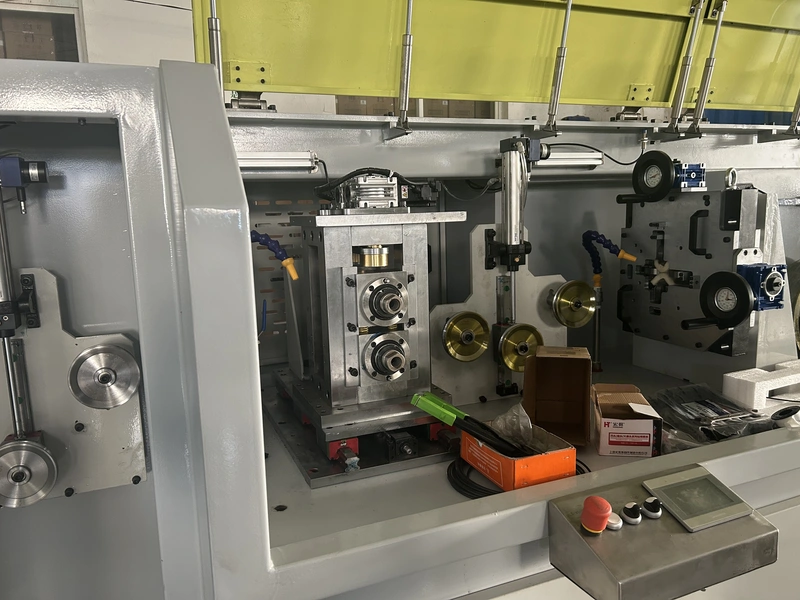
Mechanical strength of the capstan system is critical because nickel alloys generate high tensile resistance during deformation. Die system design determines product precision and tool lifespan. Cooling and lubrication systems directly affect thermal stability and surface quality.
Control systems are also essential. Modern machines rely on PLC-based automation with real-time feedback loops for tension, speed, and diameter correction.
One important point often missed is system synchronization capability. Even if individual components are high quality, poor synchronization between drawing speed, capstan torque, and lubrication flow can lead to instability.
Therefore, a reliable machine must ensure:
- Stable torque transmission
- Consistent speed synchronization
- Real-time tension compensation
- Closed-loop diameter correction
Importance of Cooling and Lubrication
One of the most critical but often overlooked factors is thermal management. Nickel alloy processing generates significant heat due to friction and deformation resistance. Without proper cooling, wire quality becomes unstable and die wear increases rapidly.
Modern systems use continuous emulsion circulation combined with precision lubrication control to maintain stable thermal conditions throughout the drawing process.
In advanced configurations, cooling systems are divided into zones:
- Pre-drawing cooling (surface stabilization)
- Mid-stage cooling (thermal balance control)
- Final-stage cooling (precision stabilization)
This zoning design significantly improves consistency in long production runs.
Lubrication also plays a dual role:
- Reducing friction between wire and die
- Extending die lifespan under high-load conditions
Without proper lubrication control, even high-end machines will experience rapid wear issues.
Common Selection Mistakes
Many manufacturers focus only on initial investment cost while ignoring long-term operational efficiency. Other common mistakes include underestimating annealing requirements, ignoring die consumption cost, and selecting machines without considering alloy hardness variations.
Another frequent issue is overestimating machine speed capability. In nickel alloy production, higher speed does not always mean higher efficiency. Beyond a certain threshold, instability increases sharply, leading to more downtime and product defects.
Common mistakes include:
- Selecting oversized speed parameters without process validation
- Ignoring maintenance accessibility of die systems
- Underestimating cooling system capacity requirements
- Not considering operator training complexity
These mistakes often lead to higher production costs and reduced equipment lifespan.
System Integration Perspective
A modern Nickel Alloy Wire Drawing Machine should not operate independently. It should be part of a complete production system that may include annealing and rolling units.
Integration ensures:
- Continuous material flow without interruption
- Reduced manual handling between stages
- Improved dimensional consistency
- Lower rejection rate in final products
For full system design, refer to: Nickel Alloy Flat Wire Production Line: From Wire Drawing to Precision Rolling
In advanced manufacturing setups, integration also enables process data tracking, which allows engineers to optimize production parameters over time.
Conclusion
Choosing the right Nickel Alloy Wire Drawing Machine requires a comprehensive understanding of material behavior, production requirements, and system engineering. A well-designed system ensures stable production, consistent quality, and long-term operational efficiency.
Sky Bluer Environmental Technology Co., Ltd. provides customized nickel alloy wire processing solutions, including advanced wire drawing machines and complete production line integration. If you are planning industrial-scale manufacturing, Sky Bluer Environmental Technology Co., Ltd. can support you with tailored equipment solutions and technical consultation to ensure stable and efficient production performance.