Why the Rolling Process Defines Stainless Flat Wire Quality
Stainless steel flat wire is prized for its precise dimensions, corrosion resistance, and mechanical stability—attributes directly determined by the rolling process. Unlike other forming methods (e.g., drawing or stamping), rolling achieves uniform deformation, preserves material integrity, and enables tight control over critical parameters like thickness tolerance, R angle, and surface finish. This article dives into the technical mechanics of the rolling process, explaining how each stage contributes to the final product’s performance and why precision in process design matters for industrial applications.
-300x200.webp)
Key Technical Principles Behind Stainless Flat Wire Rolling
Material Behavior in Cold Rolling: Grain Structure & Strength
Cold rolling reshapes stainless steel wire rods at room temperature, applying force through the rolls to elongate and realign the metal grains. This process strengthens the material through work hardening while maintaining ductility. For stainless steel grades such as 304 and 316L, the resulting grain refinement increases tensile strength by 20–30% compared to hot-rolled alternatives, enhances corrosion resistance by preserving the protective chromium oxide layer, and ensures consistent mechanical properties across the wire’s cross-section, with tensile strength variation typically within ±4%. However, over-deformation can lead to grain coarsening or cracking, so rolling passes are carefully calibrated according to the material’s yield strength, which for 304 stainless steel usually ranges between 205 and 275 MPa.
Rolling Pass Design: From Round to Flat
Flat wire production requires a series of rolling passes, each controlling deformation and cross-sectional evolution:
- Reduction Ratio Optimization: Each pass reduces thickness by 12–22%; total reduction typically 40–70%.
- Roll Profile Engineering: Precision-ground concave or convex rolls compensate for material springback (~15–20%).
- Pass Sequence Logic: Early passes focus on shape formation (round → oval → rectangular), later passes on dimensional refinement. Finite element analysis (FEA) helps prevent defects like centerline porosity or edge folding.
Critical Process Controls for Consistency
High-quality flat wire depends on precise process control:
- Temperature: Cold rolling generates heat; keeping the wire at 25–80℃ prevents corrosion issues.
- Lubrication: Reduces friction (coefficient ≤ 0.1) while avoiding residue; biocompatible lubricants are required for medical wire.
- Tension: Controlled tension ensures uniform deformation (5–15 MPa for thin wire, 20–30 MPa for thick wire).
Post-Rolling Stabilization: Annealing & Finishing
After rolling, the flat wire undergoes stabilization processes to lock in properties:
- Stress Relief Annealing: Conducted at 850–950℃ for 1–2 hours, this step relieves residual stresses from rolling (which can cause warping during storage or assembly). For precision applications, annealing is followed by re-straightening to achieve straightness ≤ 0.08mm/m.
- Surface Finishing: Depending on use case, the wire may undergo mechanical polishing (Ra ≤ 0.3μm for electrical contacts) or passivation (enhancing corrosion resistance by 30–50% per ASTM A967 standards).
Advanced Topics in Stainless Flat Wire Production
Customized R Angle and Edge Control
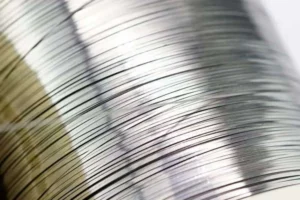
Flat wire applications—from connectors to springs—demand precise R angles and smooth edges to avoid stress concentration and improve fit in assemblies. Modern rolling mills allow R angle customization from 0.3mm to 1.5mm, ensuring compatibility with high-precision components.
Multi-Material Rolling and Hybrid Applications
Flat wire is no longer limited to stainless steel. Rolling technology now supports carbon steel, copper, aluminum, and nickel alloys. Hybrid production enables co-rolled or laminated wires, combining properties such as corrosion resistance with electrical conductivity or magnetic performance.
Conclusion: Partner with Sky Bluer for Precision Rolling Solutions
The stainless flat wire rolling process is a combination of metallurgy, mechanical engineering, and quality control. Sky Bluer Environmental Technology Co., Ltd provides precision rolling mills capable of handling stainless steel (304, 316L, 321, 430), carbon steel, copper, aluminum, and nickel alloys, with thickness 0.05–2.5mm, width 0.2–10mm, and customizable R-angle control. Our equipment ensures uniformity, high production efficiency, and reliable quality for industrial, automotive, and medical applications.
Contact us today to learn how our equipment can elevate your flat wire manufacturing process.