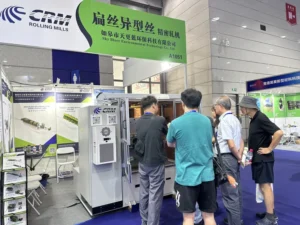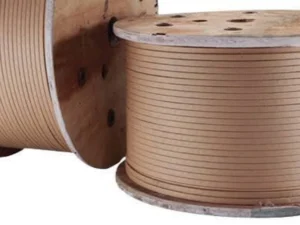
Orthodontic wires are the “engine” of teeth straightening treatments—delivering precise, continuous biomechanical force to move teeth into optimal alignment. Behind these critical medical devices lies a sophisticated manufacturing process powered by specialized orthodontic wire equipment—machinery engineered to meet the ultra-high precision, biocompatibility, and performance requirements of dental applications. As a leader in medical-grade wire processing technology, Sky Bluer Environmental Technology Co., Ltd. (CRM brand) designs and manufactures turnkey orthodontic wire production lines that adhere to global standards (ISO 6474-1:2017, YY/T 0713-2009) and cater to materials like Nickel Titanium (NiTi), stainless steel, and Beta Titanium. This comprehensive guide explores the core equipment, manufacturing process, materials, and key considerations for orthodontic wire production.
-300x200.webp)
What Are Orthodontic Wire Machines?
Orthodontic wire machines are specialized production systems designed to transform raw metal wire/bar into precision-engineered orthodontic archwires—used in braces and fixed orthodontic appliances. Unlike general wire processing equipment, these machines must meet stringent medical device requirements:
- Ultra-Precision: Tolerances as tight as ±0.001 mm to ensure consistent force application .
- Biocompatibility: Processes that preserve material purity and prevent surface contamination (critical for oral contact) .
- Performance Optimization: Heat treatment and forming steps that enhance shape memory, superelasticity, and fatigue resistance .
At the clinical level, orthodontic wires work by fitting into brackets bonded to teeth (secured by ligatures/rubber bands), applying controlled pressure to guide tooth movement. The effectiveness of this treatment directly depends on the quality of the wire—making the manufacturing equipment a cornerstone of orthodontic care .
Sky Bluer’s CRM orthodontic wire machines are designed to produce a full range of profiles: round, square, rectangular, and custom-shaped wires (diameter range: 0.1–1.5 mm), meeting the diverse needs of dental professionals worldwide.
Core Specifications of CRM Orthodontic Wire Equipment
Sky Bluer’s orthodontic wire production lines integrate advanced technology to ensure quality and efficiency, with key specifications aligned to medical device standards:
| Parameter | Details |
| Input Material | Round wire/round bar (NiTi, stainless steel, Beta Titanium, Copper Nickel Titanium) |
| Output Profiles | Square, rectangular, round, flat wires |
| Common Sizes | Square: 0.457 mm, 0.508 mm; Rectangular: 0.457×0.559 mm, 0.483×0.635 mm |
| Line Speed | Up to 400 m/min (continuous production) |
| Tolerance | ±0.001 mm (meets ISO 6474-1 dimensional requirements) |
| Forming Method | Precision cold wire rolling (preserves material integrity) |
| Production Line Composition | Wire payoff → Straightening machine → Tension control → CNC rolling mills → Heat treatment/annealing → Polishing unit → Online laser inspection → Wire take-up/packaging |
| Key Features | In-line laser warp gauge (simultaneous width/thickness measurement), programmable CNC control, biocompatible processing |
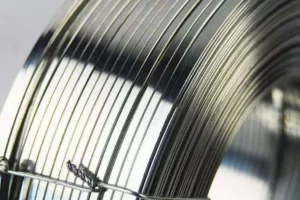
Orthodontic Wire Manufacturing Process: Step-by-Step
The production of medical-grade orthodontic wires involves 7 critical stages, each optimized by Sky Bluer’s CRM equipment to ensure performance and compliance:
1. Raw Material Preparation & Inspection
- Material Selection: High-purity raw materials are chosen based on application needs—e.g., NiTi alloy (55% nickel, 45% titanium) for shape memory, medical-grade 316L stainless steel for strength .
- Purity Verification: Raw materials undergo chemical composition testing to meet ISO 6474-1:2017 standards, ensuring biocompatibility (no harmful impurities) .
- Wire Payoff: Raw round wire is fed from spools into the production line via a tension-controlled payoff unit, preventing tangling or deformation.
2. Straightening & Diameter Reduction
- Straightening: A precision straightening machine removes residual curls from the raw wire, ensuring uniform feeding into subsequent processes.
- Wire Drawing: CRM wire drawing machines pull the wire through a series of diamond dies, progressively reducing its diameter to the target size (0.1–1.5 mm). This step enhances tensile strength and surface smoothness .
3. Precision Forming (Rolling/Shaping)
- Square/Rectangular Forming: The core of the process—CRM precision wire rolling machines (CNC-controlled) pass the round wire through sequential carbide rollers, gradually shaping it into square or rectangular profiles. Each roller set applies controlled pressure (adjustable via PLC) to ensure consistent cross-sectional dimensions and sharp edges (critical for torque expression in orthodontics) .
- Custom Shaping: For specialized archwires, wire shaping machines use custom dies/rollers to create unique profiles, with real-time laser monitoring (±0.001 mm accuracy) to maintain precision .
4. Heat Treatment & Annealing
- Purpose: Optimizes mechanical properties—e.g., NiTi wires undergo heat treatment (400–500°C, controlled cooling) to activate shape memory and superelasticity, enabling them to return to their preset form and apply continuous force .
- Stainless Steel Processing: Annealing at 800–1000°C reduces residual stress and balances strength/flexibility, ensuring the wire can withstand bending without breaking .
- CRM Advantage: Integrated heat treatment lines with programmable temperature curves and nitrogen protection to prevent oxidation and preserve surface quality .
5. Polishing & Surface Finishing
- Deburring & Polishing: The wire passes through a multi-stage polishing unit (abrasive belts + chemical polishing) to achieve a smooth surface (Ra ≤0.2 μm), reducing friction between the wire and brackets (enhancing patient comfort and treatment efficiency) .
- Cleaning: Ultrasonic cleaning removes polishing residues, ensuring biocompatibility and preventing oral irritation .
6. Quality Control & Inspection
- Dimensional Testing: In-line laser gauges measure width, thickness, and diameter at 850 scans/second, with automatic rejection of out-of-tolerance products .
- Mechanical Testing: Random samples undergo tensile strength, bending fatigue, and elasticity tests (e.g., NiTi wires must exhibit 8–10% superelastic deformation) .
- Biocompatibility Verification: Tests for cytotoxicity, 致敏性,and corrosion resistance (per ISO 10993) to ensure safety for oral use .
- Surface Inspection: Vision systems detect micro-scratches or defects, ensuring compliance with YY/T 0713-2009 surface quality requirements .
7. Packaging & Traceability
- Sterile Packaging: Wires are sealed in FDA-approved sterile packaging to prevent contamination during transport and storage .
- Traceability: Each batch is labeled with a unique batch number, material type, size, and expiration date—enabling full traceability (required for MDL/CE certification) .
- CRM Packaging Lines: Automated systems handle small spools (standard for orthodontic wires) with precise winding tension to avoid wire deformation .
Key Materials for Orthodontic Wires & Equipment Compatibility
Orthodontic wires are made from specialized materials, each requiring tailored processing equipment. Sky Bluer’s CRM lines support all major materials:
1. Nickel Titanium (NiTi)
- Key Properties: Shape memory effect, superelasticity, low modulus of elasticity (gentle force for patient comfort) .
- Applications: Initial to mid-treatment phases (e.g., aligning crowded teeth) .
- Equipment Requirements: Precision rolling mills with temperature control (to preserve shape memory), specialized heat treatment lines .
- Standards Compliance: ISO 6474-1:2017, YY/T 0713-2009 .
2. Stainless Steel
- Key Properties: High tensile strength, excellent torque expression, cost-effectiveness .
- Applications: Final treatment phases (fine-tuning tooth alignment) .
- Equipment Requirements: Wire drawing machines with diamond dies, annealing lines for stress relief .
- Advantage: CRM lines produce low-friction surfaces (Ra ≤0.2 μm) for smoother tooth movement .
3. Beta Titanium (Ti-Mo Alloy)
- Key Properties: Balance of strength and flexibility, better biocompatibility than NiTi for sensitive patients .
- Applications: Mid-to-final treatment phases .
- Equipment Requirements: CNC rolling mills with adjustable pressure (to avoid material brittleness) .
4. Copper Nickel Titanium (Cu-NiTi)
- Key Properties: Higher transition temperature (body temperature activation), more predictable force application .
- Applications: Complex cases (e.g., severe crowding) .
- Equipment Requirements: Precision heat treatment lines with tight temperature control (±5°C) .
Types of Orthodontic Wire Equipment by Function
Sky Bluer’s CRM product portfolio includes specialized machines for each manufacturing stage:
1. Wire Drawing Machines
- Purpose: Reduce raw wire diameter to target size (0.1–1.5 mm) while enhancing strength .
- CRM Features: Dry drawing technology (no lubricant contamination), diamond dies for surface smoothness, servo-driven tension control .
2. Precision Wire Rolling Machines
- Purpose: Shape round wire into square/rectangular profiles with ±0.001 mm tolerance .
- CRM Features: CNC programmable controls (quick size changes), carbide rollers (wear-resistant), in-line laser monitoring .
3. Wire Flattening Machines
- Purpose: Transform round wire into flat/rectangular profiles (e.g., for lingual braces) .
- CRM Features: Progressive roller sets, pressure adjustment via PLC, surface scratch prevention .
4. Heat Treatment & Annealing Lines
- Purpose: Optimize mechanical properties (shape memory, strength, flexibility) .
- CRM Features: Vacuum or nitrogen-protected furnaces, programmable temperature curves, batch traceability .
5. Polishing & Cleaning Equipment
- Purpose: Achieve biocompatible, low-friction surfaces .
- CRM Features: Multi-stage polishing (mechanical + chemical), ultrasonic cleaning, residue detection .
6. Packaging & Inspection Systems
- Purpose: Ensure sterile, traceable final products .
- CRM Features: Laser dimensional inspection, automated sterile packaging, batch labeling .
Compliance & Certification: Critical for Orthodontic Equipment
Orthodontic wire equipment must meet global medical device standards to ensure product safety and market access:
1. Key Standards
- ISO 6474-1:2017: International standard for surgical implant-grade NiTi alloy wires (chemical composition, mechanical properties, dimensional tolerance) .
- YY/T 0713-2009: Chinese standard for orthodontic NiTi wires (surface quality, shape memory, biocompatibility) .
- ISO 13485: Quality management system standard for medical device manufacturing .
- MDL (Canada) / CE (EU): Regulatory certifications requiring technical files (risk analysis, test reports, production controls) .
2. CRM Compliance Advantages
- Sky Bluer’s equipment is designed to meet ISO 13485 requirements, with built-in quality control features (in-line inspection, traceability) .
- CRM production lines support compliance with MDL/CE certification, including batch record keeping and risk management tools .
Why Choose Sky Bluer CRM Orthodontic Wire Equipment?
Sky Bluer Environmental Technology Co., Ltd. stands out as a trusted partner for orthodontic wire manufacturers, offering three key competitive advantages:
1. Medical-Grade Precision & Reliability
- Ultra-Tight Tolerances: ±0.001 mm dimensional accuracy, meeting ISO 6474-1 standards .
- Biocompatible Processing: Dry drawing, nitrogen-protected heat treatment, and ultrasonic cleaning prevent contamination .
- Durable Components: Carbide rollers, diamond dies, and servo motors ensure 10+ years of service life .
2. Turnkey Solutions & Customization
- Complete Production Lines: From payoff to packaging, Sky Bluer delivers fully integrated systems with minimal installation time .
- Customizable Configurations: Tailor roller sets, heat treatment parameters, and packaging options to specific materials (NiTi, stainless steel) and product sizes .
- Scalability: Modular design allows adding capacity or upgrading to multi-material processing as business needs grow .
3. Comprehensive Support & Expertise
- Technical Training: On-site training for operators and maintenance teams .
- After-Sales Service: 24/7 technical support, 1-year warranty on parts, and lifetime maintenance guidance .
- Regulatory Expertise: Consultation on ISO 13485, MDL, and CE compliance to streamline market access .
FAQs About Orthodontic Wire Equipment & Manufacturing
Q1: What makes NiTi orthodontic wire unique?
A1: Nickel-titanium (NiTi) wire features shape memory effect and superelasticity—enabling it to return to its preset form and apply continuous, gentle force (ideal for patient comfort). Sky Bluer’s CRM production lines include specialized heat treatment and rolling processes to preserve these properties, meeting YY/T 0713-2009 standards .
Q2: How does cold rolling benefit orthodontic wire production?
A2: Cold rolling (used in CRM machines) preserves the material’s grain structure, enhancing strength and surface quality without the need for high-temperature processing (which can degrade shape memory in NiTi). It also achieves tighter tolerances (±0.001 mm) than hot rolling .
Q3: Can CRM equipment produce multiple wire profiles (square, rectangular, round)?
A3: Yes—CRM’s CNC programmable rolling machines allow quick switching between profiles by changing roller sets or adjusting parameters. This flexibility supports small-batch production of custom orthodontic wires .
Conclusion
Orthodontic wire manufacturing is a precision-driven process that demands specialized equipment, strict compliance with medical standards, and expertise in material science. Sky Bluer’s CRM orthodontic wire equipment delivers on all fronts—combining ultra-high precision (±0.001 mm), biocompatible processing, and turnkey integration to meet the needs of medical device manufacturers worldwide. Whether producing NiTi shape memory wires, stainless steel precision archwires, or custom profiles, CRM machines ensure consistent quality, regulatory compliance, and operational efficiency. As the orthodontic industry evolves toward more advanced materials and personalized treatments, Sky Bluer remains at the forefront—providing innovative, reliable equipment that powers the next generation of teeth straightening solutions.