Introduction
After spending years working with precision flat wire rolling lines, I’ve found that most production defects do not come from one major failure. They usually come from small process instability that operators ignore during continuous production.
A line may produce acceptable flat wire during startup, but after several hours of rolling, problems begin appearing:
- Thickness starts drifting
- Edge cracks appear intermittently
- Camber increases from coil to coil
- Surface marks become visible
- Burrs begin forming along the edges
- Coil winding becomes unstable
In precision flat wire manufacturing, especially for PV ribbon, electronic conductors, stainless steel flat wire, and titanium alloy materials, small process changes can quickly affect final product quality.
That is why experienced rolling engineers focus heavily on process consistency instead of only checking final dimensions.
For high-precision production, we normally monitor:
| Parameter | Typical Precision Requirement |
| Thickness Tolerance | ±0.003–0.01 mm |
| Width Tolerance | ±0.01–0.03 mm |
| Camber | ≤1 mm/m |
| Surface Roughness | Ra 0.05–0.15 μm |
| Tension Stability | ±1–2% |
| Roll Runout | ≤1–2 μm |
When any of these conditions become unstable during rolling, defect rates increase very quickly.
Edge Cracking
Edge cracking is one of the most common problems in flat wire rolling, especially when processing stainless steel, titanium alloy, or hard copper alloy materials.
Most people assume excessive reduction alone causes edge cracks. In reality, edge cracking usually begins when material flow becomes uneven across the wire width.
During rolling, the center section continues elongating while the edge area resists deformation. Stress then concentrates near both edges until microscopic fractures begin forming.
Once this happens, visible cracks usually appear during later passes or during recoiling.
Typical Causes of Edge Cracking
| Cause | Typical Problem |
| Excessive single-pass reduction | High edge stress |
| Insufficient annealing | Low ductility |
| Incorrect roll profile | Uneven lateral flow |
| Poor lubrication | Increased edge friction |
| High rolling speed | Unstable deformation |
Recommended Single-Pass Reduction
| Material | Recommended Reduction |
| Copper | 15–35% |
| Stainless Steel | 8–20% |
| Titanium Alloy | 5–15% |
| Nickel Alloy | 5–18% |
For titanium and stainless materials, I usually prefer lower reduction with additional rolling passes instead of aggressive deformation.
That approach slows production slightly, but it dramatically improves edge stability.
Engineering Solutions
In our production lines, we reduce edge cracking by controlling:
- Reduction per pass
- Roll edge radius
- Tension consistency
- Roll temperature stability
- Intermediate annealing conditions
For high-hardness materials, we also closely monitor elongation values after each pass.
Typical elongation targets:
| Material | Elongation After Annealing |
| Copper | 25–40% |
| Stainless Steel | 15–30% |
| Titanium Alloy | 10–20% |
Thickness Fluctuation
Thickness instability creates major problems in PV ribbon and precision electronic applications.
A line may still appear stable visually while thickness variation slowly increases during continuous operation.
In most cases, thickness drift comes from rolling instability rather than servo positioning alone.
Common Causes
| Cause | Engineering Impact |
| Roll thermal expansion | Rolling gap variation |
| Roll eccentricity | Periodic thickness fluctuation |
| Bearing wear | Vibration |
| Tension instability | Uneven elongation |
| Servo response delay | Inconsistent reduction |
For precision flat wire production, I pay very close attention to roll temperature.
During high-speed rolling, friction and deformation generate heat continuously inside the roll body.
Even a small temperature increase changes roll diameter slightly.
For ultra-thin flat wire, this becomes critical.
Typical Roll Temperature Control
| Production Type | Temperature Stability |
| Standard Rolling | ±5°C |
| Precision Rolling | ±1–2°C |
High-end production lines usually use:
- Internal roll cooling
- Infrared temperature monitoring
- Real-time servo gap correction
Thickness Control Capability
| Product Type | Thickness Tolerance |
| Standard Flat Wire | ±0.02 mm |
| Precision Flat Wire | ±0.002 mm |
| PV Ribbon | ±0.003–0.01 mm |
For European Metal rolling machines often require thickness repeatability within ±2–3 μm during long production runs.
Camber Problems
Camber is one of the most frustrating problems in precision flat wire production because it often develops slowly during continuous rolling.
Short samples may appear acceptable, while long coils show increasing curvature.
Main Causes
| Cause | Result |
| Uneven rolling pressure | Asymmetric elongation |
| Guide misalignment | Directional deviation |
| Tension imbalance | Coil curvature |
| Uneven roll wear | Shape instability |
Typical Camber Standards
| Product Type | Camber Requirement |
| Standard Industrial Wire | ≤3 mm/m |
| Precision Flat Wire | ≤1 mm/m |
| Electronic Conductors | ≤0.5 mm/m |
To reduce camber, I normally focus on:
- Symmetrical rolling pressure
- Stable entry tension
- Accurate guide alignment
- Consistent roll cooling
In high-speed production, thermal symmetry between upper and lower rolls becomes extremely important.
Surface Scratches and Roll Marks
Surface defects become especially critical in PV ribbon and electronic conductor applications.
Even small scratches may affect:
- Conductivity
- Solder coating quality
- Contact resistance
- Fatigue performance
Common Surface Defects
- Roll marks
- Scratches
- Oxidation stains
- Embedded particles
- Lubrication streaks
Typical Surface Roughness Standards
| Product Type | Surface Roughness |
| Standard Flat Wire | Ra 0.2–0.4 μm |
| Electronic Conductors | Ra 0.05–0.15 μm |
| PV Ribbon | Ra ≤0.10 μm |
Main Causes
| Cause | Result |
| Contaminated rolls | Surface transfer marks |
| Poor cleaning | Particle embedding |
| Unstable lubrication | Surface friction damage |
| Roll wear | Rough surface finish |
Engineering Solutions
In precision rolling lines, I usually recommend:
- Ultrasonic wire cleaning
- Lubrication filtration systems
- Precision roll polishing
- Inline surface inspection cameras
For PV ribbon production, surface cleanliness directly affects solderability performance.
Burr Formation
Burr formation becomes a serious issue in battery connector and electronic conductor production.
Excessive burrs may damage insulation layers or affect connector assembly.
Typical Causes
| Cause | Effect |
| Roll wear | Sharp edge formation |
| Excessive width spread | Edge instability |
| Incorrect roll gap | Burr concentration |
| Poor lateral flow control | Edge tearing |
Typical Edge Radius Targets
| Product Type | Edge Radius |
| Standard Flat Wire | R0.03–0.08 mm |
| Precision Conductors | R0.01–0.05 mm |
High-end rolling lines usually optimize roll geometry carefully to improve edge quality during continuous rolling.
Residual Stress and Coil Memory
Residual stress is one of the most overlooked problems in flat wire manufacturing.
A coil may pass dimensional inspection but later fail during:
- Stamping
- Bending
- Soldering
- Coil unwinding
Common Symptoms
- Coil spring-back
- Shape memory
- Delayed cracking
- Flatness instability
Residual stress usually develops because deformation is not uniform through the wire thickness.
Main Causes
| Cause | Result |
| Excessive cold reduction | Stress accumulation |
| Poor annealing | Incomplete recrystallization |
| Uneven deformation | Internal stress imbalance |
| Rapid cooling | Thermal stress |
Annealing Parameters
| Annealing Method | Temperature Range |
| Resistance Annealing | 300–700°C |
| Induction Annealing | 400–900°C |
| Continuous Furnace Annealing | 500–1100°C |
For copper PV ribbon production, conductivity recovery after annealing often needs to reach:
- 97–101% IACS
Inline Quality Control Systems
Modern precision rolling lines increasingly rely on automatic monitoring systems instead of manual inspection.
Common Inline Systems
| System | Function |
| Laser Gauge | Thickness monitoring |
| Vision Inspection | Surface defect detection |
| Eddy Current System | Crack detection |
| Load Cell Monitoring | Tension feedback |
| Infrared Sensors | Roll temperature monitoring |
Advanced rolling lines can automatically correct rolling parameters in real time through closed-loop servo systems.
About CRM Rolling Mill
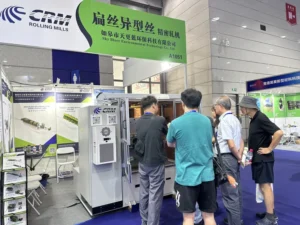
CRM Rolling Mill specializes in precision wire flattening machines, flat wire rolling mills, PV ribbon production lines, and customized turnkey rolling solutions.
Our production lines are designed for high-precision rolling of:
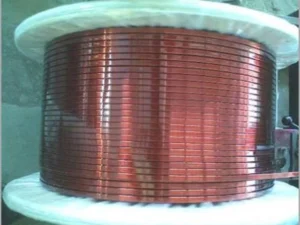
- Copper flat wire
- Stainless steel flat wire
- Titanium flat wire
- PV ribbon
- Special alloy conductors
CRM equipment integrates:
- Precision rolling systems
- Servo tension control
- Inline annealing systems
- Automatic thickness monitoring
- Intelligent PLC automation
- High-speed continuous production capability
With extensive rolling experience, we help manufacturers improve dimensional consistency, surface quality, process stability, and long-term production reliability.
Conclusion
In precision flat wire manufacturing, most defects come from unstable rolling conditions rather than isolated machine problems.
Successful production depends on maintaining stable deformation, controlled thermal behavior, consistent tension, proper lubrication, and reliable metallurgical performance throughout continuous rolling operation.
At CRM Rolling Mill, we design rolling solutions focused not only on dimensional accuracy, but also on long-term process stability and defect reduction for modern high-precision flat wire manufacturing applications.
If you are planning a new flat wire production project or upgrading an existing rolling line, contact CRM Rolling Mill for customized rolling solutions and professional technical support.