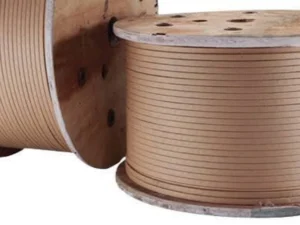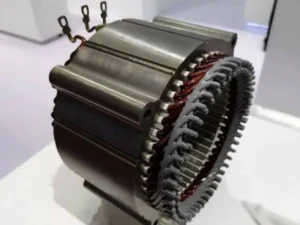
Our wire flattening mill is designed as a controlled deformation system rather than a conventional rolling machine. In real production, we focus on maintaining stable material flow under continuously changing stress conditions. The critical factors are roll deflection behavior, tension drift between stands, and lubrication stability at the roll interface. If any of these parameters are unstable, thickness deviation and edge distortion will appear immediately.
1. Mechanical Basis of Flat Wire Deformation
The deformation zone in a wire flattening mill is a confined roll gap where material undergoes plane strain compression. In this condition, longitudinal elongation is dominant while lateral flow is restricted by roll geometry and tension boundary conditions.
The actual deformation behavior is influenced by three coupled factors:
Roll contact pressure distribution along the deformation arc
Elastic flattening of work rolls under load
Material strain hardening during progressive reduction
These factors create a non-linear deformation response, which is why flat wire production is highly sensitive to system rigidity and stability.
Rolling force is not constant during operation. It increases with strain accumulation and can be approximated by:
F = σm · b · L
where mean flow stress σm increases continuously as a function of work hardening, especially in stainless steel and titanium alloys.
2. System Structure and Functional Design
A wire flattening mill is composed of multiple coupled mechanical and control subsystems that must operate in synchronization.
The mechanical frame must maintain high stiffness to prevent roll deflection under load. Even micrometer-level deformation in the roll gap directly translates into thickness deviation in the final product.
The roll system determines geometry accuracy and surface condition. Roll diameter, surface hardness, and grinding precision directly affect contact stress distribution and surface roughness transfer.
Inter-stand tension acts as a secondary forming force. If tension is unstable, the material will experience non-uniform elongation, resulting in edge waviness and center thickness variation.
Lubrication is not only a friction reduction mechanism but also a thermal and surface stability control system. In high-speed flattening, lubrication failure leads to adhesive wear, surface tearing, and rapid roll degradation.
3. Pass Design and Reduction Strategy
Flat wire production cannot rely on a single deformation stage. It is always a multi-pass controlled strain process.
Initial passes are designed to establish stable deformation conditions and typically operate under higher reduction ratios. As material work hardening increases, reduction per pass must be reduced to avoid excessive stress concentration.
A typical engineering principle is that deformation stability decreases exponentially with increasing strain accumulation. This is why finishing passes require the highest level of control in terms of tension, roll alignment, and lubrication consistency.
Uncontrolled reduction in later passes is one of the primary causes of edge cracking and surface instability in stainless and titanium alloys.
4. Material Behavior Under Flattening Conditions
Different materials respond differently under identical rolling conditions due to variations in yield strength, strain hardening exponent, and elastic modulus.
Carbon steel exhibits relatively stable plastic flow and predictable deformation behavior, making it suitable for high throughput production.
Stainless steel shows strong strain hardening, which leads to rapid increase in deformation resistance. This requires tighter control of pass reduction and inter-stand tension.
Titanium alloys present the most challenging behavior. Their combination of high strength and high elastic recovery leads to significant springback after deformation. Without precise tension compensation, final thickness deviation is unavoidable.
Copper-based materials deform easily but are highly sensitive to surface contamination and lubrication instability, which directly affects conductivity and surface integrity.
5. Surface Quality and Defect Formation Mechanisms
Surface defects in wire flattening are primarily caused by instability at the roll-material interface.
If lubrication film thickness is insufficient, direct metal-to-metal contact occurs, leading to adhesive wear and surface tearing.
If roll surface roughness is too high, micro-scratching and longitudinal marking will appear on the product surface.
If tension fluctuates during operation, relative slip between stands will cause periodic surface waviness.
Edge cracking is typically the result of excessive strain localization at the lateral boundary of the deformation zone, often aggravated by improper roll groove geometry or excessive reduction per pass.
Surface quality is therefore not a single-factor outcome but the result of system-level stability.
6. Control System and Process Stability
Modern wire flattening mills rely on closed-loop control systems rather than fixed mechanical settings.
Roll gap adjustment must compensate for elastic deformation of the mill frame under load. Without compensation, actual rolling gap deviates from the set value during operation.
Tension control systems must maintain constant inter-stand load conditions. Any deviation propagates downstream and accumulates along the production line.
Thermal expansion of rolls and frames must also be compensated in real time, especially in continuous production where temperature gradients develop across the system.
Process stability is ultimately defined by the system’s ability to maintain equilibrium under dynamic load conditions.
7. Industrial System Classification
Wire flattening technology can be categorized based on application precision and material complexity.
Standard wire flattening systems are used for general industrial flat wire production where tolerance requirements are moderate.
Precision flat wire rolling systems operate under high stiffness and closed-loop control conditions to achieve micron-level dimensional accuracy.
Shaped wire forming systems introduce controlled roll geometry variations to produce non-rectangular cross-sections.
Titanium-specific flattening systems are designed for low-speed, high-stability operation due to extreme sensitivity to deformation instability.
Each system category requires different mechanical rigidity levels, control strategies, and lubrication approaches.
8. Application Engineering Fields
Flat wire products produced by these systems are used in mechanically and electrically critical applications.
Spring systems require stable fatigue performance, which depends on controlled strain hardening during rolling.
Electrical contact materials require consistent conductivity and surface integrity, which are highly sensitive to contamination and surface micro-defects.
Aerospace components require high strength-to-weight ratios and extremely stable mechanical properties under cyclic loading conditions.
Medical wire applications require surface cleanliness and microstructural uniformity to ensure biocompatibility and performance reliability.
9.Common Machine Configurations in Wire Flattening Mills
Carbon steel, general alloy wire, standard tolerance production
Precision Flat Wire Rolling Mill
Stainless steel, spring steel, tight tolerance production
Multi-Stand Continuous Flattening Line
High-speed continuous production, multi-stand synchronization system
Shaped Wire Turks Head Rolling System
Grooved roll system, trapezoidal and custom profile wire
Titanium Wire Flattening System
Titanium alloy, high elastic recovery materials, low-speed controlled process
10. Engineering Input Requirements and Project Evaluation Scope
Wire flattening mill systems operate as integrated mechanical-thermal-control platforms rather than isolated machines.
Final product quality is determined by the interaction of structural stiffness, deformation mechanics, lubrication stability, tension synchronization, and control system responsiveness.
Small variations in any subsystem can propagate through the process and result in measurable defects in thickness, surface quality, or edge geometry.
This makes wire flattening one of the most system-sensitive metal forming processes in industrial manufacturing.
For wire flattening mill projects, we typically define system configuration based on material behavior, required dimensional tolerance, production speed, and downstream application requirements. These parameters must be evaluated at the engineering stage, as they directly determine system rigidity requirements, control strategy, and roll design limits.
In actual project execution, we recommend early-stage technical alignment before equipment selection. This allows us to validate deformation feasibility, tension stability range, and pass schedule design under real production constraints, rather than adjusting parameters after installation.
For project discussion or technical evaluation of wire flattening mill systems, we can support process review, configuration definition, and complete line layout based on your production targets and material specifications.