The rapid commercialization of TOPCon, HJT, and BC solar cell technologies is accelerating the transition from conventional flat PV ribbon to advanced 0BB (Zero Busbar) interconnection solutions. Compared with traditional busbar structures, 0BB technology significantly reduces optical shading loss, shortens current transmission paths, and improves overall module efficiency.
At the same time, 0BB technology places much higher demands on photovoltaic ribbon manufacturing equipment. Ultra-fine wire diameter control, coating consistency, annealing stability, and high-speed automation have become critical factors affecting final module performance and production yield.
For photovoltaic manufacturers planning new production capacity or upgrading existing facilities, selecting the right 0BB round ribbon production line is no longer simply an equipment purchasing decision. It directly affects stringing stability, soldering quality, module reliability, and future compatibility with next-generation solar cell technologies.
What Is 0BB Round Ribbon?
0BB round ribbon is an ultra-fine circular copper wire used for cell interconnection in advanced photovoltaic modules. Unlike traditional flat ribbon, 0BB technology typically uses multiple fine round wires distributed across the solar cell surface.
This structure offers several advantages:
- Lower front-side shading loss
- Higher current collection efficiency
- Reduced microcrack stress
- Improved module flexibility
- Better compatibility with thin wafers
- Higher power generation efficiency
0BB technology is now widely adopted in:
- TOPCon solar modules
- HJT solar modules
- BC solar modules
- High-efficiency distributed PV systems
Typical 0BB round ribbon specifications include:
| Item | Typical Range |
| Conductor Material | Copper / Copper Alloy |
| Wire Diameter | 0.18–0.35 mm |
| Common Sizes | 0.20 / 0.25 / 0.30 mm |
| Surface Coating | Sn / SnAg / Low-Temperature Solder |
| Application | TOPCon / HJT / BC |
| Interconnection Structure | Multi-wire |
As cell technology evolves toward thinner wafers and higher current density, demand for smaller diameter and higher precision 0BB wires continues increasing.
Typical 0BB Round Ribbon Production Process
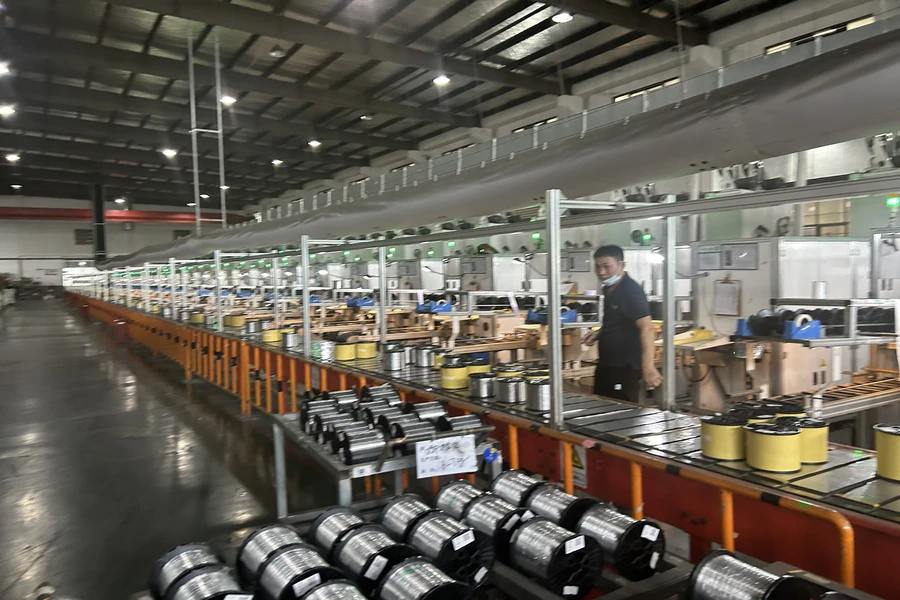
A modern 0BB round ribbon production line generally consists of the following process:
Copper Wire Payoff → Multi-Pass Precision Drawing → Continuous Annealing → Surface Electroplating → Online Inspection → Precision Spooling
Compared with conventional flat PV ribbon manufacturing, 0BB production relies far more heavily on ultra-fine wire processing capability and continuous precision control.
Key technical challenges include:
- Ultra-low wire diameter tolerance
- Stable tension control
- High wire roundness
- Surface cleanliness
- Uniform coating thickness
- High-speed continuous production stability
Each production stage directly affects final stringing performance and module reliability.
Precision Payoff System Selection
The payoff system is the starting point of the entire production line and plays a critical role in maintaining stable wire tension throughout high-speed operation.
Because 0BB wire diameters are extremely fine, unstable feeding tension may cause:
- Wire breakage
- Diameter fluctuation
- Surface scratches
- Coating inconsistency
- Spooling instability
For high-speed photovoltaic ribbon production, passive payoff systems are often insufficient. Modern 0BB lines generally adopt active payoff systems with closed-loop tension control.
Recommended configurations include:
- Active motorized payoff
- Constant tension control
- Dual-spool automatic switching
- Dancer tension regulation
- Servo synchronization control
- Real-time tension feedback
For mass production environments, non-stop spool changing systems are increasingly important to reduce downtime and improve production efficiency.
Fine Wire Drawing Machine Selection
The precision drawing machine is the core equipment of a 0BB round ribbon production line. It directly determines wire diameter consistency, surface quality, roundness, and electrical performance.
Compared with standard copper wire processing, 0BB wire drawing requires much higher machining precision and dynamic stability.
Typical technical parameters include:
| Item | Recommended Range |
| Inlet Wire Diameter | 0.8–2.0 mm |
| Finished Diameter | 0.18–0.35 mm |
| Production Speed | 800–2000 m/min |
| Drawing Dies | PCD / ND |
| Cooling System | Constant Temperature Circulation |
| Lubrication | Full Immersion |
Wire Diameter Tolerance Requirements
One of the most important indicators for 0BB wire quality is diameter consistency.
Typical requirements include:
| Product Grade | Diameter Tolerance |
| Standard 0BB | ±0.003 mm |
| High-Precision 0BB | ±0.0015 mm |
Poor diameter control may result in:
- Uneven soldering
- Current mismatch
- Stringing defects
- Unstable resistance
- Module reliability issues
High-end production lines therefore require precision servo synchronization and stable drawing speed control.
Slip Control and Mechanical Stability
At high production speeds, improper slip control may cause:
- Wire deformation
- Surface damage
- Diameter instability
- Ovality increase
- Excessive vibration
Advanced 0BB drawing systems typically use:
- Independent servo drive systems
- Electronic gear synchronization
- Precision capstan control
- Low-vibration machine structures
- Dynamic speed compensation systems
Machine rigidity and vibration suppression become increasingly important as wire diameters decrease below 0.20 mm.
Continuous Annealing System Selection
Annealing is essential for achieving the required flexibility and elongation performance for photovoltaic stringing applications.
A stable annealing process improves:
- Wire softness
- Elongation performance
- Grain structure consistency
- Solderability
- Mechanical stability
Different photovoltaic manufacturers may require different wire properties depending on their module assembly process and stringing equipment configuration.
According to the customer’s finished product requirements, different annealing technologies can be selected.
Common annealing solutions include:
- Online Induction Annealing
- Short-Circuit Annealing
Online Induction Annealing
Online induction annealing is widely used in high-speed continuous production environments.
Main advantages include:
- Rapid heating response
- High production efficiency
- Stable temperature control
- Low thermal inertia
- Excellent continuous processing capability
- Suitable for ultra-fine wires
Induction annealing is especially suitable for large-scale TOPCon and HJT ribbon manufacturing lines requiring high-speed continuous operation and stable product consistency.
Short-Circuit Annealing
Short-circuit annealing is commonly selected for applications requiring softer wire conditions and higher elongation performance.
Main advantages include:
- Excellent wire flexibility
- Higher elongation capability
- Improved conductivity stability
- Better adaptability for certain stringing processes
This method is often preferred for specialized photovoltaic module structures or customers with customized soldering requirements.
Recommended annealing performance targets include:
| Item | Recommended Value |
| Elongation | ≥20% |
| Temperature Control | Closed-loop PID |
| Mechanical Stability | High Consistency |
Selecting the appropriate annealing method helps manufacturers optimize both electrical and mechanical performance.
Electroplating Line Selection
The electroplating process directly affects solderability, corrosion resistance, and long-term photovoltaic module reliability.
Compared with traditional flat ribbon, 0BB round ribbon has smaller contact areas and higher surface sensitivity, making coating quality even more critical.
Modern 0BB production lines generally use continuous horizontal electroplating systems.
Typical process flow:
Degreasing → Acid Cleaning → Surface Activation → Electroplating → Washing → Drying
Coating Quality Requirements
High-quality electroplating systems should achieve:
| Item | Recommended Value |
| Coating Thickness Variation | ≤±5% |
| Surface Brightness | High Uniformity |
| Surface Defects | Extremely Low |
| Coating Adhesion | Excellent |
Poor coating quality may result in:
- Weak solder joints
- Oxidation issues
- Poor wetting performance
- Stringing instability
- Module reliability degradation
Multi-Alloy Compatibility
Modern photovoltaic manufacturers increasingly require compatibility with different coating materials, including:
- Pure Sn coating
- SnAg alloy coating
- Low-temperature solder coating
Future-ready electroplating systems should therefore support:
- Flexible alloy upgrades
- Multi-tank configurations
- Adjustable process parameters
- High-speed coating stability
Online Inspection System Selection
As 0BB manufacturing moves toward higher automation and tighter tolerances, online inspection systems become increasingly important.
Modern inspection systems help improve:
- Production yield
- Process consistency
- Defect traceability
- Automated quality management
Recommended systems include:
Laser Diameter Measurement
Used for monitoring:
- Wire diameter
- Diameter fluctuation
- Ovality
- Process stability
Surface Vision Inspection
Used for detecting:
- Surface scratches
- Black spots
- Coating defects
- Surface contamination
- Mechanical damage
For high-end photovoltaic ribbon production, AI-assisted visual inspection systems are becoming increasingly common.
Precision Spooling System Selection
The final spooling stage must maintain wire integrity during high-speed winding.
Improper spooling may introduce:
- Surface indentation
- Wire crossover
- Tension instability
- Secondary deformation
Recommended configurations include:
- Precision traversing systems
- Constant tension winding
- Servo-controlled spooling
- Automatic spool switching
- Scratch-free collection systems
For fully automated photovoltaic factories, non-stop spooling systems are increasingly preferred.
Recommended 0BB Production Line Configurations
Entry-Level Pilot Line
Suitable for:
- R&D centers
- Small-scale testing
- New photovoltaic material manufacturers
Typical capacity:
5–20 tons/month
Standard Mass Production Line
Suitable for:
- TOPCon module manufacturers
- Commercial photovoltaic ribbon suppliers
Typical features:
- Multi-wire drawing
- Continuous annealing
- High-speed electroplating
- Automatic spooling
- Online inspection systems
Typical capacity:
50–200 tons/month
High-End HJT / BC Production Line
Designed for:
- Ultra-fine wire production
- High automation
- Smart factory integration
Advanced features may include:
- AI visual inspection
- MES integration
- Ultra-low tolerance control
- Fully automated process management
Future Trends in 0BB Round Ribbon Manufacturing
The photovoltaic industry continues moving toward:
- Smaller wire diameters
- Higher stringing speeds
- Lower resistance loss
- Better solderability
- Higher automation levels
- Intelligent quality control systems
As TOPCon and HJT technologies continue evolving, ultra-high precision 0BB manufacturing capability will become increasingly important.
Manufacturers capable of maintaining stable ultra-fine wire production, coating consistency, and high-speed automation will gain significant advantages in the next-generation photovoltaic market.
Conclusion
Selecting a high-precision 0BB round ribbon production line requires comprehensive evaluation of:
- Precision wire drawing capability
- Dynamic tension control stability
- Annealing consistency
- Electroplating quality
- Online inspection capability
- High-speed automation performance
For TOPCon, HJT, and BC photovoltaic manufacturing, advanced 0BB equipment not only improves product quality and module efficiency, but also enhances long-term manufacturing stability and competitiveness.
Modern photovoltaic manufacturers are no longer simply purchasing individual machines. They are investing in complete 0BB interconnection solutions designed for high-yield, high-speed, and future-ready solar module production.
As a professional manufacturer of new photovoltaic ribbon production equipment,
Sky Bluer Environmental Technology Co., Ltd provides complete solutions for the photovoltaic interconnection industry, including:
- 0BB Round Ribbon Production Lines
- Flat Wire Ribbon Production Lines
- Bus Ribbon Production Lines
- Full Copper Wire Production Lines
With extensive experience in precision wire processing, rolling technology, annealing systems, and continuous production line integration, Sky Bluer delivers customized equipment solutions for TOPCon, HJT, and next-generation photovoltaic manufacturing applications.