Introduction
Thickness tolerance is one of the most critical quality requirements in titanium wire manufacturing. Industries such as aerospace, medical devices, electronics, and precision engineering often demand extremely consistent wire dimensions to ensure reliable assembly, predictable mechanical performance, and long-term product stability.
As titanium wire profiles become thinner and more complex, maintaining tight thickness tolerances becomes increasingly challenging. Small variations in rolling force, tension, material properties, or equipment condition can result in dimensional deviations that affect final product quality.
Modern precision rolling technology combines servo control systems, online measurement equipment, tension management, and high-accuracy rollers to achieve stable thickness control throughout continuous production. This article explores the key technologies and process factors that enable manufacturers to produce titanium wire with exceptional dimensional precision.
Why Thickness Tolerance Matters in Titanium Wire Production
Thickness consistency directly affects how titanium wire performs in downstream applications. Even small dimensional variations can influence product assembly, mechanical behavior, electrical conductivity, and material utilization.
For example, aerospace components often require strict dimensional repeatability to ensure accurate assembly and load distribution. In medical applications, dimensional precision is essential for implants, orthodontic products, and surgical devices. Electronics manufacturers also rely on stable wire dimensions to maintain consistent performance and manufacturing efficiency.
Poor thickness control may result in:
- Increased material waste
- Assembly difficulties
- Product rejection
- Inconsistent mechanical properties
- Higher manufacturing costs
As customer specifications become more demanding, precision thickness control has become a key competitive advantage for titanium wire manufacturers.
Factors Affecting Titanium Wire Thickness Accuracy
Achieving tight tolerance control requires understanding the variables that influence dimensional stability during rolling.
Several process factors can affect final wire thickness:
| Factor | Potential Impact |
| Material hardness variation | Uneven deformation |
| Rolling pressure fluctuation | Thickness inconsistency |
| Tension instability | Profile distortion |
| Roller wear | Dimensional deviation |
| Temperature changes | Material behavior variation |
These factors are often interconnected. For example, unstable tension may influence material flow, which in turn affects thickness consistency and profile geometry.
Successful manufacturers monitor these variables continuously to maintain stable production conditions and minimize dimensional variation.
Servo Control Systems in Precision Rolling Mills
One of the most important developments in modern titanium rolling technology is the use of servo-controlled rolling systems.
Traditional mechanical adjustment methods rely heavily on operator experience and manual intervention. Servo control systems, by contrast, provide highly accurate roll positioning and automatic correction capabilities throughout production.
Benefits of Servo Control
| Function | Production Benefit |
| Precise roll gap adjustment | Improved thickness accuracy |
| Real-time correction | Reduced dimensional variation |
| Automatic positioning | Higher repeatability |
| Closed-loop control | Stable long-term production |
Because servo systems can react quickly to process changes, they help maintain consistent rolling conditions even during extended production runs. This technology is particularly valuable when manufacturing high-precision titanium flat wire and profile wire products.
Online Measurement Technology for Thickness Control
Modern titanium wire rolling lines increasingly rely on online measurement systems to monitor dimensions in real time.
Laser gauges and non-contact measuring devices continuously collect production data and compare actual dimensions against target specifications. When deviations occur, the control system can automatically adjust rolling parameters to restore dimensional accuracy.
Unlike traditional offline inspection methods, online measurement allows manufacturers to detect problems immediately rather than after large quantities of material have already been produced.
Parameters Commonly Monitored
- Wire thickness
- Wire width
- Profile geometry
- Edge position
- Dimensional variation trends
The combination of real-time measurement and automatic feedback creates a closed-loop control system that significantly improves production consistency.
Tension Stability and Material Flow Control
While rolling force receives significant attention, wire tension is equally important in maintaining thickness tolerance.
During production, unstable tension can alter material flow through the rolling mill, causing fluctuations in thickness and profile dimensions. Variations may occur at the payoff system, within the rolling section, or during take-up operations.
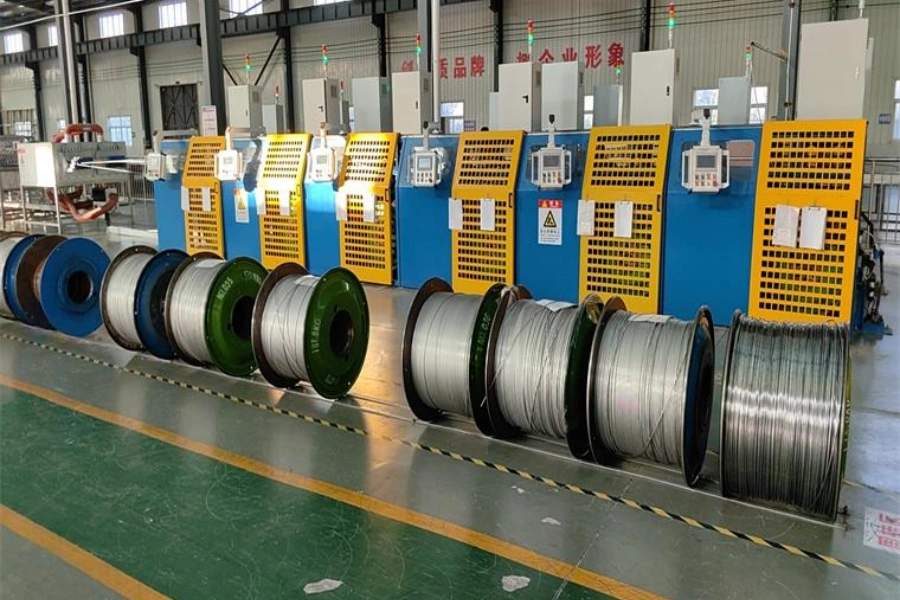
Modern production lines use advanced tension control systems to maintain consistent wire movement throughout the process.
Key benefits of stable tension management include:
- Improved thickness consistency
- Better profile symmetry
- Reduced dimensional fluctuation
- Enhanced coil quality
- More reliable production performance
Active payoff systems and intelligent take-up machines work together to ensure stable tension across the entire production line.
Roller Accuracy and Precision Forming Technology
The quality of the rolling rollers directly influences thickness control performance. Even advanced automation systems cannot compensate for poorly manufactured or worn rollers.
Precision rollers are produced using high-accuracy grinding and finishing processes to ensure excellent concentricity, surface quality, and dimensional stability.
Several roller characteristics affect rolling accuracy:
| Roller Characteristic | Influence on Production |
| Roundness | Consistent deformation |
| Surface finish | Stable material flow |
| Alignment accuracy | Profile consistency |
| Wear resistance | Long-term precision |
As production continues, roller wear gradually affects dimensional performance. Regular inspection and maintenance are therefore essential for maintaining tight thickness tolerances.
Many manufacturers implement scheduled roller replacement programs to prevent dimensional variation before it impacts product quality.
Integrated Technologies for High-Precision Rolling
No single technology can guarantee perfect thickness control. Instead, modern titanium rolling lines achieve high precision by integrating multiple systems into a coordinated manufacturing process.
A typical high-precision production line may include:
- Servo-driven rolling mills
- Online laser measurement systems
- Automatic tension control
- Precision-ground rollers
- Intelligent process monitoring software
- Real-time data analysis
Together, these technologies create a highly stable production environment capable of meeting demanding aerospace, medical, and industrial specifications.
As Industry 4.0 technologies continue to develop, manufacturers are increasingly adopting intelligent control systems that use production data to optimize rolling performance automatically.
Conclusion
Achieving high precision thickness tolerance in titanium wire rolling requires much more than accurate machinery. It depends on the successful integration of servo control systems, online measurement technology, tension stability, roller accuracy, and intelligent process management.
By continuously monitoring and controlling critical production parameters, manufacturers can achieve tighter tolerances, improved dimensional consistency, and higher product reliability. These capabilities are essential for supplying titanium flat wire, rectangular wire, and profile wire products to demanding industries where precision and quality are critical.
For companies seeking to improve manufacturing performance, investing in advanced precision rolling technology provides a reliable path toward higher product quality, reduced waste, and greater long-term competitiveness.
Sky Bluer Environmental Technology Co., Ltd. specializes in precision rolling mills, tension control systems, online measurement solutions, and complete titanium wire production lines. Our customized rolling solutions help manufacturers achieve stable thickness control, improved dimensional accuracy, and consistent production performance for high-precision titanium wire applications.