
Introduction
In high precision spring steel flat wire manufacturing, dimensional accuracy alone does not determine product performance.
For demanding applications such as automotive springs, valve springs and industrial elastic components, the internal stress condition of the material plays a critical role in fatigue life, forming stability and long-term reliability.
During cold rolling, plastic deformation changes the internal structure of steel. While this process improves strength and hardness through work hardening, it also introduces residual stress.
If residual stress is not properly controlled, manufacturers may experience:
- Dimensional changes after cutting
- Spring performance variation
- Edge deformation
- Reduced fatigue resistance
- Unexpected cracking during forming
Therefore, residual stress control has become one of the most important technologies in modern precision rolling.
Sky Bluer Environmental Technology Co., Ltd. (CRM) develops precision rolling solutions that integrate optimized deformation design, roll technology and process control to help manufacturers produce stable high-performance spring steel flat wire.
Understanding Residual Stress in Cold Rolled Flat Wire
Residual stress refers to the internal stress remaining inside a material after external forces have been removed.
During cold rolling, the material experiences:
- Compression from the rolls
- Tensile deformation in certain regions
- Non-uniform plastic flow
The final stress distribution depends on:
| Factor | Influence |
| Reduction ratio | Determines deformation intensity |
| Pass schedule | Controls stress accumulation |
| Roll geometry | Affects material flow |
| Material grade | Influences deformation resistance |
| Cooling condition | Affects stress relaxation |
For spring steel materials, controlling this stress distribution is essential because springs repeatedly experience cyclic loading.
Why Spring Steel Is Sensitive to Residual Stress
Spring steels are designed to store and release energy repeatedly.
Typical materials include:
| Material Grade | Characteristics |
| SAE1070 | High carbon spring steel |
| SAE1095 | High hardness and strength |
| 60Si2Mn | Excellent fatigue resistance |
| SUP10 | High strength valve spring material |
| EN10270 | Precision spring wire applications |
These materials provide excellent elasticity because of:
- High carbon content
- Alloy strengthening elements
- Controlled heat treatment
However, these same characteristics also make them sensitive to:
- Excessive cold work
- Uneven deformation
- Stress concentration
Therefore, rolling parameters must be carefully optimized.
Relationship Between Cold Work and Residual Stress
Cold rolling increases strength through strain hardening.
However, excessive cold deformation can create higher internal stress.
Relationship:
| Cold Work Level | Material Condition |
| Low cold work | Lower stress, lower strength increase |
| Controlled cold work | Balanced strength and stability |
| Excessive cold work | High stress and reduced ductility |
For spring steel flat wire, the objective is not maximum hardness.
The objective is achieving:
- Required mechanical strength
- Stable dimensions
- Good fatigue resistance
- Reliable forming performance
How Rolling Process Creates Residual Stress
During flat wire rolling, deformation is not completely uniform.
The surface and center areas experience different stress states.
Typical stress sources include:
Uneven Thickness Reduction
If thickness reduction is inconsistent:
- Internal stress becomes uneven
- Flatness problems may occur
Edge Deformation
Flat wire edges experience different material flow compared with the center.
Poor control may cause:
- Edge tension
- Edge cracking
- Profile instability
Excessive Single-Pass Reduction
Large reduction in one pass can increase:
- Plastic strain concentration
- Work hardening
- Residual stress accumulation
This is why optimized multi-pass rolling is commonly used for high-strength spring steels.
Methods for Residual Stress Control in Precision Rolling
Optimized Pass Schedule
A properly designed pass schedule distributes deformation gradually.
Typical strategy:
| Rolling Stage | Main Objective |
| Breakdown | Stable material transformation |
| Intermediate | Controlled width and thickness reduction |
| Finishing | Final accuracy and surface quality |
This reduces sudden deformation and prevents excessive stress concentration.
Precision Roll Design
Roll geometry directly affects stress distribution.
Important parameters include:
| Parameter | Function |
| Groove shape | Controls material flow |
| Roll diameter | Controls deformation stability |
| Pass geometry | Reduces uneven strain |
| Surface finish | Improves contact condition |
Proper roll design helps maintain uniform deformation across the wire section.
Tension Control During Rolling
Stable tension between processes helps prevent:
- Buckling
- Uneven elongation
- Dimensional variation
Modern rolling lines use:
- Servo tension control
- Automatic feeding systems
- Closed-loop monitoring
Online Measurement and Feedback Control
Modern precision rolling systems use real-time inspection technology.
Typical systems:
| Technology | Function |
| Laser gauge | Thickness and width measurement |
| Servo adjustment | Automatic roll gap correction |
| PLC control | Process optimization |
| Data monitoring | Quality tracking |
Continuous feedback helps maintain stable production conditions.
.webp)
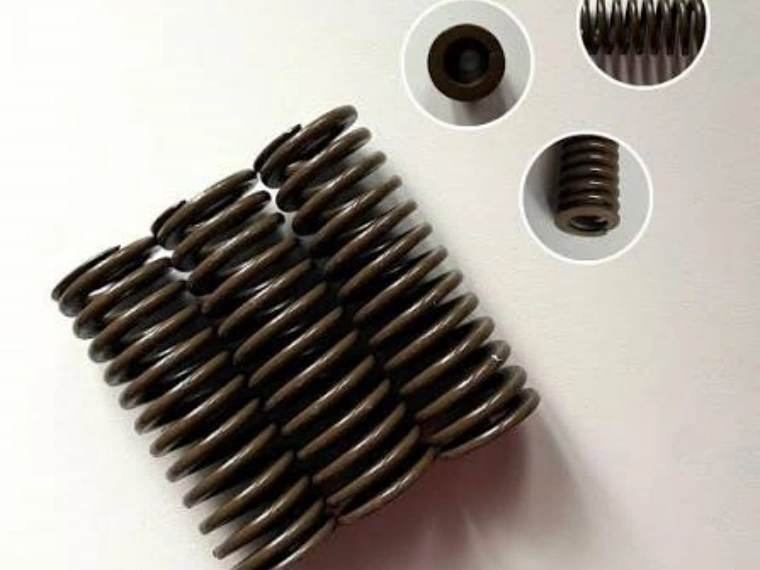
Effect of Residual Stress on Spring Performance
Residual stress directly affects spring applications.
Fatigue Performance
Springs experience millions of loading cycles.
High tensile residual stress may accelerate:
- Crack initiation
- Fatigue failure
Dimensional Stability
After cutting or forming, uncontrolled stress may cause:
- Shape change
- Warping
- Length variation
Heat Treatment Response
Residual stress can influence:
- Hardening behavior
- Tempering stability
- Final mechanical properties
Therefore, controlling stress during rolling improves overall product reliability.
Residual Stress Control for Automotive Spring Applications
Automotive springs require extremely high reliability.
Typical requirements:
| Application | Key Requirement |
| Valve spring | High fatigue resistance |
| Suspension spring | Long service life |
| Safety components | Stable mechanical performance |
For these applications, manufacturers must control:
- Surface quality
- Dimensional tolerance
- Internal stress state
A precision rolling process provides the foundation for consistent spring performance.
Connection Between Material Selection and Residual Stress
Different spring steel grades have different deformation characteristics.
Different materials require different rolling strategies.
For example:
High carbon steels:
- Higher strength
- Lower deformation capability
Silicon chrome steels:
- Excellent fatigue properties
- Require controlled cold work
Material selection directly affects:
- Reduction ratio
- Number of passes
- Roll design
- Stress control strategy
Different spring steel grades have different deformation characteristics during cold rolling, which requires optimized rolling parameters and process control.
Residual Stress Control and Spring Steel Applications
In applications such as automotive springs and precision components, fatigue life and mechanical performance are strongly affected by residual stress generated during the cold rolling process.
A complete manufacturing solution must consider:
- Material
- Rolling process
- Stress control
- Final application requirements
CRM Precision Rolling Solutions for Stress-Controlled Production
Sky Bluer Environmental Technology Co., Ltd. (CRM) provides customized precision rolling systems designed for:
- High carbon spring steel
- Silicon chrome spring steel
- Oil tempered spring wire
- Precision flat wire applications
The system can integrate:
✓ Precision rolling mill
✓ Precision rolls
✓ Online laser measurement
✓ Servo control system
✓ Automated process monitoring
Through optimized deformation control, CRM helps manufacturers achieve stable dimensions and reliable spring performance.
FAQ
1. What causes residual stress during cold rolling?
Residual stress is mainly caused by uneven plastic deformation, excessive reduction, material flow differences and non-uniform strain distribution during rolling.
2. Why is residual stress important for spring steel flat wire?
Because springs operate under repeated loading, uncontrolled residual stress can reduce fatigue life and cause dimensional instability during service.
3. Can residual stress be eliminated completely after rolling?
Complete elimination is difficult, but optimized rolling parameters, controlled deformation and suitable heat treatment can significantly reduce harmful stress.
4. How does pass schedule affect residual stress?
A properly designed pass schedule distributes deformation gradually, reducing stress concentration and improving product stability.
5. Which spring steel materials require strict stress control?
High carbon steels such as SAE1095 and alloy spring steels such as 60Si2Mn and SUP10 require careful stress management due to their high strength.
6. How does a precision rolling mill help control residual stress?
Precision rolling mills provide accurate roll positioning, stable deformation control and online monitoring, allowing manufacturers to maintain consistent stress conditions.
Conclusion
Residual stress control is one of the key technologies determining the quality of cold rolled spring steel flat wire.
A successful production process requires more than achieving final dimensions.
Manufacturers must control:
- Cold work accumulation
- Pass schedule
- Roll design
- Material behavior
- Online process stability
For high-performance spring applications, controlled residual stress improves fatigue life, dimensional stability and manufacturing consistency.
With advanced precision rolling technology, Sky Bluer Environmental Technology Co., Ltd. (CRM) supports global manufacturers in producing reliable spring steel flat wire solutions.
-300x225.webp)
-300x225.webp)