Complete Technical Guide to Precision Flat Wire Rolling Technology
Introduction
A wire flattening machine is a precision metal forming system designed to convert round wire into flat or shaped profiles through controlled cold rolling deformation. Unlike conventional wire drawing equipment, wire flattening technology focuses on dimensional precision, surface quality, rolling stability, and metallurgical consistency.
Our wire flattening machines are widely used in photovoltaic ribbon manufacturing, EV battery connectors, electronics, aerospace components, medical wire products, welding materials, and precision resistance alloys.
As demand for ultra-thin and high-tolerance flat wire continues to increase, precision rolling technology has become one of the most critical processes in advanced metal processing industries.
This article explains in detail how a wire flattening machine works, including rolling mechanics, deformation theory, machine structure, automation systems, process parameters, defect control, and production optimization.
What Is a Wire Flattening Machine?
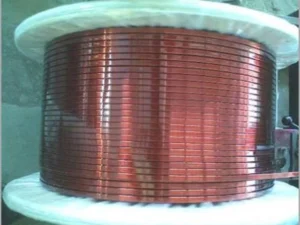
A wire flattening machine is a cold rolling system that applies compressive force through rotating precision tool steel rolls or tungsten carbide rolls to reduce wire thickness while increasing width.
The process transforms round wire into flat wire, rectangular wire, profile wire, PV ribbon, and shaped conductors while maintaining tight thickness tolerance, stable width consistency, excellent surface finish, controlled edge geometry, and uniform mechanical properties.
Unlike simple compression processes, modern precision flattening requires synchronized control of rolling pressure, tension, roll gap, speed, lubrication, thermal behavior, and material elongation.
Even small fluctuations in rolling force or tension can directly affect final product quality.
Basic Working Principle of Wire Flattening
The wire flattening process operates based on cold plastic deformation mechanics.
Round wire enters the roll gap between two hardened rolls rotating in opposite directions. Friction between the roll surface and the wire pulls the material forward while compressive force plastically deforms the wire cross-section.
The process follows the principle of volume conservation:
In practical production, factors such as elastic recovery, lateral spread, work hardening, and thermal effects make the deformation process highly complex.
Thickness decreases while width increases and the material elongates longitudinally.
Material Flow During Rolling
During flattening, the metal experiences three simultaneous deformation behaviors.
Thickness Reduction
The vertical rolling force compresses the wire thickness. This is the primary deformation direction during rolling.
Lateral Spread
As thickness decreases, the material flows sideways and increases in width. Lateral spread depends on material ductility, reduction ratio, roll diameter, friction conditions, and entry geometry.
Longitudinal Elongation
The material also elongates in the rolling direction. Higher elongation affects tension stability, coil winding, and production synchronization.
Main Components of a Precision Wire Flattening Line
A modern wire flattening production line consists of multiple integrated systems working together continuously.
Payoff System
The payoff system continuously feeds round wire into the rolling line under controlled tension.
Typical technical parameters are shown below:
| Parameter | Typical Range |
| Input Wire Diameter | 0.3–8.0 mm |
| Coil Weight | 50–3000 kg |
| Payoff Speed | Up to 300 m/min |
| Tension Accuracy | ±1–3% |
Advanced production lines use servo-driven active payoff systems combined with dancer arm tension feedback control. Stable payoff is essential because entry tension directly influences rolling consistency.
Wire Cleaning System
Before entering the rolling mill, wire surfaces must be cleaned thoroughly.
Oil residue, oxides, drawing lubricants, and metal particles can damage roll surfaces and reduce product quality.
Common cleaning technologies include mechanical brushing, ultrasonic cleaning, chemical cleaning, and plasma cleaning.
Poor cleaning conditions can lead to surface scratches, roll marks, oxidation defects, and uneven deformation during rolling.
Precision Rolling Mill
The rolling mill is the core system of the entire wire flattening machine.
It generates the rolling pressure required for deformation and determines the final dimensional precision of the flat wire.
2-High Rolling Mill
The 2-high rolling mill is the simplest and most widely used design. It is suitable for standard flat wire production, copper wire flattening, and general industrial applications.
4-High Rolling Mill
A 4-high rolling mill uses backup rolls to improve rigidity and reduce roll deflection. This structure is suitable for ultra-thin flat wire and precision electronic materials requiring tight tolerances.
Multi-Stand Rolling Mill
Multi-stand rolling mills arrange several rolling stands sequentially to achieve larger reduction ratios and higher dimensional stability. This design is commonly used for high-speed continuous production lines.
Roll Materials and Roll Precision
Roll quality directly determines final product quality.
Common roll materials include SKD11 tool steel, tungsten carbide, and powder metallurgy rolls.
Typical roll surface parameters are shown below:
| Parameter | Typical Value |
| Surface Roughness | Ra 0.05–0.2 μm |
| Hardness | HRC 60–92 |
| Roundness Accuracy | ≤1 μm |
Poor roll precision may cause thickness fluctuation, surface defects, edge waviness, and rolling vibration.
For ultra-precision products such as PV ribbon and electronic conductors, tungsten carbide rolls are commonly selected due to their excellent wear resistance and dimensional stability.
Rolling Reduction Theory
Reduction ratio is one of the most critical parameters in flattening processes.
Reduction\ Ratio=\frac{H_0-H_1}{H_0}\times100%
Where H₀ represents initial thickness and H₁ represents final thickness.
Typical single-pass reduction ratios are shown below:
| Material | Single-Pass Reduction |
| Copper | 15–35% |
| Stainless Steel | 8–20% |
| Titanium | 5–15% |
| Nickel Alloy | 5–18% |
Excessive reduction may cause edge cracking, internal stress concentration, surface tearing, and roll overload.
Hard alloys usually require multi-pass rolling combined with intermediate annealing.
Rolling Force Analysis
Rolling force determines machine frame design, motor power, and bearing selection.
The simplified rolling force equation is:
F=k\cdot w\cdot L\cdot \sigma
Where:
F = Rolling force
k = Deformation coefficient
w = Material width
L = Contact length
σ = Material flow stress
Typical rolling force ranges are shown below:
| Material | Rolling Force |
| Copper Wire | 5–30 kN |
| Stainless Steel | 20–100 kN |
| Titanium Alloy | 30–120 kN |
High rolling force requires rigid machine frames, precision bearings, stable servo drive systems, and high-strength roll shafts.
Wire Flattening Process Flow
A complete flattening process generally includes payoff, cleaning, rolling, intermediate annealing, cooling, tension stabilization, inline inspection, and take-up.
For ultra-high precision products, additional processes may include edge trimming, surface polishing, laser thickness measurement, and automatic defect detection.
The synchronization of all production stages directly affects final product quality and production efficiency.
Tension Control Technology
Tension control is one of the most important systems in modern wire flattening lines.
Unstable tension can cause thickness variation, camber, wire breakage, and uneven elongation.
Modern production lines typically use closed-loop servo systems combined with dancer roller feedback and PLC synchronization.
Typical tension control accuracy can reach ±1% to ±2%.
High-speed PV ribbon production lines often require ultra-stable low-tension rolling conditions.
Automatic Thickness Control
Precision flat wire production relies heavily on automatic gauge control systems.
Common inline measurement technologies include laser gauges, X-ray gauges, and eddy current measurement systems.
Typical thickness tolerance capability is shown below:
| Product Type | Typical Tolerance |
| Standard Flat Wire | ±0.02 mm |
| Precision Electronic Wire | ±0.005 mm |
| PV Ribbon | ±0.003–0.01 mm |
Modern servo-controlled flattening lines can achieve micron-level thickness consistency during continuous production.
Annealing After Flattening
Cold rolling increases dislocation density and material hardness.
Without annealing, the material may become brittle and difficult to process further.
Annealing restores ductility, reduces residual stress, improves conductivity, enhances flexibility, and stabilizes microstructure.
Common annealing technologies include resistance annealing, induction annealing, and continuous furnace annealing.
PV ribbon production lines commonly use inline resistance annealing for continuous high-speed processing.
Common Production Defects and Solutions
Edge Cracking
Edge cracking is usually caused by excessive reduction, hard material conditions, poor lubrication, or incorrect roll profiles.
Solutions include multi-pass rolling, intermediate annealing, and optimized roll geometry.
Thickness Fluctuation
Thickness fluctuation may result from roll eccentricity, tension instability, or thermal expansion.
Advanced servo correction systems and automatic gauge control are commonly used to stabilize production.
Camber
Camber occurs when rolling force distribution becomes unbalanced.
Improved guide systems, better alignment accuracy, and stable tension control can effectively reduce camber defects.
Technical Parameters of Precision Wire Flattening Machines
| Parameter | Typical Value |
| Input Diameter | 0.3–8.0 mm |
| Finished Thickness | 0.03–3.0 mm |
| Finished Width | 0.2–20 mm |
| Rolling Speed | 10–300 m/min |
| Thickness Tolerance | ±0.001–0.02 mm |
| Roll Diameter | 40–300 mm |
| Motor Power | 3–75 kW |
| Control System | PLC + Servo |
| Roll Material | SKD11 / Tungsten Carbide |
| Surface Roughness | Ra 0.05–0.3 μm |
Applications of Wire Flattening Machines
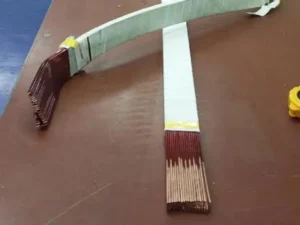
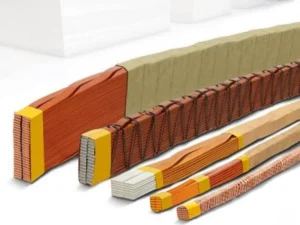
Wire flattening technology is widely used in photovoltaic ribbon manufacturing, connector terminals, flexible conductive strips, battery connector tabs, titanium flat wire production, surgical wire manufacturing, and precision aerospace materials.
As electronic products continue becoming smaller and more precise, demand for ultra-thin and high-conductivity flat wire continues growing rapidly.
Future Trends in Wire Flattening Technology
Modern wire flattening systems are developing toward intelligent automation, AI-based thickness correction, digital process monitoring, energy-efficient servo drives, high-speed continuous production, and online defect inspection.
Ultra-precision rolling technology is becoming increasingly important for semiconductor manufacturing, EV battery production, and photovoltaic industries.
About CRM Rolling Mill
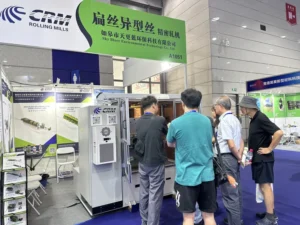
CRM Rolling Mill is a professional manufacturer specializing in precision wire flattening machines, flat wire rolling mills, shaped wire production lines, and turnkey rolling solutions.
With extensive experience in precision metal rolling technology, CRM provides customized equipment solutions for copper flat wire, stainless steel flat wire, titanium flat wire, PV ribbon production, nickel alloy wire, and precision electronic conductors.
Our production lines integrate precision rolling mills, servo tension control, inline annealing systems, automatic thickness measurement, high-speed take-up systems, and intelligent PLC automation.
CRM equipment is widely used in photovoltaic, electronics, aerospace, medical, and precision manufacturing industries worldwide.
Our wire flattening solutions are designed to provide stable rolling performance, high dimensional accuracy, excellent surface finish, long roll life, and continuous high-speed production capability.
By combining advanced rolling technology with practical manufacturing experience, CRM helps manufacturers improve production efficiency, product consistency, and long-term operational reliability.
Conclusion
A wire flattening machine is a precision rolling system designed to transform round wire into high-accuracy flat wire through controlled deformation, stable tension control, and precision rolling technology. Product quality depends heavily on roll precision, reduction ratio, material characteristics, and process stability throughout the production line.
As industries continue demanding thinner, smoother, and more precise flat wire materials, modern wire flattening technology is moving toward higher automation, tighter tolerances, and continuous high-speed production.
CRM Rolling Mill focuses on precision wire flattening machines and complete flat wire production solutions for copper, stainless steel, titanium, PV ribbon, and special alloy materials. With practical rolling experience and customized engineering solutions, CRM helps manufacturers achieve stable production performance, excellent surface quality, and reliable dimensional accuracy for demanding industrial applications.
If you are planning a new flat wire production project or looking to upgrade your existing rolling line, contact CRM Rolling Mill for customized technical solutions, machine recommendations, and turnkey production support.