Introduction
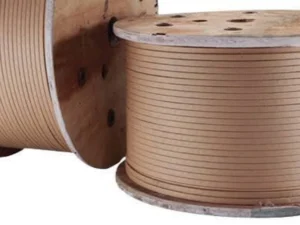
High speed flat wire production system for enameled and paper-covered conductors represent a more complex evolution of conventional copper and aluminum rolling technology. Unlike bare conductor processing, insulated wire applications require a tightly controlled interaction between mechanical deformation, thermal history, and surface condition stability.
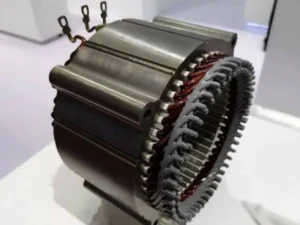
At high production speeds, even minor deviations in surface roughness, edge geometry, or residual stress can significantly affect downstream insulation performance. This is especially critical in transformers, large rotating machines, and high-voltage electrical systems, where long-term dielectric reliability depends directly on conductor surface consistency and coating adhesion behavior.
Our new production lines therefore combine precision rolling, controlled annealing, cleaning,and inline surface conditioning into a continuous, high-throughput system designed for both dimensional accuracy and functional surface engineering.
Conductor Requirements for Insulated Flat Wire Systems
In insulated conductor manufacturing, the requirements extend beyond geometry control into surface physics and material stability.
Material Selection Considerations
Typical materials include:
- Copper grades: C11000 (ETP), C10200 (OFHC)
- Aluminum grades: 1050 / 1060 electrical-grade aluminum
- Composite structures: paper-insulated base conductors for high-voltage applications
Each material behaves differently under high-speed deformation. For example, copper offers superior ductility but is more sensitive to surface oxidation, while aluminum requires stricter tension control due to its lower work-hardening tolerance.
Dimensional and Surface Requirements
A simplified technical overview:
| Parameter | Typical Range | Key Requirement |
| Thickness | 0.15 – 2.5 mm | ±0.003 – ±0.015 mm stability |
| Width | 2 – 30 mm | Edge consistency critical |
| Edge radius | 0.03 – 0.2 mm | Crack-free profile |
| Surface roughness | Ra ≤ 0.35 μm | Insulation-ready surface |
Beyond these values, surface energy stability becomes a hidden but critical factor. Even if geometry is within tolerance, inconsistent surface energy can reduce enamel adhesion or create localized insulation failure points.
High-Speed Manufacturing Process Architecture
High-speed flat wire production systems are typically built as integrated continuous lines, where each stage influences the next.
Process Flow Overview
A typical system architecture includes:
- Rod breakdown drawing (pre-form reduction)
- Multi-pass precision flat rolling
- Controlled recrystallization annealing (350–600°C)
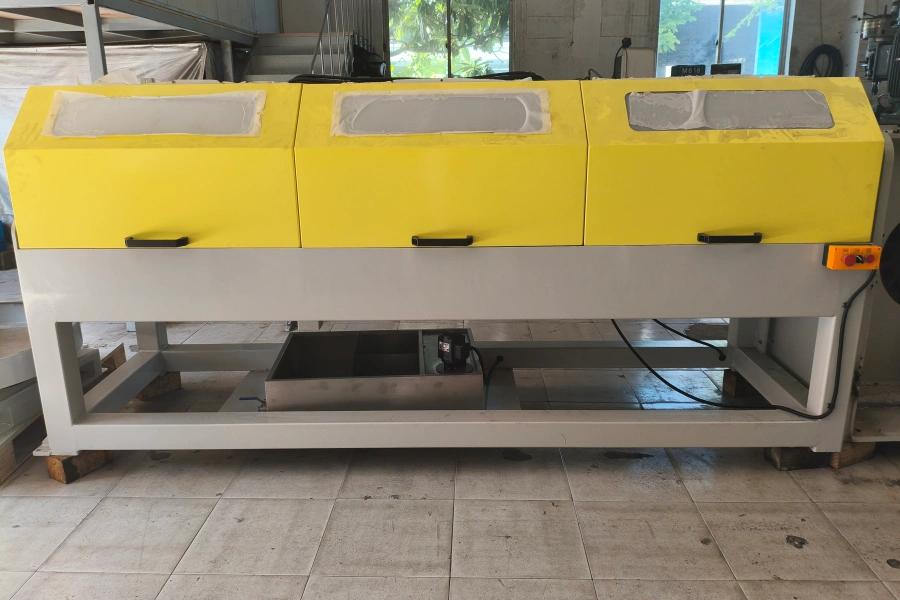
- Micro-cleaning and degreasing
- Final calibration rolling
- Inline tension stabilization system
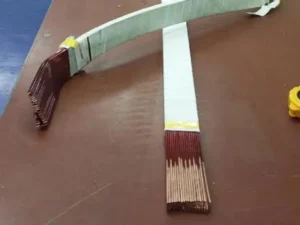
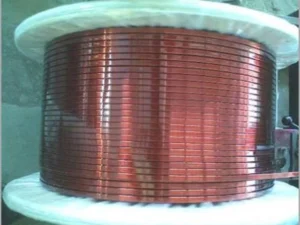
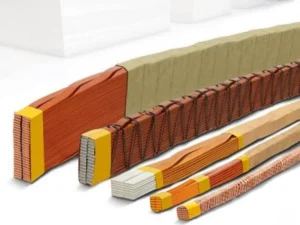
- Preparation for enamel coating or paper wrapping
Process Logic in Practice
Instead of treating each stage independently, modern systems rely on synchronization logic:
- Rolling speed must match annealing recovery rate
- Tension control must compensate for thermal expansion
- Surface cleaning must occur before final deformation memory is locked in
This creates a closed-loop manufacturing environment where mechanical, thermal, and surface parameters continuously interact.
Technical Challenges in High-Speed Enameled Flat Wire Production
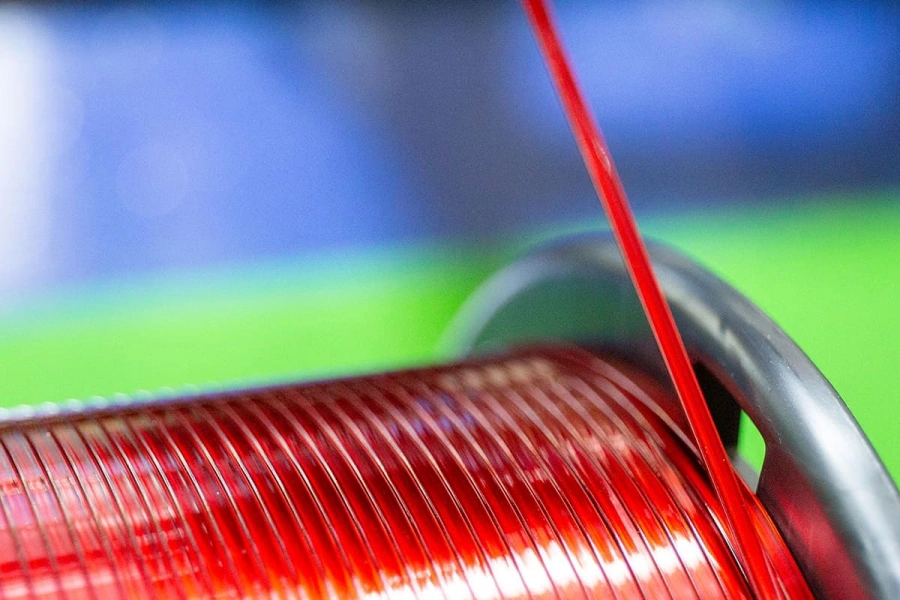
Operating above 200–600 m/min introduces several engineering constraints.Increasing production speed is not simply a matter of running the line faster. As rolling speed rises, deformation behavior, thermal input, strip tension, and surface condition become increasingly coupled, making process control significantly more complex. Copper strip experiences continuous work hardening during rolling, while variations in temperature and tension directly influence material elongation, dimensional stability, and residual stress. At the same time, even microscopic surface defects or contamination can reduce enamel wetting, weaken paper wrapping quality, and compromise insulation reliability in downstream electrical applications.
To maintain stable production at high line speeds, manufacturers must synchronize every process, including precision rolling, multi-zone annealing, tension regulation, strip guidance, cooling, and inline surface treatment. Only by controlling these interacting parameters in real time can a production line consistently achieve tight dimensional tolerances, excellent surface finish, reliable insulation performance, and high production efficiency.
Thermal and Microstructure Instability
Continuous annealing can lead to uneven recrystallization, especially at high line speeds. This may cause:
- Local hardness variation
- Residual stress accumulation
- Non-uniform elongation behavior
Degradation Effects
At high speed, even minor contamination or oxidation leads to:
- Reduced enamel bonding strength
- Paper insulation delamination risk
- Increased dielectric failure probability
Mechanical Stability Issues
- Micro-vibration of rolling stands at high RPM
- Edge wave formation under asymmetric roll pressure
- Tension fluctuation causing width drift
These issues become more severe as line speed increases beyond stability thresholds.
Rolling Mill and Line Engineering Solutions
To address these challenges, modern systems adopt multi-layer control strategies.
Precision Mechanical Design
- Low-inertia rolling stands for reduced vibration
- High-rigidity frame structures to prevent deflection
- Precision-ground roll surfaces for uniform deformation
Intelligent Control Systems
Key automation technologies include:
- Dynamic tension compensation (closed-loop feedback)
- Adaptive roll gap control in real time
- Multi-zone annealing temperature regulation
- AI-based process drift prediction (optional in advanced systems)
Surface Engineering Enhancements
To improve insulation compatibility:
- Inline micro-cleaning modules
- Plasma surface activation (optional high-end configuration)
- Controlled oxidation prevention environments
Engineering Targets in High-Speed Operation
| Performance Metric | Target Value |
| Speed stability | ±0.5% |
| Thickness deviation | ≤ ±0.005 mm |
| Surface defect rate | < 0.2% |
| Tension fluctuation | Fully compensated |
Production Advantages
When properly engineered, high-speed flat wire systems offer significant manufacturing and performance benefits:
- Stable enamel coating adhesion performance
- Improved consistency of paper insulation wrapping
- Reduced scrap and rework rates
- Higher throughput without sacrificing precision
- Enhanced dielectric reliability in final transformer assemblies
These advantages are particularly important in high-efficiency power systems and electrification infrastructure, where conductor quality directly affects energy loss and long-term system stability.
Complete Flat Wire Production Solutions for Enameled and Paper-Covered Conductorson
High-speed flat wire production systems for enameled and paper-covered conductors represent a tightly integrated manufacturing technology that combines precision rolling, thermal control, and surface engineering into a continuous production architecture. The key challenge is not only achieving dimensional accuracy, but also maintaining stable surface energy and material behavior under high-speed, high-temperature, and high-tension conditions.
By integrating advanced rolling mill design, intelligent tension control, multi-zone annealing systems, and inline surface treatment technologies, manufacturers can achieve a stable balance between productivity and precision. This enables consistent enamel adhesion, improved insulation performance, and higher dielectric reliability in critical applications such as transformers, motors, and high-voltage electrical systems.
Ultimately, the value of high-speed flat wire systems lies in their ability to transform conductor manufacturing from a purely geometric process into a fully controlled electromechanical and surface-engineered production system.
For industrial application and turnkey system development, this technology direction is closely aligned with the engineering capabilities of Sky Bluer Environmental Technology Co., Ltd, which focuses on precision rolling systems and advanced conductor manufacturing solutions for global energy and electrical industries.