Introduction to PV Ribbon Soldering
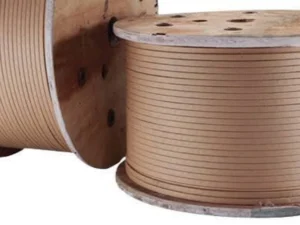
In solar module production, interconnect ribbons act as the essential conductive medium connecting individual solar cells. The quality of ribbon soldering directly impacts the module’s power generation efficiency, reliability, and service life. Typically made of high-conductivity copper with a tin-alloy coating (lead-free solder such as SAC305 or traditional leaded solder), PV ribbons create low-resistance connections between cells. Connecting 60–72 cells (each 0.5V) in series is necessary to reach the voltage required for practical applications.
The PV Interconnect Ribbon Machine (e.g., Convenwe CRM2026-PV) is the key equipment for this critical process. Its automated soldering process not only replaces the inefficiency and instability of manual soldering but also overcomes the soldering bottlenecks of advanced solar cells like TOPCon and HJT through technological innovation.
Typical Ribbon Dimensions and Sky Bluer Machine Capabilities
PV ribbons come in a variety of widths and thicknesses depending on cell type and module design. Common dimensions include:
- Ribbon width: 0.8mm, 1.0mm, 2.0mm
- Ribbon thickness: 0.1mm–0.3mm
- Length: customized for string connections in 60–72 cell modules
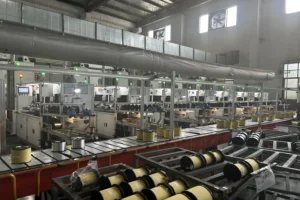
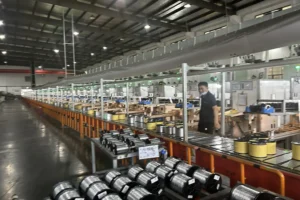
Sky Bluer interconnect ribbon production lines are designed to handle these standard and custom dimensions with high precision. Their integrated systems support both traditional and advanced cell technologies, allowing manufacturers to produce ribbons that meet exacting tolerance requirements while maintaining high-speed production. This ensures compatibility with HJT, TOPCon, and PERC cells without changing equipment.
Core Process Breakdown: Soldering Temperature Control & Multi-Material Compatibility Technology
Temperature Control: The “Art of Thermal Balance” with ±5℃ Precision
Soldering temperature is the core factor for reliable ribbon-to-cell connections. It requires a precise balance between “sufficient solder melting” and “no thermal damage to cells.” Mainstream soldering temperature ranges are 220℃–280℃, dynamically adjusted according to cell type and ribbon characteristics:
- HJT cells: thinner (≤160μm) and thermally sensitive, requiring 220℃–250℃
- TOPCon cells: need 250℃–270℃ to optimize contact resistance
- BC cells: benefit from low-temperature soldering (220℃–250℃) with stepwise heating to reduce hidden cracks
The Convenwe CRM2026-PV uses a patented tunnel light box and PID closed-loop control. Multi-point thermocouples and infrared thermal imaging ensure ±5℃ stability, avoiding cold solder joints, over-soldering, or back passivation layer degradation. Module factory data shows string soldering yield consistently above 99%, even with advanced cells.
Multi-Material Compatibility: Overcoming “Material Selection Barriers”
As solar technology evolves from PERC to TOPCon and HJT, equipment must support diverse cells, ribbons, and fluxes. Traditional soldering often requires equipment replacement for different cells. The new string soldering machine achieves “unbiased compatibility” through:
- Steady-State Soldering with Patented Tunnel Light Box: Zonal infrared heating and AI-generated temperature curves stabilize molten connections even for challenging materials.
- Dynamic Process Window Adaptation: Ribbon width and flux activity differences are handled via PLC-controlled rapid parameter adjustment, enabling model switching in under 30 minutes.
AI Empowerment: Intelligent Soldering for Consistent Quality
Real-Time Quality Control: From Post-Inspection to In-Process Prevention
The AI visual inspection system detects ribbon offset (±0.05mm), solder joint voids, hidden cracks, and other defects during soldering. Combined with online EL re-judgment, it classifies over 50 complex defects with 99.9% consistency, replacing multiple manual inspection roles.
High-Efficiency Integration: 4-in-1 Production Revolution
The new integrated machine combines cell dicing, soldering, string layout, and stack soldering, reducing the single-module production cycle to 36 seconds. High-rigidity robotic arms and dynamic trajectory algorithms maintain repeat positioning accuracy of ±0.06–0.2mm.
Practical Value – Cost Reduction, Efficiency, and Green Production
Case studies from a 13GW N-type workshop show that Sky Bluer intelligent string soldering machines achieve:
- Labor cost reduction: AI replaces manual re-judgment
- Energy optimization: Precise temperature control reduces waste
- Flexible production: Quickly adapts to 156mm–230mm cells
Industry Trends: The Future of PV Ribbon Soldering
As solar modules develop toward “higher efficiency, thinner wafers, and gridless technology,” the soldering process will show three major trends: first, low-temperature soldering ( achieve damage-free soldering of HJT cells); second, lead-free soldering (comprehensive replacement of leaded solder in response to environmental policies); third, embedded soldering technology to further reduce contact resistance. The core competitiveness of equipment will focus on a wider process window, higher intelligence level, and lower comprehensive cost.
Conclusion: Achieving Smart, Efficient, and Sustainable PV Ribbon Soldering
PV ribbon soldering is no longer just a connecting process—it is a critical determinant of module efficiency, reliability, and sustainability. By integrating precise temperature control, multi-material compatibility, and AI-powered inspection, modern soldering machines like Sky Bluer enable manufacturers to meet evolving market demands, reduce costs, and improve green production.
Take the next step toward higher efficiency solar production—explore Sky Bluer intelligent soldering solutions today!