Introduction
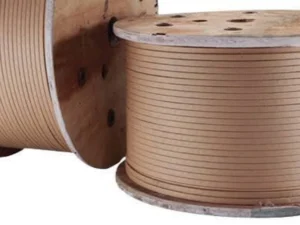
Enamelled wire, a core insulated conductor in electrical and electronic manufacturing, comes in two primary forms: flat enamelled wire and round enamelled wire. Their distinct cross-sectional geometries drive major differences in performance, application scenarios, and production workflows. Understanding these contrasts helps manufacturers select the optimal wire type for motors, transformers, generators, and other winding components. This blog explores their core differences, typical uses, and critical production processes—with a focus on how manufacturing techniques shape final wire quality.
Core Differences Between Flat and Round Enamelled Wire
Structural and Dimensional Differences
The most fundamental distinction lies in cross-sectional shape:
- Round enamelled wire: Features a uniform circular cross-section, with diameters ranging from ultra-fine (0.01 mm) to heavy gauges (5.0 mm). Its symmetrical form delivers consistent mechanical and electrical properties in all directions.
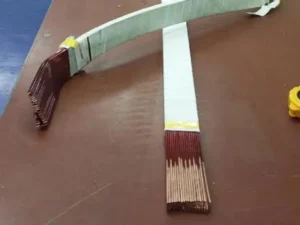
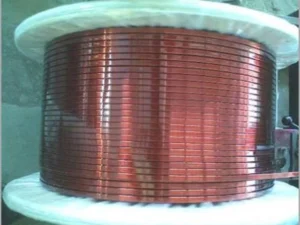
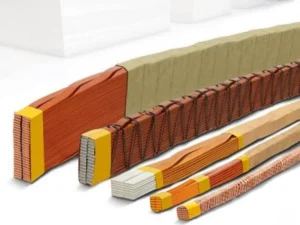
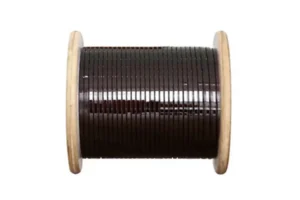
- Flat enamelled wire: Boasts a rectangular or square cross-section, with thicknesses of 0.3–10.0 mm and widths of 1.0–22.0 mm. It supports customizable width-to-thickness ratios (2:1 to 50:1) to fit specific winding designs.
Performance Contrasts
| Performance Metric | Round Enamelled Wire | Flat Enamelled Wire |
| Slot Fill Factor | ~70% (gaps between turns) | 90%+ (tight, gap-free winding) |
| Heat Dissipation | Standard (smaller surface area) | Superior (larger contact area with cores) |
| Flexibility | High (easy to wind manually/automatically) | Low (rigid, requires precision handling) |
| Current-Carrying Capacity | Moderate | 20–50% higher than round wire (same cross-section) |
Application-Specific Advantages
- Round enamelled wire: Ideal for low-to-medium power devices such as general-purpose motors, small transformers, UPS systems, and consumer electronics. Its low cost and flexibility make it perfect for cost-sensitive, high-volume production.
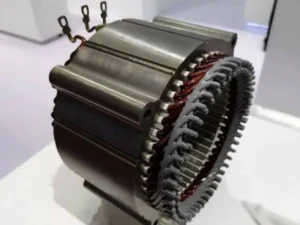
- Flat enamelled wire: Optimized for high-power, compact, and high-efficiency applications, including new energy vehicle drive motors, high-frequency transformers, photovoltaic inverters, and industrial generators. It enables higher power density and reduced energy loss in space-constrained designs.
Common Uses of Flat and Round Enamelled Wire
Round Enamelled Wire Applications
General electrical equipment: Household appliances, small motors, and low-voltage transformers.
Consumer electronics: Inductors, coils, and winding components in speakers, chargers, and power supplies.
Low-frequency devices: 50/60 Hz power transformers and traditional motor stator windings.
Flat Enamelled Wire Applications
New energy vehicles: Drive motors, battery management systems, and high-voltage distribution components.
Power electronics: High-frequency transformers, DC-DC converters, and inverter windings.
Industrial high-efficiency motors: IE4/IE5 premium efficiency motors and large generator windings.
Renewable energy: Wind turbine generators and photovoltaic inverter coils.
Production Process: Flat vs Round Enamelled Wire
While both wire types share core production stages (conductor forming, annealing, enameling, curing), their conductor shaping workflows differ drastically—this is the key process distinction driving their unique properties.
Round Enamelled Wire Production Process
- Wire Drawing: High-purity copper/aluminum rods (8–10 mm diameter) are pulled through a series of progressively smaller diamond or carbide dies. This cold-working process reduces diameter to target gauges (0.01–5.0 mm) while increasing length.
- Annealing: Cold-drawn wire is heated to 300–500°C to remove internal stress, soften the conductor, and restore conductivity/flexibility.
- Enameling: Insulating varnish (polyester, polyamide, or polyesterimide) is applied via felt or dies. 6–20 thin layers are deposited to build insulation thickness.
- Curing & Cooling: Each enamel layer is cured in ovens (250–300°C) to evaporate solvents and polymerize the resin. The wire is then cooled to <100°C before the next coating cycle.
- Lubrication & Spooling: A protective lubricant is applied to reduce winding friction, and the finished wire is spooled for packaging.
Flat Enamelled Wire Production Process
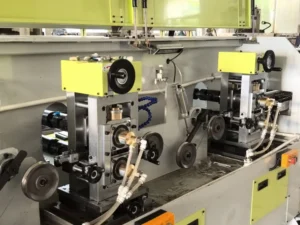
- The critical difference lies in conductor shaping: flat wire uses precision rolling instead of multi-die drawing to achieve rectangular cross-sections.
- Rod Preparation & Pre-Drawing: Copper/aluminum rods are pre-drawn to a intermediate round wire size (e.g., 2–5 mm diameter) suitable for rolling.
- Precision Rolling: The pre-drawn wire passes through rolling mills with paired cylindrical rollers. These rollers compress and shape the round wire into a rectangular profile with precise thickness, width, and corner (R) dimensions. Multiple rolling passes ensure dimensional accuracy (±1 μm) and uniform cross-section.
- Annealing: Identical to round wire—removes rolling-induced stress and softens the flat conductor.
- Enameling & Curing: Similar to round wire, but with specialized dies to apply uniform insulation to rectangular surfaces. High-temperature varnishes (180–220°C) are often used for high-power applications.
- Finishing: Cooling, lubrication, and spooling—with extra care to protect the flat profile from bending or scratching.
Why Production Process Matters for Final Wire Quality
Dimensional accuracy is a cornerstone of enamelled wire performance: flat wire relies on precision rolling to maintain consistent thickness and width (with ±1 μm tolerance), directly enhancing slot fill efficiency (reaching 90%+) and winding uniformity, while round wire depends on die precision during drawing to ensure diameter consistency for reliable electrical output. Insulation integrity, critical for withstanding electrical stress in motors and transformers, is achieved through multi-layer enameling and precise curing control that eliminates pinholes and weak spots—with flat wire further leveraging specialized dies to ensure uniform coating on rectangular surfaces. Meanwhile, annealing parameters (temperature and duration) tailor mechanical properties: round wire gains optimal flexibility for easy manual or automated winding, while flat wire balances rigidity and structural strength, preventing cracking or insulation damage during precision winding for high-power applications.
Conclusion
Flat and round enamelled wires meet distinct manufacturing demands, with their cross-sectional designs and production processes (precision rolling for flat wire vs. multi-die drawing for round wire) driving unique performance: round wire excels in cost-effective, flexible high-volume applications, while flat wire leads in high-power, compact, efficient designs via superior slot fill and heat dissipation. Sky Bluer Environmental Technology Co., Ltd. specializes in enamelled wire rolling mills, supporting materials like stainless steel, copper, aluminum, and their alloys (various grades) with flat wire dimensional ranges of 0.3–10.0 mm (thickness) and 1.0–22.0 mm (width), plus customizable corner radii—delivering high-precision, stable, efficient solutions for flat enamelled wire production.